
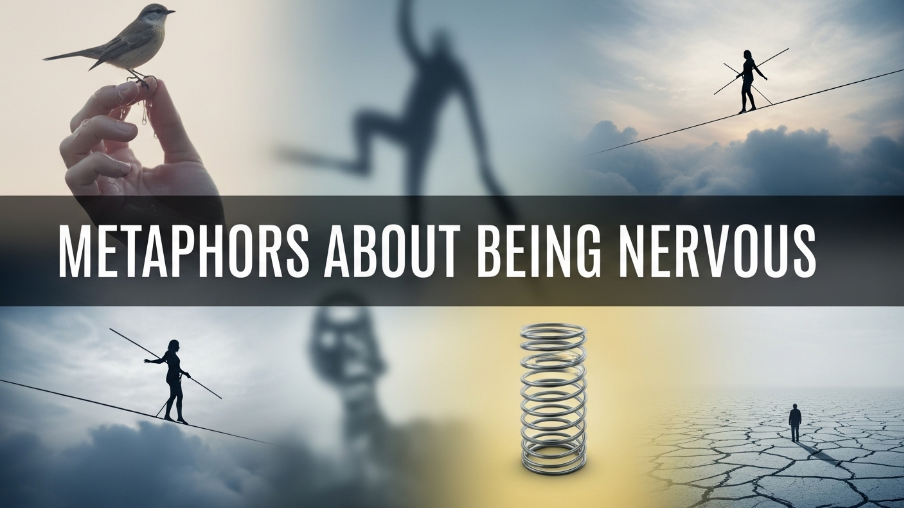
When Nervousness Feels Like Thunder Under the Skin – An Introduction
There are moments when the world doesn’t change, but your body does. A door opens, a name is called, a message is read, or silence stretches a second too long—and suddenly, your heart begins to speak louder than your thoughts. It knocks, it races, it stumbles like it forgot how rhythm works. Your palms turn into small rivers, your breath becomes uneven, and your mind feels like a room with too many open windows.
That feeling is nervousness—not just an emotion, but a full-body experience. And because it is so physical, so vivid, we often reach for metaphors to explain it. We say “butterflies in the stomach” or “walking on a tightrope,” not because they are literal, but because they come closer than plain language ever could.
Metaphors about being nervous help us translate invisible emotions into something we can see, touch, or imagine. They are important because they allow us to communicate fear, excitement, anxiety, and anticipation in ways that others can feel too. In writing, speech, or storytelling, these metaphors turn abstract tension into living imagery.
Understanding Metaphors About Nervousness and Their Emotional Power
Metaphors are not just decorative language—they are emotional shortcuts. When we describe nervousness through imagery, we make internal chaos visible. Instead of saying “I was anxious,” we say “I felt like I was standing in front of a storm that hadn’t started yet.”
This matters because nervousness is often hard to explain. It is both mental and physical, both fear and excitement. Metaphors help bridge that gap.
For example:
- Nervousness becomes a trembling bridge over deep water.
- It becomes a phone ringing in an empty room.
- It becomes a candle flickering in a drafty hall.
Each image carries emotional weight, allowing readers or listeners to step into the experience rather than simply observe it.
Writers, speakers, students, and even everyday storytellers use these comparisons to make communication more human, more relatable, and more memorable.
Metaphor of Nervousness: Butterflies Trapped in a Stormy Jar
One of the most common metaphors is “butterflies in the stomach,” but let’s expand it into something more vivid: butterflies trapped in a stormy glass jar.
Meaning & Explanation: This metaphor represents the fluttering, restless energy inside when you are nervous. The butterflies symbolize fragile emotions, while the jar represents the body trying to contain them. The storm adds intensity—chaotic thoughts colliding inside.
Example Sentence: “When I stepped onto the stage, it felt like butterflies were trapped in a stormy jar inside my chest, banging against the glass.”
Alternative Expressions:
- A swarm of restless wings inside me
- A storm of fragile wings in my chest
- Tiny storms fluttering under my ribs
Sensory & Emotional Detail: You can almost hear it—the soft, frantic beating of invisible wings. It is not painful, but it is uncontrollable, like excitement and fear sharing the same heartbeat.
This metaphor is powerful in storytelling because it blends beauty with discomfort, showing how nervousness is not always ugly—it can be delicate and alive.
Metaphor of Nervousness: Walking a Tightrope Over an Endless Abyss
Another striking metaphor is the idea of balancing on a tightrope suspended over a deep, unknown abyss.
Meaning & Explanation: Nervousness often feels like being extremely aware of every step you take. One mistake feels like it could lead to collapse—even if the situation is not truly dangerous.
Example Sentence: “Answering the interview questions felt like walking a tightrope over an endless abyss, where every word had to be carefully placed.”
Alternative Expressions:
- Balancing on a thread of uncertainty
- Stepping across invisible danger
- Walking above silence with no safety net
Sensory & Emotional Detail: Your body feels stiff, your focus sharp. Every movement is slow and deliberate. You imagine the fall even when you are standing still.
This metaphor is often used in professional, academic, or high-pressure contexts because it captures performance anxiety and fear of failure.
Metaphor of Nervousness: An Engine Revving Inside the Chest
Sometimes nervousness is not fragile—it is loud, mechanical, and unstoppable.
Meaning & Explanation: This metaphor compares nervousness to an engine that keeps revving without moving forward. It represents energy with no release.
Example Sentence: “My heart was like an engine revving inside my chest, waiting for a signal that never came.”
Alternative Expressions:
- A motor stuck in overdrive
- A machine of anxiety with no brakes
- Internal thunder with no outlet
Sensory & Emotional Detail: You can feel vibration in your body, like something is trying to burst forward. Your breath shortens, your muscles tighten, and your thoughts race ahead of your actions.
This metaphor is especially useful for describing anticipatory anxiety—waiting for something important to happen.
The Emotional Science Behind Nervous Metaphors
Nervousness is deeply connected to the body’s fight-or-flight system. Adrenaline rises, heart rate increases, and senses become sharper. But language transforms this biological response into meaning.
Metaphors help the brain organize emotional chaos. Instead of random sensations, we get structured images:
- Storms = emotional overload
- Tightropes = pressure and precision
- Engines = energy and urgency
Psychologically, these metaphors also provide relief. Naming an emotion through imagery makes it easier to process. It is why people often say “it felt like…” when describing anxiety—they are translating internal signals into shared understanding.
A Story of Nervousness: The Exam Hall Silence
The hall was too quiet. Even the sound of turning pages felt too loud, like breaking glass in a sacred place. I remember sitting there, pen in hand, staring at the first question as if it were written in a foreign language.
It wasn’t just an exam. It felt like standing at the edge of a frozen lake, unsure if the ice would hold my weight.
Every second stretched longer than the last. My thoughts were not thoughts anymore—they were flashes, scattered and unorganized, like birds startled into flight.
When I finally began writing, it wasn’t confidence that guided my hand. It was surrender. The nervousness didn’t leave; it simply transformed into motion.
This is how nervousness often behaves—it does not disappear, but it changes shape when expressed.
Another Real-Life Moment: The Interview Room
The chair was too straight, the air too conditioned, the silence too intentional. Across from me, three faces waited—not unkind, but unreadable.
My throat felt like it had forgotten its purpose. My answers, prepared carefully the night before, now felt like they belonged to someone else.
It was like standing in front of a mirror that slightly distorted reality. Every question reflected more pressure than meaning.
And yet, when the conversation began, something shifted. Nervousness didn’t vanish, but it became background noise—like rain on a distant roof instead of a storm overhead.
Cultural and Literary Metaphors for Nervousness
Writers across time have described nervousness in countless ways. Shakespeare often used imagery of storms, trembling voices, and restless hearts to reflect inner turmoil. In poetry, nervousness is frequently shown as wind shaking fragile branches or shadows moving before light arrives.
In modern storytelling, nervousness appears as:
- A glitch in reality before a big moment
- A heartbeat syncing with ticking clocks
- A pause that feels louder than words
Across cultures, nervousness is rarely described directly. Instead, it is painted through environment—weather, movement, sound, and silence. This shows that humans everywhere rely on metaphor to make emotional experience universal.
Exercise: Create Your Own Nervousness Metaphor
Try completing these prompts:
- Nervousness feels like ______ in a ______.
- When I am nervous, my thoughts become like ______.
- My heartbeat during nervous moments sounds like ______.
Now expand one of your answers into a full sentence or paragraph. Try to include sensory details like sound, temperature, or movement.
Example: “Nervousness feels like a flashlight flickering in a long tunnel, revealing pieces of thoughts that disappear before I can hold them.”
This exercise helps you turn emotion into imagery, strengthening both creativity and emotional awareness.
Exercise: Turn Real Moments Into Metaphors
Think of a recent moment when you felt nervous—before speaking, performing, or meeting someone new.
Now rewrite it using metaphor only. Avoid direct emotional words like “nervous” or “anxious.”
Example transformation: Instead of: “I was nervous before speaking.” Write: “I stood like a bridge under too many footsteps, waiting to see if I would hold.”
This practice is especially useful for writers, students, and content creators.
Using Nervousness Metaphors in Writing and Creativity
Metaphors about nervousness can elevate storytelling, poetry, essays, and even social media captions. They make emotional content more relatable and memorable.
Tips:
- Use nature imagery for emotional depth (storms, wind, rivers)
- Use mechanical imagery for intensity (engines, wires, alarms)
- Use spatial imagery for pressure (tightropes, rooms, edges)
In writing, avoid overusing common phrases. Instead of always saying “butterflies,” try fresh variations like “restless wings behind my ribs.”
Nervousness Metaphors for Social Media Expression
On social platforms, metaphors can make posts more engaging and expressive.
Examples:
- “My thoughts are running like a train with no destination today.”
- “Standing here like a paused song before the beat drops.”
- “Nervousness feels like waiting for rain inside a closed sky.”
These expressions are powerful because they are short, visual, and emotionally relatable.
Coping With Nervousness Through Imagery and Awareness
Interestingly, metaphors don’t just describe nervousness—they can also help calm it. When you visualize your anxiety as something external (like a storm or engine), you create distance from it.
You can even reshape metaphors:
- Storm becomes passing weather
- Tightrope becomes a learning path
- Engine becomes energy waiting for direction
This mental reframing can make nervousness feel less threatening and more manageable.
Conclusion
Nervousness is one of the most universal human experiences, yet one of the hardest to describe directly. That is why metaphors matter—they give shape to something shapeless, voice to something silent, and meaning to something overwhelming.
Whether it is butterflies in a stormy jar, a tightrope over darkness, or an engine revving in the chest, each metaphor is a bridge between feeling and understanding. When we learn to describe nervousness creatively, we do more than improve language—we learn to understand ourselves a little better.
FAQs
1. What are metaphors for nervousness?
They are figurative expressions that describe nervous feelings using imagery, like storms, butterflies, or engines.
2. Why do writers use metaphors for nervousness?
Because nervousness is hard to describe directly, metaphors make it easier to understand and emotionally relatable.
3. What is the most common metaphor for nervousness?
“Butterflies in the stomach” is the most widely used metaphor.
4. Can metaphors help reduce nervousness?
Yes, reframing nervous feelings through imagery can make them feel less overwhelming.
5. How can I create my own nervousness metaphors?
Think of physical sensations and compare them to objects, nature, or movement, then expand with sensory details.