
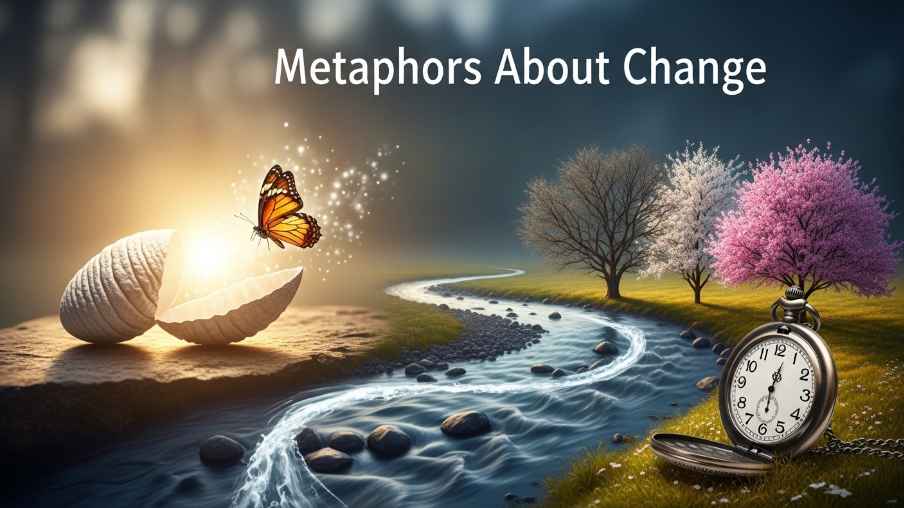
The first time change arrives, it rarely knocks politely. It feels more like a sudden shift in the wind—quiet, invisible, yet powerful enough to rearrange everything you thought was stable. One day you are walking a familiar road, and the next, the ground beneath your thoughts seems slightly different, like the world has exhaled and decided to begin again.
Change does not always announce itself with drama; sometimes it slips in through small moments—a goodbye you didn’t expect, a new beginning you weren’t ready for, or a version of yourself you no longer recognize. Metaphors about change help us give shape to this invisible force. They turn uncertainty into imagery we can hold, understand, and even embrace.
In literature, storytelling, and everyday conversation, metaphors become bridges between confusion and clarity. They allow us to describe transformation not as chaos, but as something meaningful—like seasons turning, rivers flowing, or clay being reshaped in patient hands. Understanding these metaphors is more than a literary exercise.
It helps readers process life transitions, express emotions more creatively, and communicate complex feelings in relatable ways. Whether you are a writer, student, or someone simply navigating life’s unpredictable turns, metaphors about change can give language to what the heart already knows.
Understanding Metaphors About Change in Literature and Life
Metaphors about change are expressions that describe transformation by comparing it to something familiar. Instead of saying “I am changing,” we might say “I am a river finding a new path.” This makes emotional experiences more vivid and relatable.
In literature, change is often shown as seasons shifting or doors opening and closing. These images help readers feel transformation rather than just understand it logically. In life, we use similar expressions without even noticing—“turning a new leaf” or “closing a chapter.”
These metaphors matter because they give emotional structure to uncertainty. When life feels unstable, language can provide grounding. By framing change in symbolic ways, we make it less intimidating and more meaningful.
Why Metaphors About Change Matter in Everyday Expression
Metaphors about change are not just poetic tools; they are emotional survival strategies. When people go through transitions—moving cities, ending relationships, or starting new careers—they often struggle to explain how they feel. Metaphors step in where plain language falls short.
For example, saying “I feel like I’m shedding an old skin” communicates transformation, discomfort, and renewal all at once. It captures emotional depth that simple explanation cannot.
In daily conversation, metaphors also help us connect with others. They make our experiences more relatable. When someone says, “I’m rebuilding from scratch,” we instantly understand the emotional weight behind those words.
Ultimately, metaphors about change matter because they transform confusion into clarity and isolation into shared understanding.
Metaphor 1: Life as a River Finding New Paths
One of the most powerful metaphors about change is comparing life to a river. A river does not resist obstacles—it flows around them, reshapes itself, and keeps moving forward.
Meaning and Explanation: This metaphor represents adaptability. Even when blocked, a river does not stop; it finds another direction. Similarly, life often requires us to adjust rather than resist.
Example Sentence or Scenario: “After losing his job, he realized life was like a river—it simply carved a new path through uncertainty.”
Alternative Expressions:
- Life is a flowing stream
- Change is water reshaping its course
- Existence is a current that never stops moving
Sensory and Emotional Detail: Imagine cold water slipping over smooth stones, patient yet unstoppable. The sound is constant, calming, and persistent. That is the emotional rhythm of change—gentle but unyielding.
Mini Storytelling Element: In ancient stories, rivers were often seen as symbols of destiny. Travelers followed them, trusting their direction. In the same way, we often follow life’s unexpected turns, discovering new landscapes within ourselves.
Metaphor 2: Change as Seasons Turning in Silence
Another timeless metaphor about change is the shifting of seasons. Autumn fades into winter without announcement, and spring arrives without apology.
Meaning and Explanation: This metaphor reflects natural cycles of growth, loss, rest, and renewal. Change is not random; it is rhythmic and necessary.
Example Sentence or Scenario: “She accepted her grief as winter—cold, quiet, but always followed by spring.”
Alternative Expressions:
- Life moves like seasonal cycles
- Change is nature renewing itself
- Emotions bloom and fade like weather
Sensory and Emotional Detail: Picture golden leaves falling softly, frost gathering on windowpanes, or the first warm breeze after a long cold season. Each sensation reflects emotional transitions.
Mini Storytelling and Cultural Reference: Many poets, from classical Persian writers to modern English literature, use seasons to describe human emotion. In traditional storytelling, winter often symbolizes hardship, while spring represents hope and rebirth.
This metaphor reassures us that no state is permanent—not even pain.
Metaphor 3: Transformation as Clay Being Molded
One of the most intimate metaphors about change is clay being shaped by human hands.
Meaning and Explanation: Clay represents human potential. It is soft, flexible, and responsive. Change, in this metaphor, is the process of being shaped by experience.
Example Sentence or Scenario: “Every challenge molded her like clay in skilled hands, forming strength she never knew she had.”
Alternative Expressions:
- Life is a sculpture in progress
- Change is shaping raw material into form
- We are vessels constantly being formed
Sensory and Emotional Detail: Imagine cool, damp clay pressing between fingers—soft yet resistant, transforming with every touch. There is pressure, but also creation.
Mini Storytelling Element: In many ancient cultures, creation myths describe humans being formed from clay. This reflects the idea that change is not destruction but formation—becoming something intentional.
This metaphor highlights growth through pressure and experience.
How Writers Use Metaphors About Change in Storytelling
Writers rely on metaphors about change to give emotional depth to narratives. Instead of stating that a character is evolving, they might describe a “storm clearing in the character’s mind” or a “broken mirror slowly being pieced together.”
These images allow readers to feel transformation rather than just observe it. In novels, films, and poetry, change is rarely direct—it is symbolic.
For example, in many coming-of-age stories, characters walk through physical journeys that mirror internal growth. A road becomes a metaphor for self-discovery. A house becomes a metaphor for memory.
Metaphors turn abstract transformation into visual storytelling, making narratives more immersive and emotionally powerful.
Practical Tips for Creating Strong Metaphors About Change
To create meaningful metaphors about change, start with emotion rather than objects. Ask yourself: what does this change feel like?
Try comparing emotions to natural elements—water, fire, wind, or earth. These are universal and easily understood.
Avoid overly complex comparisons. The strongest metaphors are simple yet layered in meaning.
Experiment with contrast. For example, pairing darkness with light or silence with sound can highlight transformation more clearly.
Finally, revise your metaphors aloud. If they create an image in your mind, they will likely resonate with readers too.
Using Metaphors About Change in Social Media and Writing
Metaphors about change are powerful tools for social media expression. A simple caption like “becoming a new season of myself” can convey personal growth in a poetic and relatable way.
In blogging or journaling, metaphors help structure emotional reflection. Instead of writing “I feel different,” you might write “I am a river changing direction after rain.”
On platforms like Instagram or Twitter, short metaphorical lines often perform well because they are emotionally resonant and visually suggestive.
The key is authenticity. A metaphor should reflect genuine feeling, not forced creativity.
Interactive Exercise: Finding Your Own Metaphor About Change
Think about a recent change in your life. Now answer these prompts:
- If this change were a place, what would it look like?
- If it were weather, what season or storm would represent it?
- If it were an object, what would best describe its texture and form?
Write your answers into a single sentence metaphor.
For example: “My career change feels like a door opening into a forest I have never walked through.”
This exercise helps translate emotional experience into symbolic language.
Try rewriting your metaphor three different ways. Notice how each version changes the emotional tone.
Interactive Exercise: Turning Emotions into Imagery
Take one emotion you associate with change—fear, excitement, uncertainty, or hope.
Now transform it into an image:
- Fear might become a fog-covered road
- Hope might become a sunrise behind clouds
- Uncertainty might become shifting sand
Write a short paragraph using that image.
This exercise strengthens creative thinking and helps you build your own library of metaphors about change.
Bonus Tips for Using Metaphors About Change Creatively
Use metaphors sparingly in formal writing but freely in creative expression. Too many metaphors can overwhelm readers, but one strong image can define an entire piece.
Combine metaphors with storytelling for deeper impact. Instead of saying “I changed,” describe the journey of that change.
Draw inspiration from nature, daily life, and personal memory. The most powerful metaphors often come from ordinary experiences seen differently.
Keep a metaphor journal. Write down interesting comparisons whenever they come to mind. Over time, this becomes a valuable creative resource.
FAQs
1. What are metaphors about change?
They are symbolic expressions that describe transformation by comparing it to familiar images like nature, objects, or journeys.
2. Why are metaphors useful for describing change?
They help simplify complex emotions and make abstract experiences easier to understand and relate to.
3. Can metaphors about change be used in daily conversation?
Yes, they are commonly used in speech, writing, and storytelling to express emotional transitions.
4. What are some common metaphors about change?
Examples include life as a river, change as seasons, and transformation as clay being molded.
5. How can I create my own metaphors about change?
Start by identifying an emotion and comparing it to something visual, natural, or sensory that reflects its feeling.
Conclusion
Change is one of life’s few certainties, yet it often feels like the most uncertain experience. Metaphors about change give us a way to understand it without fear, to describe it without confusion, and to accept it without resistance.
Whether it flows like a river, turns like the seasons, or shapes us like clay, change is always in motion. It is not something that happens to us alone—it is something we become part of.
By using metaphors, we turn transformation into meaning. We learn to see change not as an ending, but as a continuous unfolding of possibility, quietly shaping who we are becoming.