
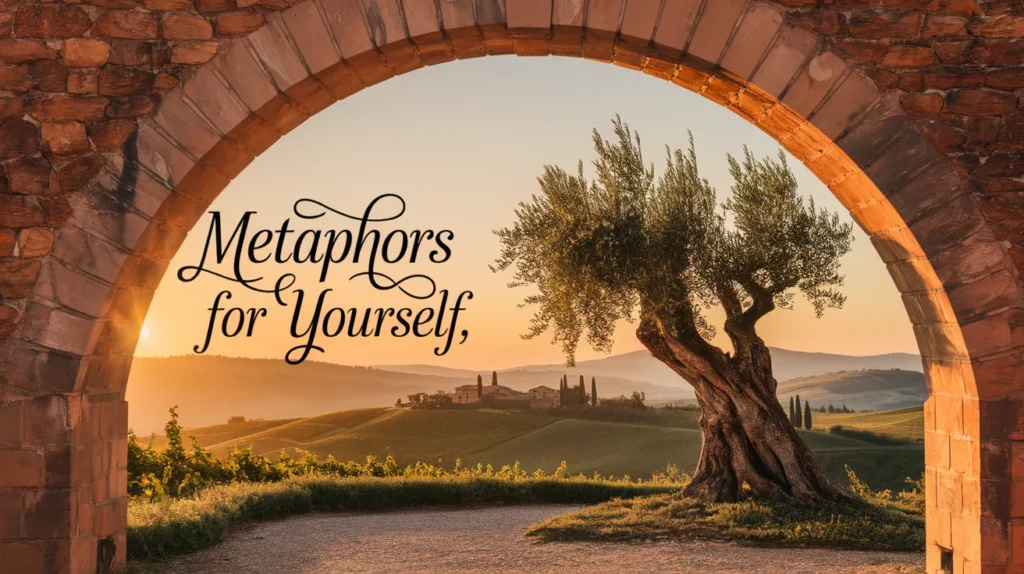
Have you ever caught yourself staring out of a window on a quiet evening, thinking, “Who am I really?” The light fades slowly, the air feels heavier than usual, and your reflection in the glass seems almost like a stranger. In moments like these, language becomes more than communication—it becomes identity. We reach for metaphors not just to describe the world, but to describe ourselves.
You are not just a name, a job, or a list of roles. You are a story in motion. A storm passing through calm skies. A garden still deciding what to bloom into. A road that keeps unfolding even when the map ends.
This is where metaphors for yourself become powerful. They help you understand your emotions, reshape your identity, and express inner experiences that plain language cannot fully hold. In writing, journaling, storytelling, or even social media expression, self-metaphors allow you to speak from a deeper place.
In this article, we’ll explore creative, emotional, and practical ways to use metaphors for yourself—along with examples, storytelling, exercises, and writing techniques that help you turn self-reflection into art.
Understanding Metaphors for Yourself: A Language of Inner Identity
Metaphors for yourself are imaginative comparisons you use to describe your personality, emotions, growth, or life journey. Instead of saying “I am confused,” you might say “I am a compass spinning without north.”
This isn’t just poetry—it’s psychological clarity. Metaphors help your mind organize emotions that feel chaotic or overwhelming.
When you define yourself metaphorically, you are:
- Translating emotions into imagery
- Giving shape to abstract feelings
- Creating meaning from confusion
- Building a personal narrative
In essence, metaphors are not just decoration in language—they are tools for self-understanding.
Why Metaphors for Yourself Matter in Personal Growth and Expression
Self-metaphors matter because they allow you to step outside yourself and observe who you are from a creative distance. This makes emotional processing easier and more insightful.
For example, saying “I am a broken person” can feel limiting. But saying “I am a cracked vase holding wildflowers through the breaks” shifts perspective entirely. Suddenly, brokenness becomes resilience.
Metaphors help you:
- Heal emotional experiences
- Improve writing and storytelling skills
- Communicate feelings more clearly
- Understand personal transformation
They are especially powerful in journaling, therapy writing, poetry, and self-reflection practices.
The Mirror of the Ocean: You Are Deep and Always Changing (Metaphor 1)
One of the most powerful metaphors for yourself is the ocean.
Meaning & Explanation
You are like the ocean—vast, layered, and constantly shifting. Some days you are calm and reflective; other days you are stormy and unpredictable. Beneath the surface, there are depths no one sees immediately.
Example Sentence / Scenario
“I thought I understood myself, but I am an ocean—always changing, always deeper than I appear.”
Alternative Expressions
- A sea of shifting tides
- A body of water holding unseen worlds
- A quiet wave hiding storms beneath
Sensory & Emotional Detail
Imagine salt air on your skin, waves rolling in slow rhythm, the sound of something endless. The ocean metaphor gives emotional permission: you are not fixed—you are fluid.
Mini Reflection
Think of a moment when your emotions changed quickly. Were you still “you,” or were you simply another wave passing through your own sea?
The Garden Within You: Growth, Weeds, and Seasons (Metaphor 2)
Meaning & Explanation
You are a garden—alive, evolving, and sometimes messy. Growth doesn’t happen evenly. Some parts bloom, while others wilt. Some areas need pruning; others need patience.
Example Sentence / Scenario
“I am a garden learning how to grow without rushing my seasons.”
Alternative Expressions
- A field learning its own weather
- A wild garden of untamed thoughts
- Soil waiting for the right seeds
Literary & Emotional Reference
Writers often use gardens to symbolize human growth because they reflect cycles—birth, decay, and renewal. Just like in life, nothing blooms forever, and nothing stays barren forever.
Sensory Detail
Imagine the smell of wet soil after rain, the quiet buzz of insects, the soft persistence of roots breaking through earth.
Mini Story
There was a time when I thought I was “behind in life.” But looking at nature changed that thought. No flower blooms in January because it is not its season. And suddenly, I realized—I wasn’t delayed. I was still growing underground.
The Traveler on an Endless Road: Becoming Through Experience (Metaphor 3)
Meaning & Explanation
You are a traveler. Life is not a fixed destination but a journey of continuous movement, discovery, and transformation.
Example Sentence / Scenario
“I am a traveler collecting versions of myself at every turn of the road.”
Alternative Expressions
- A wanderer of changing landscapes
- A pilgrim of unseen destinations
- A map that redraws itself
Emotional & Cultural Reference
Many ancient stories—from epics to folk tales—frame life as a journey. The traveler metaphor reminds us that identity is not something you “arrive at,” but something you experience.
Sensory Detail
Dust on shoes, distant horizons, unfamiliar skies—each step feels like becoming someone slightly new.
Mini Reflection
Think of your past self five years ago. Would they recognize you now? Or are you still traveling toward someone you haven’t met yet?
How to Create Metaphors for Yourself: A Step-by-Step Guide
Creating your own self-metaphors is simpler than it seems.
- Identify your current emotional state
- Ask: “What object, place, or force feels like this?”
- Expand the image with detail
- Connect it to your identity
Example:
- Feeling overwhelmed → “I am a sky filled with too many migrating birds.”
- Feeling calm → “I am a lake holding the sky without ripples.”
The key is honesty, not perfection.
Emotional Layers Behind Self Metaphors in Daily Life
Metaphors aren’t just writing tools—they are emotional maps.
When you say:
- “I am a storm,” you express intensity
- “I am glass,” you express fragility
- “I am fire,” you express transformation
These images help you name feelings that are otherwise difficult to express.
Mini Story: The Day I Became My Own Storm
One afternoon, everything felt too loud—thoughts, expectations, memories. I couldn’t separate what I felt from what I feared.
So I wrote one sentence: “I am a storm trying to understand its own weather.”
And strangely, something softened. I wasn’t broken. I was just weather passing through myself.
Cultural and Literary Inspirations for Self Metaphors
Writers and poets have always used metaphors for identity:
- Shakespeare compared life to a stage
- Rumi described the soul as a guesthouse
- Modern poets often use space, fire, and water imagery
These traditions show that self-metaphors are timeless—they connect personal emotion with universal human experience.
Interactive Exercise: Discover Your Personal Metaphor
Take a moment and complete these prompts:
- Right now, I feel like a ______ because ______
- My growth feels like ______ in a ______
- If my thoughts had a shape, they would be ______
Now combine your answers into a single metaphor. That is your current self-image.
Writing Practice: Turning Metaphors into Powerful Sentences
Try expanding your metaphor:
Basic: “I am a forest.” Expanded: “I am a forest where silence grows between branches, and even lost paths find their way through me.”
This technique is powerful for poetry, journaling, and storytelling.
Using Metaphors for Yourself in Journaling and Reflection
Journaling becomes more meaningful when you use metaphors.
Instead of writing: “I felt sad today.”
You might write: “I was a gray sky holding rain I didn’t know how to release.”
This makes emotional processing more vivid and healing.
Social Media Creativity: Expressing Yourself with Metaphors
On social platforms, self-metaphors can make your writing stand out.
Examples:
- “Still learning how to bloom in unfamiliar seasons.”
- “Currently a book with missing pages and rewrites in progress.”
- “A quiet fire learning not to burn everything at once.”
These expressions feel personal yet universal.
Common Mistakes When Creating Metaphors for Yourself
Avoid:
- Overcomplicating language
- Using clichés without meaning
- Forcing imagery that doesn’t fit your emotion
A good metaphor feels natural, not forced.
Bonus Tips: Making Your Self Metaphors More Impactful
- Use sensory details (sound, smell, texture)
- Keep them emotionally honest
- Revise them as you grow
- Let them evolve over time
Your metaphors should grow with you.
FAQs
1. What are metaphors for yourself?
They are creative comparisons you use to describe your identity, emotions, or life experience in symbolic language.
2. Why should I use metaphors to describe myself?
They help you understand emotions better and express complex feelings in a clearer, more creative way.
3. Can metaphors change over time?
Yes. As you grow and evolve, your self-metaphors naturally change too.
4. Are metaphors only for writers or poets?
No. Anyone can use them in journaling, reflection, communication, or even daily thinking.
5. How do I know if my metaphor is good?
If it feels emotionally true and helps you understand yourself better, it is effective.
Conclusion
Metaphors for yourself are not just literary tools—they are mirrors made of language. They allow you to see yourself in ways logic alone cannot reveal. Whether you are an ocean, a garden, a traveler, or something entirely new, each metaphor is a step toward deeper self-understanding.
You are not limited to one definition. You are a collection of images, emotions, and evolving stories. And the beautiful part is—you get to keep rewriting them. So the next time you struggle to describe yourself, don’t look for a label. Look for a metaphor.