
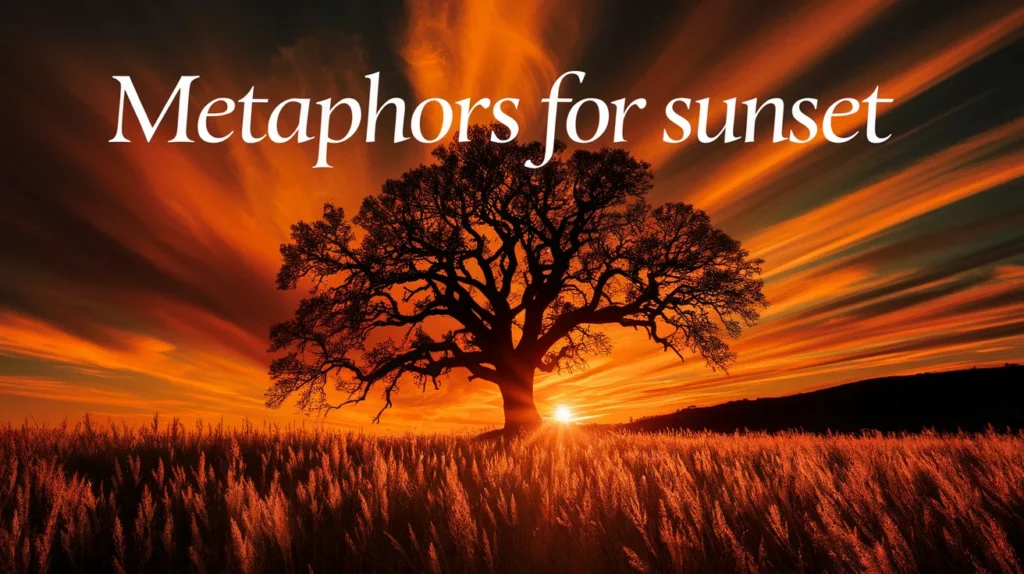
The sky begins to soften. Gold melts into amber, amber fades into rose, and somewhere between light and darkness, the world seems to pause—just for a moment. You stand there, watching the horizon swallow the sun, feeling something you can’t quite name. Is it peace? Nostalgia? Hope? Or a quiet goodbye?
That fleeting beauty is exactly why we reach for metaphors. A sunset is more than a daily event—it’s a canvas for emotion, memory, and imagination. Metaphors for sunset help us translate that silent spectacle into language, allowing writers, poets, and everyday dreamers to capture what the eyes see and the heart feels.
In this article, you’ll explore vivid and creative metaphors for sunset, learn how to craft your own, and discover ways to use them in writing, storytelling, and daily expression. Let’s step into the golden hour of language.
The Beauty of Sunset Metaphors in Creative Writing
Sunsets have always inspired storytellers. They symbolize endings, transitions, romance, and reflection. When you use metaphors, you don’t just describe a sunset—you transform it into something meaningful.
Instead of saying “the sun is setting,” you might say:
- “The sky is tucking the sun into bed.”
This adds warmth, personality, and emotion. Metaphors elevate simple observations into memorable imagery, making your writing more engaging and immersive.
Why Metaphors for Sunset Matter in Expression
Metaphors allow you to express complex feelings in simple yet powerful ways. A sunset can represent:
- The end of a chapter
- The beauty of impermanence
- A moment of peace after chaos
Whether you’re writing a poem, a caption, or a story, sunset metaphors help your audience feel what you feel—not just see it.
Common Themes in Sunset Imagery
Before creating metaphors, it helps to understand recurring themes:
- Endings and closure
- Transformation and change
- Romance and intimacy
- Calm and reflection
For example:
- “The sunset is a closing curtain on the day’s performance.”
Recognizing these themes helps you craft metaphors that resonate deeply.
Metaphors for Sunset as Emotional Mirrors
Sunsets often reflect inner emotions. A peaceful mind might see:
- “A gentle lullaby in the sky.”
While a heavy heart might describe:
- “A slow-burning goodbye written in fire.”
Your emotional state shapes your metaphor, making each description uniquely yours.
Example 1: Sunset as a Gentle Goodbye
Meaning and Explanation
This metaphor frames the sunset as a farewell—soft, warm, and comforting rather than abrupt or sad.
Example Sentence
- “The sunset whispered a gentle goodbye to the weary day.”
Alternative Expressions
- “The sun waved its final farewell”
- “Daylight slipped away like a quiet goodbye”
Sensory or Emotional Details
Imagine the fading warmth on your skin, the cooling breeze, and the hush that follows.
Mini Storytelling Element
After a long, tiring day, you sit by the window. The sky dims, and the sun disappears slowly, as if reluctant to leave. In that moment, it feels like the world is saying, “You made it through.”
Example 2: Sunset as a Burning Canvas
Meaning and Explanation
This metaphor compares the sky to an artist’s canvas, painted with bold, fiery colors.
Example Sentence
- “The horizon became a burning canvas brushed with strokes of gold and crimson.”
Alternative Expressions
- “The sky was painted in flames”
- “A masterpiece of fire unfolded above”
Sensory or Emotional Details
Visualize intense reds, glowing oranges, and the dramatic contrast against darkening blue.
Cultural Reference
Artists throughout history have tried to capture sunsets, but words often succeed where brushes cannot—because they carry emotion as well as image.
Example 3: Sunset as a Closing Chapter
Meaning and Explanation
This metaphor connects sunset with the end of a story or phase in life.
Example Sentence
- “The sunset marked the closing chapter of a day filled with untold stories.”
Alternative Expressions
- “The day folded its final page”
- “The sun wrote its last line across the sky”
Emotional Layer
This metaphor evokes reflection, making it perfect for journaling or storytelling.
Using Sunset Metaphors in Poetry and Prose
In poetry, metaphors for sunset can create rhythm and depth:
- “A golden sigh fell across the sky.”
In prose, they enrich description:
- “As the sun dipped, the sky turned into a quiet symphony of fading light.”
The key is balance—use metaphors to enhance, not overwhelm.
Crafting Your Own Sunset Metaphors
To create original metaphors:
- Observe the sunset closely
- Identify the emotion it evokes
- Compare it to something familiar
For example:
- Emotion: Peace
- Comparison: A lullaby
- Result: “The sunset hummed a lullaby across the sky.”
Sensory Language to Enhance Sunset Imagery
Great metaphors engage the senses:
- Sight: “molten gold”
- Touch: “warm glow fading into cool dusk”
- Sound: “a silent sigh of light”
Combining sensory details makes your metaphors vivid and immersive.
Cultural and Literary Inspirations for Sunset Metaphors
Across cultures, sunsets symbolize:
- Rest and renewal
- Spiritual reflection
- The passage of time
In literature, sunsets often signal turning points or emotional climaxes, making them powerful narrative tools.
Sunset Metaphors for Social Media Captions
Want your captions to stand out? Try:
- “The sky set itself on fire just to say goodnight.”
- “Sunsets: proof that endings can be beautiful.”
Short, poetic metaphors work best for platforms like Instagram or Facebook.
Using Sunset Metaphors in Daily Conversations
You don’t need to be a writer to use metaphors. Try saying:
- “Today ended on a golden note.”
- “The sky looked like it was dreaming.”
These small touches make everyday speech more expressive and memorable.
Interactive Exercise: Create Your Own Sunset Metaphor
Try this simple activity:
Step 1: Watch a sunset (or imagine one) Step 2: Write down 3 emotions you feel Step 3: Compare the sunset to something unexpected
Example prompt:
- “The sunset is like ______ because it feels ______.”
Write at least three variations and notice how each one changes the mood.
Creative Writing Prompts Inspired by Sunsets
- Write a short paragraph where a sunset symbolizes a life change
- Describe a sunset using only one color family
- Create a dialogue where two characters interpret the same sunset differently
These prompts help you explore perspective and creativity.
Bonus Tips for Using Sunset Metaphors Effectively
- Keep it original: Avoid clichés like “the sky was red”
- Match tone: A romantic scene needs soft metaphors, not harsh ones
- Use sparingly: Too many metaphors can overwhelm the reader
- Blend with storytelling: Let metaphors reveal emotion naturally
FAQs
1. What is a metaphor for sunset?
A metaphor for sunset is a figurative comparison that describes the sunset in a creative or symbolic way, such as “the sky’s farewell kiss.”
2. Why are sunset metaphors popular in writing?
Because sunsets naturally evoke strong emotions like peace, nostalgia, and beauty, making them perfect for expressive language.
3. Can beginners create effective sunset metaphors?
Yes. Start by observing the sunset and connecting it to familiar emotions or objects.
4. How do I avoid clichés in sunset metaphors?
Focus on unique comparisons and personal experiences rather than common phrases.
5. Where can I use sunset metaphors?
In poetry, stories, social media captions, journaling, and even daily conversations.
Conclusion
A sunset is never just a sunset. It’s a quiet ending, a fiery masterpiece, a whispered promise of tomorrow. Through metaphors, you give voice to that silent beauty, turning fleeting moments into lasting impressions.
As you begin to craft your own metaphors for sunset, remember: there’s no single “right” way to describe it. Your perspective, your emotions, and your imagination are what make your words glow.
So the next time the sky begins to fade into gold and crimson, pause. Watch. Feel. And then—write your own sunset into existence.