
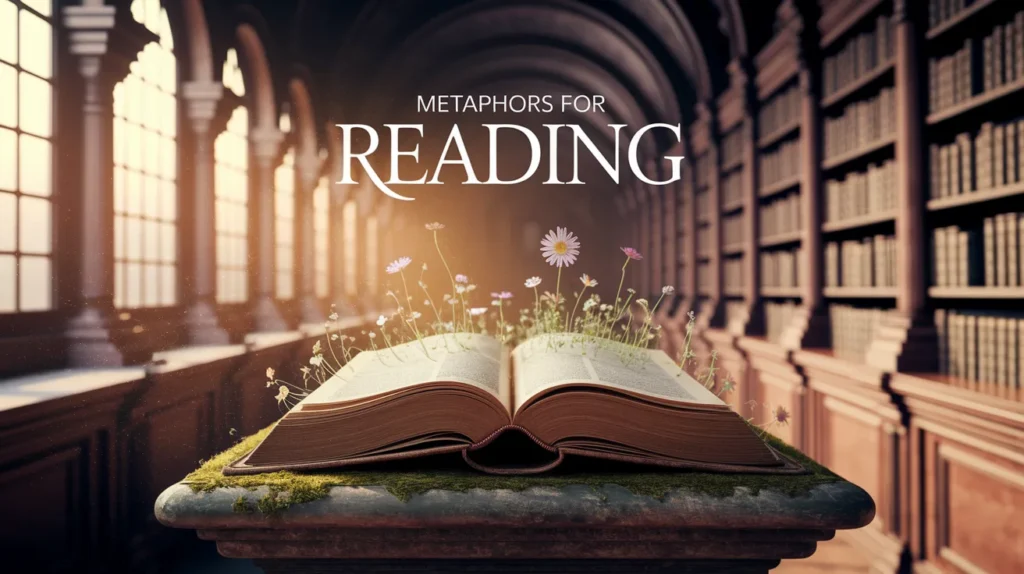
Introduction: When Reading Feels Like Stepping Into Another World
There is a quiet moment many readers know well—the rustle of a turning page, the faint smell of paper, and the sudden disappearance of the real world. In that instant, a book is no longer just ink on paper; it becomes a doorway. Reading has always been more than decoding words. It is an experience, a feeling, a journey that takes place both in the mind and the heart.
Metaphors for reading help us describe this magical process in ways that feel alive and meaningful. They turn something ordinary into something poetic. Instead of simply saying “I like reading,” we can say reading is a voyage, a fire, a mirror, or a key. These comparisons deepen our understanding and make literature more emotionally powerful.
In this article, we will explore vivid metaphors for reading, each one offering a different way to see books and storytelling. You’ll also find creative examples, storytelling moments, and practical exercises to help you use these ideas in writing, speaking, and daily reflection.
Metaphors for Reading as a Journey Through Words
Reading is often described as a journey—and for good reason. Every story takes us somewhere new, even if our body never moves an inch. One page might lead us through ancient kingdoms, while another takes us into the mind of a struggling character.
This metaphor emphasizes progression, discovery, and transformation. Like a traveler, a reader collects experiences along the way.
Example scenario: “I began the novel as a stranger and ended it as someone who had crossed emotional continents.”
Alternative expressions:
- Reading is a road through imagination
- Books are maps of unknown lands
- Stories are paths through time
Sensory/emotional detail: You can almost feel your thoughts walking forward, step by step, as if each paragraph is a new landscape unfolding beneath your feet.
Metaphors for Reading as a Window to Other Worlds
Reading can also be seen as a window—one that opens into places we could never physically reach. Through it, we observe lives, cultures, and emotions far beyond our own experience.
This metaphor highlights observation and perspective. A window lets us see without fully entering, yet we still feel connected.
Example sentence: “This book was a window into a city I had never visited but somehow felt I belonged to.”
Alternative ways to express it:
- Books are glass doors to imagination
- Reading opens skylights into other lives
- Stories are transparent bridges between worlds
Mini storytelling moment: A student in a small town reads about Paris for the first time and suddenly hears the echo of distant streets in her mind, even though she has never left her room.
Books as Seeds of Imagination
Books do not just show us things—they plant ideas that grow inside us long after we finish reading. This metaphor compares reading to planting seeds in fertile soil.
Each idea, character, or lesson becomes something that slowly grows in our thinking.
Example scenario: “That childhood fairy tale became a seed that later grew into my love for writing stories.”
Alternative expressions:
- Books are gardens of thought
- Reading plants forests in the mind
- Stories grow into ideas over time
Emotional detail: Even days later, a single sentence can return like a sprout pushing through memory, surprising you with its growth.
Reading as a Key Unlocking Knowledge
Books often feel like keys—each one unlocking a different door of understanding. This metaphor emphasizes discovery and access.
When we read, we are not just consuming information; we are unlocking hidden rooms in our mind.
Example sentence: “This science book was the key that unlocked my curiosity about the universe.”
Alternative ways to express it:
- Reading opens locked doors of knowledge
- Books are master keys to wisdom
- Stories unlock hidden chambers of thought
Interactive idea: Think of a book you recently read. What “door” did it open in your thinking? Write it down as if you are describing a locked room that suddenly became accessible.
Metaphors for Reading as a Conversation with the Past
Reading connects us with voices from other times. Writers who lived centuries ago still speak through their words today.
This metaphor turns reading into a timeless dialogue.
Example scenario: “When I read Shakespeare, it feels like I am sitting across from him in conversation.”
Alternative expressions:
- Books are whispers from history
- Reading is talking to minds beyond time
- Stories are letters from the past
Literary reference: Many classic works survive because they continue this “conversation,” allowing modern readers to respond emotionally to ancient thoughts.
Reading as a Fire That Lights the Mind
Reading can ignite curiosity, passion, and understanding. Like fire, it spreads warmth and energy through the mind.
This metaphor emphasizes transformation and intensity.
Example sentence: “That philosophy book lit a fire in my thinking that never went out.”
Alternative ways to say it:
- Reading sparks mental flames
- Books kindle curiosity
- Stories set the imagination ablaze
Sensory detail: You can almost feel warmth spreading through your thoughts, like a candle slowly brightening a dark room.
Books as Mirrors of the Self
Sometimes reading does not show us the world—it shows us ourselves. Books act like mirrors, reflecting our emotions, fears, and desires.
This metaphor highlights introspection.
Example scenario: “I saw my own loneliness reflected in the character’s journey.”
Alternative expressions:
- Reading reflects inner truths
- Books are emotional mirrors
- Stories show us who we are
Interactive prompt: Think of a character you once related to. What part of yourself did you see in them?
Reading as a River of Thoughts
Reading flows like a river—continuous, deep, and ever-moving. Ideas carry us forward, sometimes gently, sometimes forcefully.
This metaphor emphasizes movement and flow.
Example sentence: “I let the novel carry me like a river through unfamiliar emotional landscapes.”
Alternative expressions:
- Books flow through the mind
- Reading is a stream of imagination
- Stories are currents of thought
Sensory detail: Words feel like water moving steadily, sometimes calm, sometimes rushing, but always forward.
Metaphor Example 1: Reading as Traveling Without Moving
Reading allows us to travel without leaving our place. It is physical stillness paired with mental motion.
Meaning/explanation: This metaphor emphasizes imagination as transportation.
Example sentence: “With every page, I traveled through deserts, oceans, and cities while sitting in silence.”
Alternative expressions:
- Books are passports to imagination
- Reading is teleportation through words
- Stories are journeys of the mind
Mini storytelling: A tired office worker reads during lunch break and suddenly finds herself in a medieval castle, forgetting the noise of the city around her.
Metaphor Example 2: Reading as Feeding the Mind
Just as food nourishes the body, reading nourishes the mind. It provides intellectual and emotional sustenance.
Meaning/explanation: This metaphor emphasizes growth, learning, and mental health.
Example sentence: “I feed my curiosity every night with a chapter before bed.”
Alternative expressions:
- Books are meals for thought
- Reading is nourishment for intelligence
- Stories are mental nutrition
Emotional detail: A good book leaves you satisfied yet still hungry for more knowledge.
Metaphor Example 3: Reading as Building a Library in Your Head
Every book we read adds another shelf to an internal library. Over time, our minds become vast collections of stories, ideas, and memories.
Meaning/explanation: This metaphor highlights accumulation and memory.
Example sentence: “Her mind was a library built one book at a time.”
Alternative expressions:
- Reading constructs mental archives
- Books build inner collections of wisdom
- Stories stack into personal knowledge halls
Interactive exercise: Imagine your mind as a library. What are the top three “bookshelves” currently filled with?
Reading as a Garden of Ideas
Books can also be seen as gardens where ideas bloom. Some grow instantly, while others take time to blossom.
This metaphor emphasizes beauty, patience, and creativity.
Example scenario: “A single poem grew into a garden of inspiration in my thoughts.”
Alternative expressions:
- Reading cultivates imagination
- Books are fields of thought
- Stories bloom in the mind
Reading as a Lighthouse in the Dark
When life feels uncertain, reading can guide us like a lighthouse. It offers clarity, direction, and comfort.
This metaphor highlights guidance and emotional support.
Example sentence: “That self-help book became a lighthouse during a confusing time in my life.”
Alternative expressions:
- Books are guiding lights
- Reading illuminates confusion
- Stories shine through darkness
Reading Practice Exercises and Creative Prompts
Try these activities to strengthen your understanding of reading metaphors:
- Describe your favorite book using three different metaphors.
- Write a short paragraph where reading is a “storm,” “garden,” or “fire.”
- Imagine your bookshelf is alive—what story does it tell about you?
- Turn a recent reading experience into a travel story.
- Share a metaphor for reading on social media and explain it in one sentence.
These exercises help you transform abstract thinking into creative expression.
Using Reading Metaphors in Writing, Social Media, and Daily Life
Metaphors are powerful tools for communication. They make writing more engaging and memorable.
In writing, they add depth and emotional color. On social media, they create relatable captions that connect with readers. In daily life, they help you express how books affect your mood and thinking.
Bonus tips:
- Use simple metaphors for clarity
- Combine emotion with imagery
- Keep comparisons personal and relatable
- Avoid overcomplicating the metaphor
A well-placed metaphor can turn a simple sentence into something unforgettable.
FAQs
1. What are metaphors for reading?
They are imaginative comparisons that describe reading as something else, like a journey, fire, or window.
2. Why are metaphors used to describe reading?
They help express emotions and experiences that are difficult to explain literally.
3. Can metaphors improve writing skills?
Yes, they make writing more vivid, creative, and engaging.
4. What is the most common metaphor for reading?
“Reading as a journey” is one of the most widely used metaphors.
5. How can I create my own reading metaphors?
Think about how reading makes you feel and compare it to everyday experiences like traveling, eating, or observing nature.
Conclusion
Reading is never just an act—it is an experience that reshapes how we see everything around us. Through metaphors, we learn to describe this experience in richer, more imaginative ways. Whether reading becomes a journey, a fire, a mirror, or a garden, each comparison reveals a different layer of meaning.
The beauty of metaphors for reading lies in their flexibility. They allow every reader to find their own truth in books. In the end, reading is not just about understanding words—it is about living inside them, even if only for a little while.