
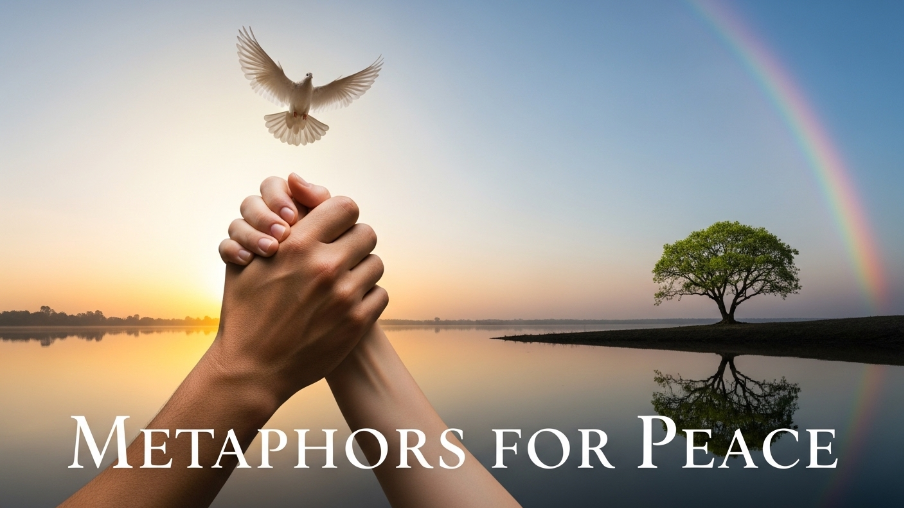
A soft breeze moves through a quiet morning street. Somewhere, a kettle whistles gently, birds stitch invisible threads of sound across the sky, and for a brief moment, everything feels aligned—like the world has remembered how to breathe slowly again. That feeling, delicate yet powerful, is what we often try to describe when we talk about peace.
But peace is not always visible; it is something we sense, something we build, something we imagine through language. And that is where metaphors become essential. Metaphors for peace help us turn an invisible experience into something we can see, touch, and feel in our minds. They allow writers, speakers, and thinkers to translate calmness, harmony, and emotional balance into vivid imagery.
Whether you are writing poetry, improving storytelling, or simply trying to understand your own inner world, peace metaphors become bridges between emotion and expression. In this article, we will explore powerful metaphors for peace, how they work, and how you can use them creatively in writing and everyday communication.
Metaphors for Peace in Everyday Life and Emotional Expression
Peace often hides in ordinary moments—a warm cup of tea after a long day, the silence after an argument, or the steady rhythm of walking alone under evening light. In language, metaphors help us capture these fragile experiences.
We don’t just say “I feel calm.” Instead, we say:
- “I feel like the storm has passed.”
- “My mind is a still lake.”
- “My heart has finally settled.”
These comparisons allow emotions to become landscapes. When used effectively, metaphors for peace can transform simple descriptions into emotional storytelling.
Writers often rely on them because they speak to universal human experiences. Everyone understands weather, nature, light, and shelter. So when peace is described through these elements, it becomes instantly relatable and deeply emotional.
Peace as a Calm Ocean: A Vast Metaphor for Inner Stillness
One of the most powerful metaphors for peace is the calm ocean. The sea is never truly silent, yet when it is peaceful, it reflects the sky like a mirror, steady and infinite.
Meaning and Explanation
This metaphor represents emotional stability after chaos. Just as ocean waves settle after a storm, human emotions also stabilize after stress, conflict, or confusion.
Example Sentence
“My thoughts became a calm ocean, no longer tossed by worry or fear.”
Sensory and Emotional Detail
Imagine standing on a shoreline at dawn. The air is cool, salt-laced, and still. Waves move in slow rhythm, not crashing but breathing. That is what emotional peace feels like in this metaphor—expansive, endless, and quietly powerful.
Alternative Expressions
- A still sea of thoughts
- A tranquil water horizon
- Emotional waters at rest
Mini Storytelling Element
A young student preparing for exams once described her anxiety as a stormy sea. After days of rest and focus, she said it felt like “the ocean finally remembered how to be still.” That shift in imagery helped her regain control over her emotions.
Interactive Prompt
Think of a stressful moment in your life. Rewrite it as a weather or ocean scene. How would your emotions look if they were water?
Peace as a Gentle Garden: Growth, Healing, and Renewal
A garden is never rushed. It grows quietly, patiently, and beautifully over time. This makes it a perfect metaphor for peace.
Meaning and Explanation
Peace as a garden represents emotional healing and gradual growth. It suggests that peace is cultivated, not instantly achieved.
Example Sentence
“She tended to her thoughts like a gentle garden, removing weeds of worry and planting seeds of hope.”
Sensory and Emotional Detail
Picture soft soil, warm sunlight filtering through leaves, and the faint scent of blooming jasmine. The garden doesn’t demand attention—it invites it. This is the essence of inner peace: slow, nurturing, and alive.
Alternative Expressions
- A blooming inner landscape
- A cultivated mind
- A field of emotional harmony
Cultural and Literary Reference
Many poets in Persian and Urdu literature have compared inner peace to gardens, where silence becomes fertile ground for reflection and spiritual clarity.
Interactive Exercise
Write down three negative thoughts you had today. Now imagine pulling them out like weeds and replacing them with positive “seeds.” What would your mental garden look like?
Peace as a Soft Light in Darkness: Hope and Emotional Clarity
Light is one of the oldest metaphors in human storytelling, often symbolizing knowledge, hope, and peace.
Meaning and Explanation
Peace as light represents clarity emerging after confusion or emotional darkness. It is not overwhelming brightness but a soft, steady glow.
Example Sentence
“In the middle of grief, a soft light of peace began to glow inside her.”
Sensory and Emotional Detail
Imagine a dark room where a single candle flickers. It does not erase all shadows, but it makes the space feel safe. That is emotional peace—subtle, reassuring, and persistent.
Alternative Expressions
- A lantern in the mind
- Inner dawn breaking
- A glow of quiet understanding
Real-Life Reflection
People recovering from loss or hardship often describe “small moments of light”—a kind word, a memory, or a realization that things will be okay. These are emotional turning points.
Interactive Prompt
Think of a difficult memory. What small “light” helped you through it? Describe it as if it were a physical glow.
Peace as a Bridge Between Hearts: Connection and Understanding
Peace is not only internal; it also exists between people. One of the most meaningful metaphors for peace is the bridge.
Meaning and Explanation
A bridge represents connection, reconciliation, and understanding between individuals or communities.
Example Sentence
“Forgiveness built a bridge of peace between them after years of silence.”
Emotional Depth
Bridges are not built overnight. They require effort, trust, and courage. Similarly, peace in relationships is constructed slowly through empathy and communication.
Alternative Expressions
- A connection of understanding
- Emotional crossing point
- A pathway between hearts
Mini Storytelling Element
Two childhood friends stopped speaking after a misunderstanding. Years later, a simple conversation became the first plank in rebuilding their emotional bridge. That moment did not erase the past, but it created space for peace to return.
Interactive Exercise
Write about a relationship you would like to heal. What would your “bridge of peace” look like? What materials (words, actions, apologies) would it need?
Peace as a Quiet Room Inside Us: Inner Sanctuary Metaphor
Sometimes peace is not outside in nature or relationships but within the self.
Meaning and Explanation
This metaphor describes the mind as a quiet room where thoughts settle and noise fades.
Example Sentence
“She closed her eyes and stepped into the quiet room inside her mind.”
Sensory Detail
Soft silence, dim light, and still air define this space. It is not empty—it is safe.
Alternative Expressions
- Inner sanctuary
- Mental safe space
- Emotional retreat
Interactive Prompt
Imagine your mind as a room. What objects are inside when you feel peaceful? What changes when chaos enters?
Metaphors for Peace in Literature and Cultural Traditions
Across cultures, peace has been described through symbols like doves, olive branches, rivers, and stars.
Writers from different traditions use nature to express harmony because nature itself is balanced. In Japanese haiku, peace is found in minimal imagery. In Urdu poetry, peace often appears through moonlight and gardens. In Western literature, peace is frequently connected to silence after storms or battles.
These shared symbols show that peace is a universal human desire, even if expressed differently.
Peace as a River Flowing Smoothly: Continuity and Balance
A river that flows without obstruction is another powerful metaphor for peace. It represents life moving smoothly without emotional blockages or disruptions.
This metaphor suggests that peace is not static but dynamic—always moving, yet calm.
Peace as a Warm Blanket of Safety: Comfort and Security
This metaphor reflects emotional protection. Just as a blanket shields us from cold, peace protects us from emotional distress.
It is often used to describe moments of safety, love, or belonging.
How to Use Peace Metaphors in Writing Effectively
To use metaphors for peace effectively:
- Connect them to sensory details
- Avoid overuse in a single paragraph
- Match them with emotional tone
- Keep them relatable
Metaphors should enhance meaning, not overwhelm it.
Creative Exercises for Practicing Peace Imagery
Try these exercises:
- Turn emotions into weather reports
- Describe your day as a landscape
- Rewrite stress as natural chaos (storm, fire, wind)
- Rewrite calm as nature after balance is restored
These exercises strengthen creative thinking and emotional awareness.
Peace in Social Media Expression and Modern Communication
On social media, peace metaphors are often used in captions like:
- “Finding my calm ocean again 🌊”
- “Growing through my inner garden 🌱”
Such expressions help people share emotional journeys in relatable ways.
Real-Life Stories of Peace Moments
A nurse during a long hospital shift described peace as “the moment between alarms.” A traveler described it as “the silence after landing in a new country.” These stories show that peace is not always permanent—it appears in brief, meaningful intervals.
Common Mistakes When Using Peace Metaphors
Avoid:
- Mixing too many metaphors in one sentence
- Using clichés without originality
- Forcing imagery that doesn’t match emotion
Good metaphors feel natural, not artificial.
Bonus Tips for Living and Writing with Peace Metaphors
- Observe nature daily for inspiration
- Keep a metaphor journal
- Practice describing emotions creatively
- Read poetry for imagery inspiration
The more you notice peace, the easier it becomes to describe it.
FAQs
1. What are metaphors for peace?
They are comparisons that describe peace using imagery like nature, light, or objects to express calmness and emotional harmony.
2. Why are peace metaphors important in writing?
They help readers emotionally connect with abstract feelings and make writing more vivid and relatable.
3. Can peace metaphors be used in daily conversation?
Yes, they can make speech more expressive and emotionally engaging.
4. What are some common peace metaphors?
Examples include calm ocean, gentle garden, soft light, and quiet room.
5. How can I create my own peace metaphors?
Think of calm experiences in nature or life and compare them to emotions you feel internally.
Conclusion
Peace is not just the absence of noise or conflict—it is a language of balance, healing, and emotional clarity. Through metaphors, we give shape to something invisible yet deeply felt. Whether it is a calm ocean, a blooming garden, or a quiet inner room, each image helps us understand peace in a more human way.
When you begin to see peace through metaphor, you also begin to recognize it more easily in your life. It appears in small pauses, gentle moments, and silent understandings. And once you can name it, you can nurture it—both in your writing and within yourself.