
Introduction: When Nervousness Feels Like a Living Thing
You know that moment right before speaking in front of a crowd—your palms turn slightly damp, your heartbeat starts to tap faster, and suddenly even silence feels loud. Nervousness doesn’t just stay in the mind; it spreads through the body like it has its own language. It is not just an emotion—it is a physical experience, a quiet storm that hums beneath the skin. This is where metaphors for nervousness become powerful.
Instead of simply saying “I was nervous,” metaphors help us feel it, see it, and share it. They turn invisible emotions into vivid images—fluttering birds, shaking earth, tangled wires, or brewing storms. Understanding and using these metaphors is important because they enrich communication, strengthen storytelling, and help us process emotions more deeply.
Whether you’re a writer, student, content creator, or simply someone trying to express yourself better, these comparisons can bring your inner world to life in meaningful ways. Let’s explore how nervousness transforms into language that breathes, trembles, and speaks.
Understanding Metaphors for Nervousness in Emotional Expression
Metaphors for nervousness are figurative expressions that describe anxious or uneasy feelings through imagery. Instead of stating emotions directly, they compare them to familiar sensations or objects.
For example:
- “My nerves were a live wire” suggests tension and unpredictability.
- “My stomach was a washing machine” conveys chaos inside.
These metaphors help readers connect emotionally because they translate abstract feelings into sensory experiences. Nervousness becomes something we can see or touch in our imagination.
They are widely used in literature, daily conversation, speeches, and even social media storytelling because they make emotional expression more relatable and powerful.
Why Nervousness Metaphors Matter in Communication and Writing
Metaphors are not just decorative language—they shape how we understand emotion. Nervousness, in particular, is difficult to describe because it involves both mental and physical sensations.
Using metaphors:
- Enhances emotional clarity
- Makes writing more engaging
- Helps readers empathize
- Adds depth to storytelling
For example, saying “I felt like I was standing on the edge of a cliff” communicates far more than “I was nervous.” It creates tension, imagery, and emotional context in a single line.
Writers, poets, and even psychologists use such expressions to understand and describe emotional states more effectively.
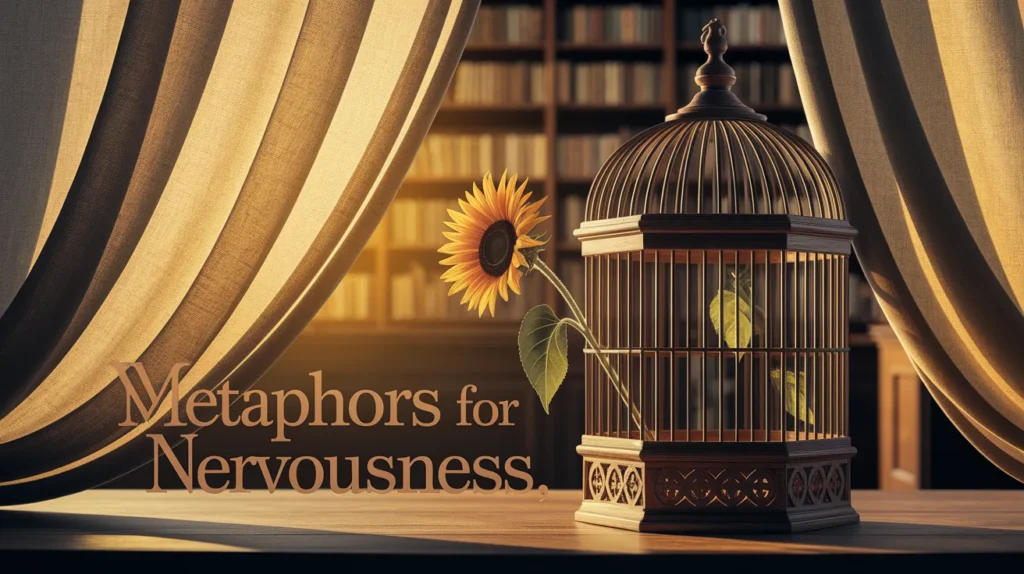
Nervousness Like a Fluttering Cage Bird: A Classic Emotional Metaphor
One of the most common metaphors for nervousness is imagining a bird trapped in a cage, fluttering uncontrollably.
Meaning & Explanation
This metaphor represents the feeling of anxiety trapped inside the body. The “bird” symbolizes restless thoughts and emotions trying to escape.
Example Sentence
“My heart was a cage bird, beating wildly against my ribs before the interview began.”
Alternative Expressions
- A trapped butterfly in my chest
- A restless sparrow inside my thoughts
- Wings beating against invisible walls
Sensory & Emotional Detail
You can almost hear the frantic fluttering. There’s a sense of urgency, confinement, and helpless movement. This metaphor is often used in poetry and storytelling to represent emotional overwhelm.
Mini Story
Imagine a student waiting outside an exam hall. Every passing second feels like another flap of wings inside their chest. The bell hasn’t rung yet, but their body already feels in motion.
Nervousness Like a Storm Brewing Inside the Chest
Another powerful metaphor compares nervousness to an approaching storm.
Meaning & Explanation
This suggests growing emotional intensity. Just like dark clouds gather before rain, anxiety builds before an important moment.
Example Sentence
“Before stepping on stage, I felt a storm gathering in my chest, heavy and impossible to ignore.”
Alternative Expressions
- Thunder rolling in my thoughts
- Lightning under my skin
- A pressure system of fear building inside me
Sensory & Emotional Detail
There’s heaviness, pressure, and anticipation. You can imagine thunder echoing in the distance and wind picking up before chaos.
Mini Story
A musician tuning their guitar backstage feels the air thicken. The crowd noise fades into a dull roar. Inside, something is shifting—like weather about to break.
Nervousness Like Tangled Wires in the Mind
This metaphor reflects confusion and mental overload.
Meaning & Explanation
Nervousness often disrupts clear thinking. The “tangled wires” symbolize thoughts crossing, short-circuiting, and becoming difficult to organize.
Example Sentence
“My thoughts were tangled wires, sparking every time I tried to speak.”
Alternative Expressions
- A knot of electricity in my brain
- Overloaded circuits of fear
- A maze of crossed signals
Sensory & Emotional Detail
This metaphor feels mechanical and chaotic. There is buzzing, static, and mental noise.
Interactive Exercise
Try describing your last nervous moment using a technology-related metaphor. Was your brain like a buffering screen? A glitching device? Write it down in 2–3 sentences.
Everyday Situations Where Nervousness Metaphors Appear Naturally
We often use metaphors without realizing it in daily conversations:
- Job interviews (“I was a mess of nerves”)
- First dates (“butterflies in my stomach”)
- Exams (“my mind went blank like a wiped screen”)
These expressions help us communicate emotional intensity quickly and effectively. Even children naturally use them when describing fear or excitement.
Nervousness Metaphors in Literature and Storytelling Traditions
Writers like Shakespeare, Emily Dickinson, and modern novelists often use metaphors to describe anxiety.
In literature:
- Nervousness is a “shaking candle flame”
- Fear becomes a “shadow that follows footsteps”
- Anxiety turns into “tight ropes inside the mind”
These metaphors deepen character development and allow readers to feel internal conflict rather than just observe it.
Psychological Meaning Behind Nervousness Metaphors
Psychologically, metaphors help the brain process emotions indirectly. Instead of confronting anxiety directly, the mind externalizes it into imagery.
This makes emotions:
- Easier to understand
- Less overwhelming
- More structured
For example, saying “storm inside me” gives shape to something otherwise abstract. It creates distance, allowing reflection instead of panic.
How to Use Nervousness Metaphors in Writing Effectively
To use metaphors well:
- Choose familiar imagery (weather, animals, machines)
- Match intensity with emotion
- Avoid mixing too many metaphors in one sentence
Example: Instead of “I was nervous,” try: “My thoughts scattered like papers in a sudden wind.”
Good metaphors should feel natural, not forced.
Social Media Captions Using Nervousness Metaphors
Metaphors work beautifully in short content too:
- “Standing here like a storm waiting to break 🌩️”
- “Butterflies are throwing a concert in my stomach 🦋”
- “My nerves are louder than my thoughts today 🎧”
They add creativity and emotional relatability to posts.
Creative Exercise: Build Your Own Nervousness Metaphor
Try this:
- Think of a nervous moment
- Choose an image (weather, object, animal, machine)
- Connect emotion to behavior
Example:
- Emotion: Nervous before presentation
- Image: Broken radio
- Metaphor: “My voice felt like a broken radio, cutting in and out under pressure.”
Write 3 of your own and compare them with different moods.
Common Mistakes When Using Nervousness Metaphors
Avoid:
- Overcomplicating the imagery
- Using clichés too often (like only “butterflies”)
- Mixing unrelated images
Instead, aim for clarity and emotional resonance. A simple metaphor often carries more power than an elaborate one.
Cultural Interpretations of Nervousness Imagery Around the World
Different cultures describe nervousness differently:
- Western expressions often use weather (storms, shaking)
- Eastern metaphors may use internal balance or energy flow
- Indigenous storytelling may connect emotions with nature spirits or animals
These variations show how deeply emotion and culture are connected in language.
Bonus Tips for Enhancing Emotional Writing with Metaphors
- Read poetry for inspiration
- Observe real physical reactions to nervousness
- Keep a metaphor journal
- Practice rewriting simple sentences creatively
Example transformation:
- Basic: “I was nervous.”
- Enhanced: “My nerves hummed like a storm waiting for permission to break.”
Bringing It All Together: Mastering Nervousness Metaphors
Metaphors for nervousness allow us to transform invisible emotional tension into vivid, relatable imagery. Whether it’s a fluttering bird, a brewing storm, or tangled wires, each metaphor reveals a different side of anxiety.
By practicing these expressions, you not only improve your writing but also develop a richer emotional vocabulary. Nervousness becomes less of a blur and more of a story you can describe, understand, and even share with others.
FAQs
1. What are metaphors for nervousness?
They are figurative expressions that describe anxiety using imagery like storms, birds, or tangled thoughts.
2. Why are metaphors useful for describing nervousness?
They make emotions easier to understand, visualize, and communicate effectively.
3. What is a common metaphor for nervousness?
“Butterflies in the stomach” is one of the most widely used expressions.
4. Can metaphors help reduce anxiety?
Indirectly, yes. They help people externalize emotions, making them easier to process.
5. How can I improve my use of metaphors?
Practice regularly, observe emotions closely, and experiment with creative comparisons.
Conclusion
Nervousness is a universal human experience, but words give it shape. Through metaphors, we transform internal chaos into meaningful imagery—something we can see, feel, and share. Whether it is a storm building in the chest or a bird fluttering against invisible bars, these expressions help bridge the gap between emotion and language. The more you explore them, the more vividly you can tell your story—and understand your feelings in return.