
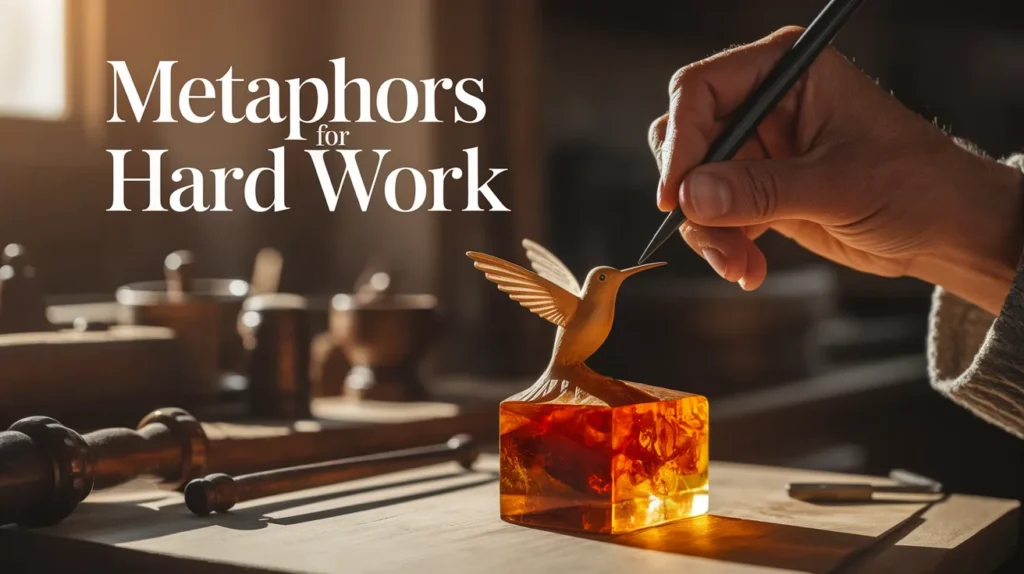
The sun hasn’t fully risen yet, but the air already hums with quiet determination. A farmer bends over the soil, hands deep in earth, planting seeds that won’t bloom for weeks. Nearby, a student flips through pages, eyes heavy but spirit unbroken. Somewhere else, a runner pushes past exhaustion, chasing a finish line only they can see. Hard work isn’t always loud—it often whispers through effort, persistence, and invisible progress.
This is where metaphors for hard work come alive. They give shape to effort, turning abstract struggles into vivid, relatable imagery. Whether you’re writing, speaking, or motivating yourself, metaphors make the grind meaningful and memorable. They help us feel the effort, not just understand it. In this article, you’ll explore powerful metaphors, learn how to use them creatively, and discover ways to weave them into your writing, storytelling, and daily life.
Understanding Metaphors for Hard Work in Everyday Language
Metaphors compare one thing to another, helping us understand complex ideas through familiar images. Hard work, though intangible, becomes clearer when we describe it as climbing mountains, forging steel, or planting seeds.
These comparisons:
- Add emotional depth
- Make communication more vivid
- Inspire motivation and resilience
When you say “hard work is a marathon,” you instantly convey endurance, patience, and long-term commitment.
Why Hard Work Metaphors Matter in Writing and Communication
Metaphors don’t just decorate language—they transform it. Instead of saying “keep trying,” you might say, “keep hammering the stone until it cracks.” The second version sticks, motivates, and paints a picture.
They are especially useful in:
- Motivational writing
- Speeches and storytelling
- Social media captions
- Personal journaling
A strong metaphor can turn a simple idea into something unforgettable.
Classic Metaphors for Hard Work That Stand the Test of Time
Some metaphors have endured because they capture universal truths:
- Hard work is climbing a mountain
- Hard work is forging iron in fire
- Hard work is rowing against the current
These images resonate across cultures because they reflect shared human experiences of struggle and perseverance.
Creative Metaphors for Hard Work to Spark Imagination
If you want to stand out, try fresh metaphors:
- Hard work is writing a story one stubborn sentence at a time
- Hard work is building a bridge in the fog
- Hard work is watering a garden you cannot yet see
These imaginative comparisons feel personal and emotionally engaging.
Metaphors for Hard Work in Literature and Culture
Writers and storytellers have long used metaphors to describe effort:
- In literature, hard work often appears as a long journey
- In folklore, it’s a test of endurance or courage
- In modern culture, it’s the hustle or grind
These metaphors reflect how societies view effort and success.
Using Metaphors to Motivate and Inspire Others
A well-placed metaphor can uplift someone instantly.
Instead of saying: “Don’t give up,”
Say: “You’re closer to the summit than you think.”
This reframing gives hope and perspective, making challenges feel purposeful.
How to Create Your Own Metaphors for Hard Work
Creating metaphors isn’t complicated. Follow this simple process:
- Think about the feeling of hard work (tiring, slow, rewarding)
- Match it with a physical experience (climbing, digging, building)
- Combine them into a vivid comparison
Example: Hard work feels slow → like planting seeds → Hard work is planting seeds in unseen soil
Powerful Example 1: Hard Work as Climbing a Mountain
Meaning & Explanation: This metaphor emphasizes persistence, struggle, and gradual progress. The higher you climb, the harder it gets—but the view improves.
Example Sentence: “She treated her career like a mountain, taking one step at a time toward the peak.”
Alternative Expressions:
- Scaling new heights
- Reaching the summit
- Climbing uphill
Mini Storytelling: Imagine a young entrepreneur facing setbacks. Each failure feels like slipping down loose gravel, but every attempt strengthens their footing. Eventually, they reach a point where they can look back and see how far they’ve come.
Sensory Detail: Cold winds, aching muscles, and thin air—yet the horizon expands with every step.
Powerful Example 2: Hard Work as Forging Steel in Fire
Meaning & Explanation: This metaphor highlights transformation through pressure and heat. Challenges shape strength.
Example Sentence: “Every setback forged her resilience like steel in fire.”
Alternative Expressions:
- Tempered by trials
- Strengthened in the flames
- Hardened through struggle
Real-Life Reflection: Think of athletes who train under intense conditions. Their discipline and resilience are not accidental—they are forged through repeated effort.
Emotional Detail: The heat is uncomfortable, even painful—but it creates something unbreakable.
Powerful Example 3: Hard Work as Planting and Growing a Garden
Meaning & Explanation: This metaphor focuses on patience and delayed results. Effort today leads to rewards later.
Example Sentence: “He approached his goals like a garden, nurturing them daily with care.”
Alternative Expressions:
- Sowing seeds of success
- Cultivating growth
- Harvesting results
Mini Storytelling: A student studies daily, not seeing immediate results. Months later, their efforts bloom into success—just like a garden finally bursting with color.
Sensory Detail: The smell of soil, the warmth of sunlight, the slow but steady growth beneath the surface.
Comparing Similes vs Metaphors for Hard Work
While metaphors say something is something else, similes use “like” or “as.”
- Metaphor: Hard work is a marathon
- Simile: Hard work is like running a marathon
Both are useful, but metaphors tend to feel stronger and more direct.
Common Mistakes to Avoid When Using Hard Work Metaphors
- Overusing clichés without adding freshness
- Mixing too many metaphors in one sentence
- Using unclear or confusing comparisons
Keep your imagery simple, clear, and emotionally resonant.
Interactive Exercise: Create Your Own Hard Work Metaphors
Try this:
Prompt 1: Hard work feels like ______ because ______.
Prompt 2: Describe your current goal as a journey, object, or process.
Prompt 3: Turn this sentence into a metaphor: “I am working hard to achieve my dreams.”
Example Answer: “I am chiseling my dreams out of stone, one strike at a time.”
Bonus Tips for Using Metaphors in Writing and Social Media
- Keep them short and punchy for captions
- Use sensory words (sight, sound, touch)
- Match tone with audience (formal vs casual)
Example Social Caption: “Still planting seeds, even on days I see no growth.”
Applying Hard Work Metaphors in Daily Life and Mindset
Metaphors aren’t just for writing—they shape thinking.
If you see hard work as:
- A burden → you feel drained
- A journey → you feel purposeful
- A process → you stay patient
Changing your metaphor can change your mindset.
Expanding Your Vocabulary with Related Figurative Language
Combine metaphors with:
- Similes
- Personification
- Analogies
This enriches your writing and makes your message more dynamic.
Final Thoughts: Turning Effort into Meaningful Expression
Hard work is universal, but how we describe it shapes how we experience it. Metaphors turn effort into something vivid, relatable, and even beautiful. Whether you’re climbing mountains, forging steel, or tending a garden, your journey becomes more meaningful when you can see it clearly.
Use these metaphors not just to write better—but to think better, feel stronger, and stay inspired.
FAQs
1. What are metaphors for hard work?
They are figurative comparisons that describe effort using vivid imagery, like “hard work is climbing a mountain.”
2. Why are metaphors important in writing?
They make language more engaging, emotional, and memorable.
3. Can I create my own metaphors?
Yes! Personal metaphors often feel more authentic and impactful.
4. What is the difference between a metaphor and a simile?
A metaphor says something is something else, while a simile uses “like” or “as.”
5. How can I use metaphors in daily life?
You can use them in journaling, motivation, social media, or even self-talk to reframe challenges.
Conclusion
Metaphors for hard work are more than just literary tools—they are lenses through which we see effort, struggle, and success. By transforming invisible effort into powerful imagery, they help us stay motivated and communicate more effectively. Whether you’re writing an article, crafting a speech, or simply trying to stay inspired, the right metaphor can turn your journey into something unforgettable.