
The Invisible Threads That Hold Us Together
There are moments in life when family feels like a quiet presence rather than a loud definition. It might be the smell of tea brewing in a familiar kitchen, the sound of someone calling your name from another room, or even the silence that somehow feels safe instead of empty. Family relationships are often hard to explain directly because they are lived more than they are defined. That is where metaphors step in—like soft lanterns lighting up feelings we struggle to name.
Metaphors for family relationships help us understand emotional bonds by comparing them to familiar things in nature, objects, or experiences. Instead of saying “we are connected,” we might say “we are branches of the same tree” or “we flow like one river.”
These comparisons make emotions visible and meaningful. Understanding these metaphors is not just about poetry. It helps in communication, healing misunderstandings, and even improving how we express love in daily life.
What Are Metaphors for Family Relationships?
Metaphors for family relationships are imaginative comparisons that describe how family members are connected emotionally, psychologically, or socially. Instead of literal explanations, they use symbolic imagery.
For example:
- “Family is a backbone” suggests support and strength.
- “Family is a garden” suggests growth, care, and patience.
- “Family is a web” suggests interconnection.
These metaphors allow us to understand complex emotional dynamics in simple, relatable ways.
They are especially powerful in storytelling, therapy, education, and writing because they translate invisible emotions into visible imagery.
Why Metaphors for Family Relationships Matter in Everyday Life
We often struggle to express family emotions directly. Love, conflict, loyalty, and distance are not always easy to articulate. Metaphors bridge that gap.
They help us:
- Understand emotional patterns
- Express feelings more creatively
- Heal from misunderstandings
- Communicate across generations
- Reflect on our own roles in the family
A child might say, “My family feels like a storm,” while an elder might say, “We are the roots that hold the soil.” Both express truth—but in different emotional languages.
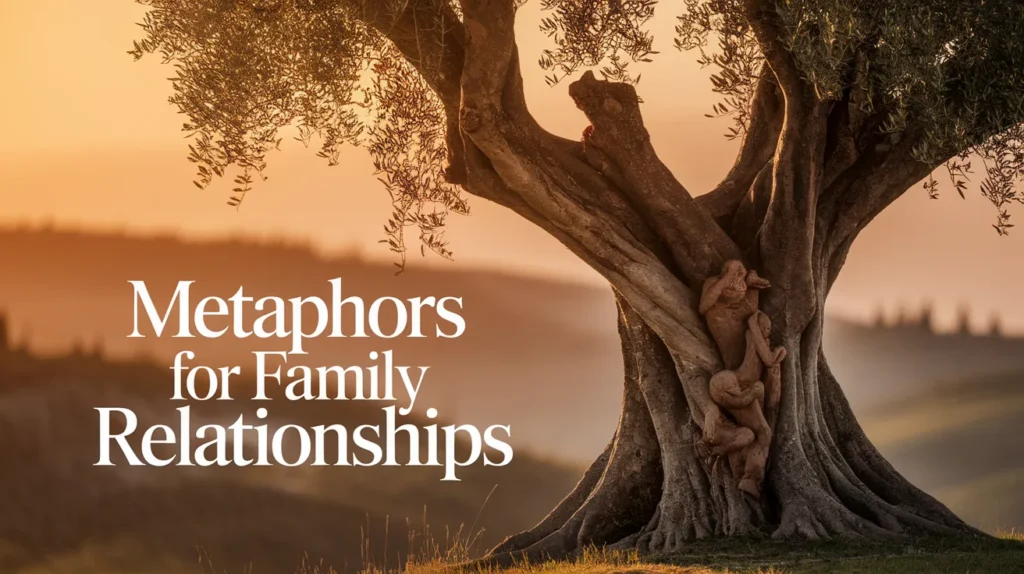
Family as a Tree: A Living System of Roots and Branches (Example 1)
One of the most common metaphors for family relationships is the family tree. It represents generations, growth, and shared roots.
Meaning and Explanation
In this metaphor, the roots represent ancestors and heritage. The trunk represents the present generation, and the branches represent children and future descendants. Each part depends on the other for strength and survival.
Example Sentence
“Our family is like a strong tree—its roots run deep in tradition, and its branches keep reaching toward new dreams.”
Alternative Expressions
- Family as a growing oak
- Family as rooted branches of life
- Family as a forest of generations
Sensory & Emotional Detail
Imagine the smell of wet earth after rain, the rough texture of bark under your hand, and the shade that protects you from harsh sunlight. That is what emotional security in a family feels like in this metaphor.
Mini Story
A grandmother once told her grandson while planting a sapling, “One day, this tree will be taller than you. But remember, it grows because roots like ours held the ground long before.” The boy later realized that every family argument or celebration was part of strengthening those unseen roots.
Lessons from the Family Tree Metaphor
This metaphor teaches us that family is not static—it grows, bends, and sometimes loses branches. Yet the core remains.
Interactive Exercise
Think about your own family:
- Who are the “roots” (elders, ancestors)?
- Who are the “branches” (younger generation)?
- What nourishes your family tree emotionally?
Write a short paragraph describing your family as a tree.
Family as a River: Constant Flow and Change (Example 2)
Another powerful metaphor for family relationships is the river.
Meaning and Explanation
A river represents movement, change, and emotional flow. Families are not fixed; they evolve over time. Members enter and leave, emotions rise and settle, and life continues downstream.
Example Sentence
“Our family is like a river—sometimes calm, sometimes wild, but always moving forward together.”
Alternative Expressions
- Family as flowing water
- Family as a winding stream of life
- Family as currents of connection
Sensory & Emotional Detail
Picture cool water touching stones, the sound of rushing currents after rain, or the calm reflection of the sky on a still surface. These sensations mirror emotional highs and lows within families.
Mini Story
A father and daughter once stood by a river after a long argument. He said, “We are like this water. It may hit rocks, but it still finds its way forward.” That moment softened the silence between them, not through apology—but understanding.
Emotional Currents in the River Metaphor
Families experience emotional tides—love, anger, forgiveness, and distance. Like water, emotions never stay still.
Interactive Exercise
Write down:
- A “calm water” moment in your family
- A “stormy river” memory
- A “bridge-building” moment of reconciliation
Reflect on how those moments shaped your relationships.
Family as a Tapestry: Woven Lives and Shared Threads (Example 3)
The tapestry metaphor describes family as interwoven threads forming a larger design.
Meaning and Explanation
Each person in a family is a thread. Alone, a thread is fragile, but together they create a strong, meaningful pattern. Even broken threads contribute to the design.
Example Sentence
“Our family is a tapestry—each thread unique, yet all woven into one story of love and struggle.”
Alternative Expressions
- Family as woven fabric of life
- Family as embroidered destiny
- Family as a quilt of memories
Sensory & Emotional Detail
Imagine soft fabric, colorful threads crossing each other, and the warmth of a handmade quilt on a cold night. This metaphor feels intimate and protective.
Mini Story
A young woman once discovered her grandmother’s unfinished embroidery. Instead of discarding it, she added her own stitches. She realized later that her family history was not complete without her contribution.
Weaving Bonds and Repairing Breaks
Unlike perfection, family tapestry metaphors accept flaws. Tears can be stitched. Colors may fade, but meaning remains.
Interactive Exercise
Draw a simple “family tapestry”:
- Assign each member a color or pattern
- Show how their lives intersect
- Highlight moments of connection or conflict
Childhood Memories That Shape Family Metaphors
Our earliest experiences shape how we see family. A warm home may feel like a “sunlit garden,” while conflict may feel like a “broken mirror.”
Metaphors often come naturally from memory. That is why they feel emotionally true even when they are not literal.
Cultural Perspectives on Family Metaphors
Different cultures use different symbols:
- In some cultures, family is a pillar system
- In others, it is a community circle
- Some see it as a fire that must be kept alive
These metaphors reflect values like unity, responsibility, and continuity.
How Writers Use Family Metaphors in Literature
Writers use metaphors for family relationships to deepen emotional storytelling. Novels, poetry, and films often rely on them to show rather than tell.
For example:
- A broken house = fractured family
- A fading photograph = lost connection
- A garden in winter = emotional distance
These images help readers feel the story instead of just reading it.
Interactive Creative Writing Prompts
Try writing your own metaphors:
- “My family is like ______ because ______.”
- “If my family were a place, it would be ______.”
- “Our bond feels like ______ during difficult times.”
Then expand each sentence into a short paragraph or story.
Bonus Tips for Using Family Metaphors in Writing and Daily Life
- Use simple, relatable imagery
- Avoid overcomplicating comparisons
- Match metaphor to emotion (calm, conflict, growth)
- Use nature-based imagery for emotional depth
- In conversations, metaphors can soften difficult discussions
On social media, metaphors can turn personal thoughts into poetic captions that resonate with others.
Common Mistakes When Using Metaphors for Family Relationships
Even powerful metaphors can lose impact if:
- They are too abstract or confusing
- They are overused without emotion
- They do not match the situation
- They become clichés without personal meaning
Refining metaphors means making them personal, vivid, and emotionally grounded.
FAQs
1. What are metaphors for family relationships?
They are symbolic comparisons that describe family bonds using imagery like trees, rivers, or tapestries.
2. Why are metaphors useful for describing family?
They help express complex emotions in simple, relatable ways that words alone may fail to capture.
3. Can I create my own family metaphors?
Yes, personal metaphors are often more powerful because they reflect your real experiences.
4. Are family metaphors used in literature?
Yes, many writers use them to symbolize emotional depth and generational connections.
5. How can metaphors improve communication in families?
They help people express feelings gently and creatively, reducing misunderstandings.
Conclusion
Family relationships are not just roles written on paper—they are living emotions shaped by time, memory, and connection. Metaphors for family relationships give us language for what we often feel but cannot easily explain. Whether it is a tree rooted in generations, a river flowing through change, or a tapestry woven from many lives, each metaphor reveals a different truth about belonging.
In the end, family is not one fixed image. It is a collection of images—growing, shifting, and evolving with us. And perhaps the most beautiful part is this: we are not just inside the metaphor. We are also the ones writing it.