
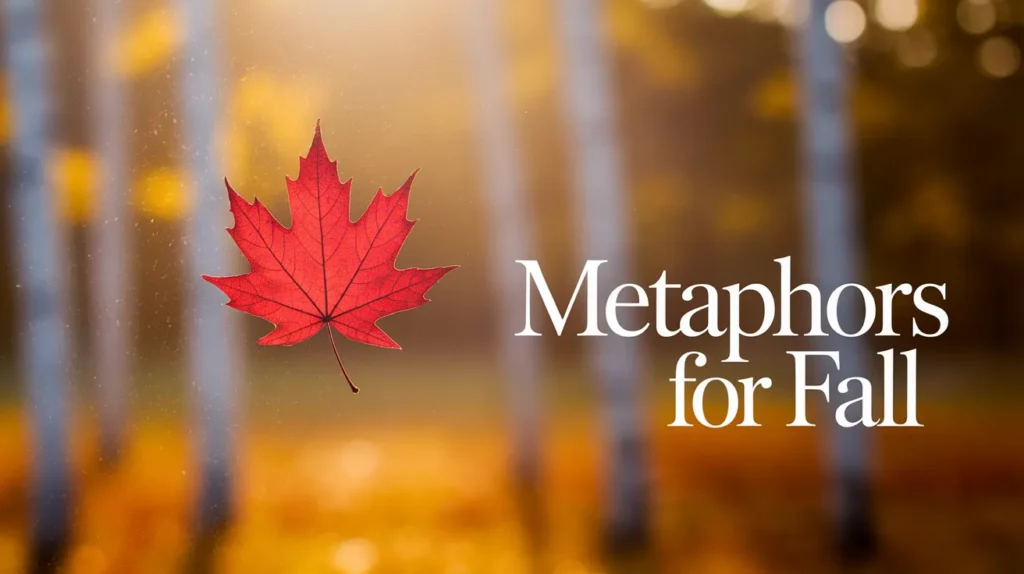
The first crisp breeze of autumn feels like a whisper from another world. Leaves loosen their grip on branches as if they’ve grown tired of holding on, drifting downward in slow, golden spirals. Streets become painted with amber, rust, and cinnamon tones, while the air carries the scent of woodsmoke and quiet endings. Fall does not arrive loudly—it arrives like a memory returning.
And in that gentle transformation, we begin to understand why language so often turns to metaphors when describing this season of change, beauty, and release. Metaphors for fall help us translate what we feel but cannot easily explain: the emotional weight of transition, the poetry of decay, and the strange comfort found in letting go.
Writers, poets, and everyday storytellers use fall as a symbol of maturity, reflection, and impermanence. This article explores vivid metaphors for fall, their meanings, and how you can use them creatively in writing, storytelling, or even daily reflection.
Fall as a Golden Goodbye: Metaphors for Autumn’s Farewell
One of the most common metaphors for fall is “a golden goodbye,” where the season becomes a graceful farewell to warmth and light.
Fall is not an abrupt ending—it is a soft closing of a chapter. The trees do not lose their leaves in sorrow, but in surrender, as if offering a final gift of color before rest.
Meaning & Explanation: This metaphor reflects the idea that endings can be beautiful rather than painful.
Example Sentence: “The park looked like a golden goodbye, each leaf drifting away like a handwritten farewell note.”
Alternative Expressions:
- A glowing farewell
- Nature’s gentle goodbye
- The earth’s warm departure
Sensory & Emotional Detail: Imagine sunlight filtering through amber leaves, each step on the ground sounding like a page turning. There is sadness, yes—but also peace.
Mini Storytelling Moment: An old man sits on a bench every October, watching the same maple tree shed its leaves. He calls it his “golden goodbye ritual,” remembering people he has lost and seasons he has lived through.
Fall as a Burning Canvas: Metaphors for Autumn Colors
Fall is often described as a “burning canvas,” where nature becomes an artist painting with fire instead of paint.
The reds, oranges, and yellows feel alive, as if the trees are holding a final celebration before winter silence.
Meaning & Explanation: This metaphor highlights the intensity and vibrancy of autumn colors.
Example Sentence: “The mountains became a burning canvas, alive with strokes of crimson and gold.”
Alternative Expressions:
- Nature’s masterpiece
- A flame-painted sky
- The forest’s artwork
Sensory & Emotional Detail: You can almost feel warmth radiating from the trees, even as the air turns cool.
Cultural Reference: In Japanese aesthetics, autumn foliage viewing (koyo) is deeply tied to appreciating fleeting beauty—much like admiring a painting that will soon fade.
Interactive Prompt: Describe your neighborhood in autumn using “burning canvas.” What colors dominate? What emotions appear?
Fall as a Whispering Forest: Metaphors for Autumn Silence
Fall is not only visual—it is deeply auditory. It can be imagined as a “whispering forest,” where every rustle carries a secret.
Meaning & Explanation: This metaphor represents the quietness and reflective mood of autumn.
Example Sentence: “The wind moved through the whispering forest like a story only the trees understood.”
Alternative Expressions:
- Nature’s hush
- The silent storyteller
- Wind-touched woods
Sensory & Emotional Detail: Leaves crunch underfoot, distant crows call out, and the wind sounds like pages turning in an invisible book.
Mini Storytelling Moment: A child walks through a park after school, imagining the leaves are whispering advice about growing up—about patience, change, and courage.
Bonus Writing Tip: Use this metaphor in journaling when describing quiet emotional moments or personal reflection.
Fall as a Slow Dance of Falling Leaves: Metaphors for Movement
Autumn can feel like a “slow dance of falling leaves,” where every leaf moves with intention and grace.
Meaning & Explanation: This metaphor emphasizes motion, rhythm, and natural elegance.
Example Sentence: “The trees performed a slow dance of falling leaves, twirling in silence before touching the earth.”
Alternative Expressions:
- Nature’s waltz
- The aerial ballet of autumn
- A drifting choreography
Sensory & Emotional Detail: Leaves spin, glide, and pause mid-air, as if time itself slows down to watch.
Mini Storytelling Moment: A couple walking through a park in October finds themselves slowing down without realizing it—matching the rhythm of falling leaves around them.
Interactive Exercise: Try describing your own walk using dance-related metaphors. What kind of movement does the season inspire?
Fall as a Library of Memories: Metaphors for Reflection
Fall often feels like a “library of memories,” where each leaf represents a page of lived experience.
Meaning & Explanation: This metaphor connects autumn to nostalgia and reflection.
Example Sentence: “Walking through autumn streets felt like wandering through a library of memories I never checked out.”
Alternative Expressions:
- Archive of seasons
- Shelves of nostalgia
- Chapters of change
Sensory & Emotional Detail: The scent of old paper, the crunch of leaves like turning pages, and the stillness of remembering.
Literary Reference: Writers like Robert Frost often used seasonal imagery to explore memory, choice, and reflection.
Bonus Tip for Writers: Use fall imagery when writing flashbacks or emotional storytelling scenes.
Fall as a Fading Flame: Metaphors for Transition
Autumn can also be seen as a “fading flame,” slowly dimming as winter approaches.
Meaning & Explanation: This metaphor emphasizes transition and impermanence.
Example Sentence: “The warm afternoons of September felt like a fading flame against the coming cold.”
Alternative Expressions:
- Cooling ember
- Dimming light
- Soft extinguishing glow
Sensory & Emotional Detail: Warm sunlight weakens, evenings arrive sooner, and shadows stretch longer.
Interactive Prompt: Think of a personal change in your life. How would you describe it as a fading flame?
Fall as Earth’s Final Celebration: Metaphors for Abundance
Despite its associations with endings, fall can also be seen as a “final celebration” of abundance.
Meaning & Explanation: This metaphor reflects harvest, gratitude, and completion.
Example Sentence: “The fields stood like Earth’s final celebration, overflowing with harvest gold.”
Alternative Expressions:
- Harvest festival of nature
- Season of abundance
- Nature’s farewell feast
Sensory & Emotional Detail: Apples, pumpkins, wheat fields, and markets filled with warm colors and earthy scents.
Mini Storytelling Moment: Farmers gather at the end of the season, not with sadness, but gratitude for what the land has given.
Fall as a Painter’s Palette Spilled Across the Sky: Metaphors for Color
This metaphor turns the entire sky and landscape into a creative accident of beauty.
Meaning & Explanation: It emphasizes spontaneity and artistic richness.
Example Sentence: “Autumn arrived like a painter’s palette spilled across the sky.”
Alternative Expressions:
- Sky of scattered colors
- Nature’s accidental masterpiece
- Horizon of pigments
Sensory & Emotional Detail: Sunsets deepen into fiery gradients that feel almost unreal.
Interactive Exercise: Write a short paragraph describing sunset using only art-related metaphors.
Fall as a Soft Closing Curtain: Metaphors for Endings
The season can also be imagined as a “soft closing curtain” in a theater.
Meaning & Explanation: This metaphor highlights closure and transition.
Example Sentence: “Autumn felt like a soft closing curtain after summer’s bright performance.”
Alternative Expressions:
- The final act
- The dimming stage
- Nature’s closing scene
Sensory & Emotional Detail: The world quiets, lights soften, and the energy of summer fades into rest.
Fall as a Time-Soaked Photograph: Metaphors for Nostalgia
Autumn often feels like a “time-soaked photograph,” slightly faded but deeply emotional.
Meaning & Explanation: It represents memory and emotional depth.
Example Sentence: “The town looked like a time-soaked photograph under the autumn mist.”
Alternative Expressions:
- Sepia-toned season
- Faded memory frame
- Nostalgic snapshot
Bonus Writing Tip: Use this metaphor for describing childhood memories or old places.
Fall as Nature’s Deep Breath: Metaphors for Pause and Rest
Fall can be seen as “nature’s deep breath,” preparing for winter silence.
Meaning & Explanation: It represents rest and renewal before transformation.
Example Sentence: “Autumn felt like nature taking a deep breath before the long sleep of winter.”
Alternative Expressions:
- Seasonal pause
- Earth’s exhale
- Quiet intermission
Sensory Detail: The air feels still, almost meditative, as if the world is resting its shoulders.
Fall as a River of Gold: Metaphors for Flow and Change
This metaphor imagines fallen leaves as a flowing river of gold.
Meaning & Explanation: It emphasizes movement and transformation.
Example Sentence: “The streets turned into a river of gold as leaves gathered along the sidewalks.”
Alternative Expressions:
- Golden stream of change
- Flowing amber path
- Liquid autumn light
Fall as a Classroom of Seasons: Metaphors for Learning
Autumn can also be viewed as a “classroom of seasons,” teaching lessons about change.
Meaning & Explanation: It symbolizes growth and wisdom.
Example Sentence: “Every autumn feels like a classroom of seasons, teaching me how to let go gracefully.”
Interactive Prompt: What has fall taught you personally? Write a short reflection using school-related metaphors.
Fall as a Song of Wind and Leaves: Metaphors for Sound
The season can be heard like a “song of wind and leaves.”
Meaning & Explanation: It emphasizes natural harmony and rhythm.
Example Sentence: “The park played a soft song of wind and leaves, each gust a new verse.”
Fall as a Bridge Between Light and Shadow: Metaphors for Transition
Fall connects summer’s brightness with winter’s darkness.
Meaning & Explanation: It symbolizes balance and transformation.
Example Sentence: “Autumn stood like a bridge between light and shadow, carrying the world from warmth to silence.”
Fall as a Story Half-Told: Metaphors for Incompleteness
Finally, fall can be seen as “a story half-told,” leaving space for imagination.
Meaning & Explanation: It represents openness and continuation.
Example Sentence: “Autumn felt like a story half-told, waiting for winter to write the next chapter.”
FAQs
What are metaphors for fall?
They are figurative expressions that describe autumn using imaginative comparisons like colors, emotions, and natural imagery.
Why are fall metaphors important in writing?
They help create emotional depth, vivid imagery, and a stronger connection between reader and text.
Can I use fall metaphors in everyday speech?
Yes, they can enrich conversations, journaling, storytelling, and social media captions.
What is the most common fall metaphor?
“Golden leaves” or “golden goodbye” are among the most widely used metaphors.
How can I create my own fall metaphors?
Observe the season closely—colors, sounds, feelings—and compare them to emotions, objects, or experiences.
Conclusion
Fall is more than a season—it is a language of transformation written in color, silence, and movement. Through metaphors, we translate its fleeting beauty into meaning we can hold onto. Whether it becomes a burning canvas, a whispering forest, or a golden goodbye, autumn teaches us that change is not something to fear but something to witness with awe.
By using these metaphors in writing or reflection, you can capture not just what fall looks like, but what it feels like to live through it.