
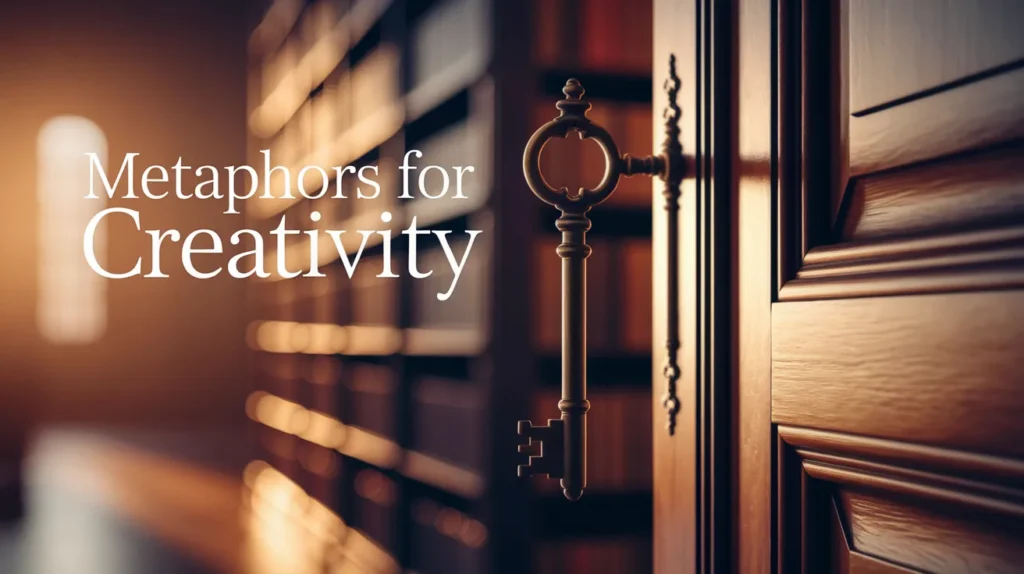
The room is quiet, but not empty. A pencil rolls slightly across the desk, as if nudged by an invisible idea trying to escape. Outside the window, rain taps gently on glass like impatient fingers rehearsing a rhythm no one has yet written down. Somewhere between thought and feeling, something begins to form—not a sentence yet, not a picture, but a possibility. That is creativity before it becomes visible.
Creativity often refuses to arrive in straight lines. It comes as a spark, a storm, a garden, a river—never quite what we expect, always more alive than we can explain directly. That is why metaphors for creativity matter. They give shape to the invisible. They turn abstract imagination into something we can see, touch, and understand.
In simple terms, a metaphor compares creativity to something else to reveal its nature more vividly. Instead of saying “creativity is complex,” we might say “creativity is a wild garden,” instantly bringing color, movement, and unpredictability into the idea. Metaphors are not just decorative language—they are thinking tools.
They help writers, artists, students, and even problem-solvers understand how creativity flows, where it gets blocked, and how it can be nurtured. When we change the metaphor, we often change the mind. Let’s explore the most powerful metaphors for creativity, and discover how they can reshape the way you think, write, and imagine.
Understanding Metaphors for Creativity and Imagination
Metaphors for creativity are symbolic comparisons that describe creative thinking in relatable, often sensory-rich ways. Instead of defining creativity in technical terms, they translate it into experiences we already understand.
For example, creativity can be seen as light breaking through clouds, or a seed pushing through soil. These images help us feel what creativity is doing, not just define it.
This matters because creativity is not just for artists—it is used in problem-solving, communication, innovation, and even daily decision-making. Metaphors give us mental shortcuts to understand how ideas form, evolve, and sometimes disappear.
When we think of creativity metaphorically, we stop treating it like a mystery and start seeing it as a process we can interact with.
Creativity as a Garden of Endless Ideas
One of the most powerful metaphors for creativity is the garden. In this image, ideas are seeds, and the mind is the soil.
A garden does not produce flowers instantly. It requires patience, watering, sunlight, and time. Similarly, creative ideas need nurturing, reflection, and space to grow.
Meaning & Explanation: Creativity is not immediate perfection—it is cultivation. Some ideas bloom quickly, others take seasons.
Example Sentence: “My imagination is a garden; if I neglect it, everything withers into silence.”
Alternative Expressions:
- Creativity as fertile soil
- Ideas as growing plants
- Imagination as cultivation
Sensory Detail: You can almost smell the damp earth of early ideas, feel the soft resistance of soil being turned, and see small shoots of thought pushing upward.
Mini Story: A young writer once felt stuck for months. Instead of forcing ideas, she began writing one sentence a day, like planting a seed each morning. Weeks later, those sentences grew into a short story collection. She realized creativity had been growing quietly all along—just like a garden after rain.
Creativity as a Flowing River of Thought
Another vivid metaphor is creativity as a river—constantly moving, reshaping itself, carving new paths.
Meaning & Explanation: Ideas flow naturally when not blocked. Creativity is dynamic, not static. It depends on movement, not perfection.
Example Sentence: “When I stop overthinking, my creativity becomes a river again, smooth and unstoppable.”
Alternative Expressions:
- Flow of ideas
- Stream of imagination
- Current of thought
Sensory Detail: Imagine cool water rushing over smooth stones, the sound of movement never repeating exactly the same way twice.
Mini Story: A musician once described his best compositions as moments when he “stopped swimming against the current.” Instead of forcing notes, he followed them—like drifting downstream with music already waiting to be heard.
This metaphor teaches us that sometimes creativity is not about control, but surrender.
Creativity as a Fire That Must Be Fed
Fire is one of the oldest metaphors for creativity. It represents energy, passion, and transformation.
Meaning & Explanation: Creative energy can ignite suddenly, but it needs fuel—practice, curiosity, and inspiration—to continue burning.
Example Sentence: “Her curiosity was a fire that turned every question into light.”
Alternative Expressions:
- Spark of imagination
- Flame of inspiration
- Burning ideas
Sensory Detail: The crackle of burning wood, the warmth spreading through cold fingers, the glow lighting up a dark room of doubt.
Mini Story: A painter once said his creativity started as a small spark during childhood sketches. But during difficult years, the fire dimmed. It was only when he began exploring new experiences—travel, books, conversations—that the fire returned stronger than before.
Fire reminds us that creativity is alive, and like all living things, it needs care.
Why Metaphors Help Unlock Creative Thinking
Metaphors are more than poetic language—they are cognitive tools that help us think differently.
When we describe creativity as a garden, river, or fire, we are not just decorating language; we are reshaping perception. A “blocked idea” becomes a “dam in a river.” Suddenly, the solution is not frustration—it is removal of the blockage.
Metaphors allow flexibility in thinking. They encourage problem-solving by changing perspective. Instead of asking “Why am I stuck?” we might ask “Where is the flow interrupted?”
This shift often leads to insight.
Creativity in Literature: How Writers Use Metaphors
Writers have always relied on metaphors to describe creativity itself. From Shakespeare to modern poets, imagination is often depicted as light, music, storms, or dreams.
For example, in Romantic poetry, creativity is often portrayed as a divine wind guiding the artist. In modern literature, it is sometimes seen as fragmented—like broken mirrors reflecting reality.
These metaphors shape not only how we read but how we create. When writers think of ideas as “visitors,” they become more open to unexpected inspiration.
Metaphors in literature remind us that creativity is both personal and universal.
Creativity in Art, Music, and Cultural Expression
Across cultures, creativity is expressed through symbolic imagery.
In visual art, creativity is often shown as chaos turning into order—brushstrokes forming meaning from randomness. In music, it is rhythm flowing from silence. In dance, it becomes movement escaping stillness.
Different cultures also offer unique metaphors:
- In some traditions, creativity is seen as divine breath.
- In others, it is a thread weaving stories together.
- In modern digital culture, it is often described as “content streams” or “idea ecosystems.”
These metaphors reflect how deeply creativity is tied to human expression.
Psychological Benefits of Thinking in Creative Metaphors
Psychologically, metaphors help reduce mental pressure. When creativity feels like a “flowing river” instead of a “task,” the mind relaxes.
They also help reduce fear of failure. If creativity is a garden, then mistakes are just weeds—not disasters. If creativity is fire, then low energy simply means needing more fuel, not personal inadequacy.
This reframing encourages resilience. It makes creative work feel more natural and less judgmental.
Metaphors also activate imagination in the brain, helping people think more flexibly and intuitively.
Breaking Creative Blocks with Metaphorical Thinking
Creative blocks often feel like walls—but what if they are something else?
A wall suggests permanence. But a metaphor like “fog” suggests something that will clear. A “dam” suggests something that can be opened. A “locked door” suggests a key exists.
By changing the metaphor, we change our emotional response.
When feeling stuck, try asking:
- Is my creativity blocked, or just resting?
- Is this a wall, or a temporary fog?
- What would help the river start flowing again?
This simple shift often creates surprising breakthroughs.
Creativity in Modern Life, Social Media, and Daily Expression
In today’s digital world, creativity moves faster than ever. Social media platforms are often described as “streams,” “feeds,” or “ecosystems,” all metaphorical ways of understanding creative flow.
Content creators often think of ideas as “drops” in an ocean of information, or “sparks” that catch attention quickly.
Bonus Tips for Everyday Use:
- In writing, use metaphors to make ideas memorable.
- On social media, compare emotions or experiences to natural imagery for stronger engagement.
- In daily conversation, metaphors help explain complex feelings simply.
Even saying “I feel like I’m running on empty” communicates exhaustion more vividly than “I am tired.”
Metaphors make communication human.
Interactive Exercises: Practicing Metaphors for Creativity
Try these simple exercises to train your metaphorical thinking:
- Object Transformation Exercise Pick any object near you. Describe your creativity as that object. If it is a lamp, how does your creativity “turn on”? If it is a clock, how does it “measure ideas”?
- Emotion Mapping Exercise Choose a feeling—like excitement or confusion—and create a metaphor for how it affects your creativity.
- Rewrite the Block Think of a creative problem you are facing. Rewrite it using three different metaphors (river, fire, garden). Notice how each version changes your perspective.
These exercises help you build flexibility in thinking and deepen your creative awareness.
Common Mistakes When Using Creative Metaphors
One common mistake is using metaphors that are too abstract or overused, making them lose impact. Saying “creativity is light” is meaningful, but without expansion, it becomes vague.
Another mistake is sticking to one metaphor too rigidly. Creativity is multi-dimensional—it can be both fire and water depending on context.
Finally, avoid forcing metaphors. The best ones feel natural, not artificial.
Strong metaphors grow from observation, not decoration.
Real-Life Stories of Creativity and Metaphorical Thinking
Many artists, writers, and innovators describe creativity in metaphorical ways.
A designer once said his ideas came like “birds landing unexpectedly on an empty wire.” A teacher described student creativity as “unlocking different rooms in a house they didn’t know they owned.”
These metaphors are not just poetic—they reveal how people experience creativity internally.
In real life, thinking metaphorically often leads to innovation. Engineers compare systems to ecosystems, and scientists describe data as landscapes. These comparisons help solve complex problems by making them relatable.
FAQs
1. What are metaphors for creativity?
They are symbolic comparisons that describe creative thinking in imaginative ways, such as calling creativity a river, garden, or fire.
2. Why are metaphors important for creativity?
They help people understand abstract ideas more clearly and unlock new ways of thinking.
3. Can metaphors improve writing skills?
Yes, they make writing more vivid, engaging, and emotionally powerful.
4. How do I create my own metaphors?
Observe everyday objects or experiences and compare them to emotions or ideas in creative ways.
5. Are metaphors useful outside writing?
Absolutely—they help in problem-solving, communication, learning, and even emotional understanding.
Conclusion
Creativity is not a fixed idea—it is a living experience that shifts shape depending on how we see it. Through metaphors, we give it texture, movement, and meaning. Sometimes it is a garden waiting for care. Sometimes it is a river needing no permission to flow. Sometimes it is fire asking only for fuel. Each metaphor reveals a different truth about how ideas live inside us.
When we learn to think in metaphors, we do not just describe creativity—we begin to experience it more fully. And in that shift, imagination stops being something distant and becomes something we are already part of.