
Introduction: When Words Become Windows into Meaning
On a quiet Sunday morning, sunlight filters through stained glass, scattering colors like broken rainbows across wooden pews. The air carries a blend of old hymn pages, polished wood, and soft whispers of greeting. Somewhere between the first note of music and the final “Amen,” something unspoken happens—people begin to feel connected, not just to a place, but to something larger than themselves.
This is where metaphors for church become powerful. A church is not only a building; it is an idea, a living experience, and a spiritual ecosystem. Metaphors help us understand it in ways logic alone cannot. They translate faith into images we can see, feel, and remember.
In literature, theology, and everyday speech, metaphors for church reveal its purpose: unity, healing, growth, belonging, and hope. This article explores those metaphors in depth, offering creative insights, examples, and exercises to help you use them in writing, reflection, or conversation.
What Are Metaphors for Church and Why They Matter
Metaphors for church are symbolic comparisons that describe the church using familiar images—like a body, a family, a garden, or a lighthouse. Instead of defining the church in abstract theological terms, metaphors make it relatable and emotionally vivid.
They matter because:
- They make spiritual ideas easier to understand
- They help writers and speakers communicate faith creatively
- They connect personal experience with shared belief
- They add emotional depth to religious expression
For example, saying “the church is a hospital” instantly shifts how we think about it—from a place of perfection to a place of healing.
Metaphors don’t replace truth; they illuminate it.
The Church as a Living Body Metaphor (Deep Dive Example 1)
One of the most powerful metaphors in Christian thought is the church as a body.
Meaning & Explanation
This metaphor suggests that every member of the church has a unique role—like organs in a body. No part is unnecessary. Unity is essential, but diversity is strength.
Example Sentence or Scenario
In a church community, one person may teach, another may comfort, and another may serve quietly behind the scenes. Together, they form a functioning whole—just like a body working in harmony.
Alternative Expressions
- A spiritual organism
- A connected body of believers
- A unified structure of living parts
Sensory & Emotional Detail
Imagine hands lifting in worship, voices blending like breath in a single living creature, hearts beating in rhythm through shared faith.
Mini Story
In an old village church, a young musician once stopped playing, thinking his part didn’t matter. But when the music faded, the congregation felt the gap immediately. Only then did he realize: even one missing note changes the entire song.
Interactive Exercise
Write about your community or classroom as a “body.” What role would each person play? How would harmony be achieved?
The Church as a Lighthouse in Darkness
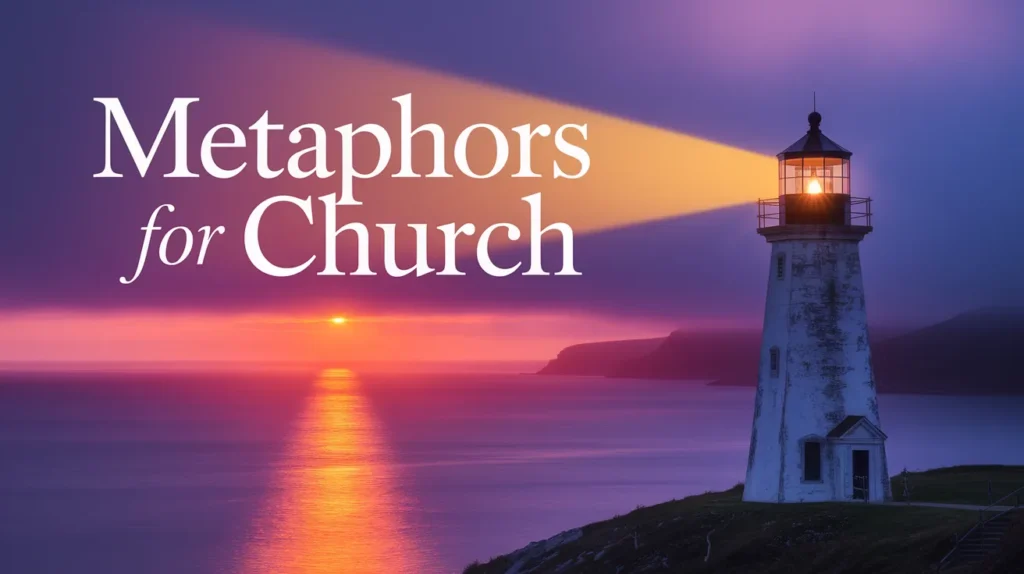
A lighthouse stands firm against crashing waves, guiding ships safely to shore. This is a strong image for the church.
It represents guidance, hope, and direction in confusing times.
When life feels like a stormy sea, the church is often seen as a steady beam of light—pointing toward safety and meaning.
Example: A person going through grief may find clarity and comfort in community gatherings, like a ship finding direction after being lost.
Alternative expressions:
- Beacon of hope
- Spiritual lighthouse
- Guiding flame in darkness
Sensory detail: The glow cutting through fog, waves breaking below, wind howling while the light remains steady.
The Church as a Family Table Gathering (Deep Dive Example 2)
Few metaphors feel as warm as the church as a family table.
Meaning & Explanation
This metaphor emphasizes belonging, hospitality, and shared life. A church is not a performance stage; it is a table where everyone is invited.
Example Sentence or Scenario
At the church gathering, people from different backgrounds sit together, share meals, stories, laughter, and silence—like one extended family.
Alternative Expressions
- A spiritual household
- A shared table of grace
- A circle of belonging
Sensory & Emotional Detail
The smell of warm bread, the sound of clinking cups, gentle laughter echoing through a room filled with acceptance.
Mini Story
A newcomer once entered a church feeling invisible. Someone quietly placed a chair next to them and said, “Sit with us.” That simple act turned strangers into family in a single moment.
Interactive Exercise
Draw or describe your “ideal church table.” Who sits there? What is being shared besides food?
The Church as a Garden of Growth
A garden is not instant—it grows slowly, season by season. Similarly, the church is a place of spiritual growth.
Seeds represent people, teachings represent water, and time represents sunlight.
Some grow quickly; others take years to bloom. But all are part of the same soil.
Example: A child learning kindness in a church setting slowly develops into a compassionate adult.
Alternative expressions:
- A spiritual orchard
- A field of growth
- A blooming community
Sensory detail: Earthy soil, morning dew, soft green shoots breaking through ground.
The Church as a Hospital for the Broken
This metaphor highlights healing and restoration.
People come to church not because they are perfect, but because they need healing—emotionally, spiritually, or mentally.
Example: Someone struggling with guilt or loss finds support, counseling, and prayer.
Alternative expressions:
- A healing center
- A refuge for wounded hearts
- A restoration house
Sensory detail: Quiet rooms, soft conversations, the relief of being heard without judgment.
The Church as a Building of Living Stones
Here, the church is not made of bricks but of people.
Each person is a “stone,” forming a structure together. No stone stands alone; all are connected.
This metaphor emphasizes unity and purpose.
The Church as a Vine and Branches Connection
This metaphor shows dependency and life flow.
Branches cannot survive without the vine; likewise, believers draw strength from spiritual connection.
It reflects nourishment, dependence, and shared life energy.
The Church as a Journey or Pilgrimage Path
Life is often described as a journey, and the church becomes a traveling companion.
People walk together through challenges, milestones, and discoveries.
It is not about arriving instantly—it is about moving forward together.
The Church as a Symphony of Voices
A symphony blends different instruments into one harmonious sound.
Similarly, the church includes diverse voices, backgrounds, and experiences.
When unified, differences create beauty instead of conflict.
The Church as a Shelter in the Storm
In difficult times, the church acts like a shelter.
It protects, comforts, and stabilizes.
People find emotional safety during life’s storms of grief, fear, and uncertainty.
The Church as a Flame or Light Bearer
Fire represents passion, truth, and transformation.
The church carries light into darkness, spreading hope and awareness.
It is not meant to be hidden but shared.
The Church as a School of Wisdom and Learning
Church is also a place of teaching.
It nurtures moral understanding, spiritual wisdom, and life guidance.
Like a school, it shapes thought and behavior over time.
Creative Writing Exercises Using Church Metaphors
Try these creative prompts:
- Write a paragraph describing your life as part of a “church garden.” What are you growing?
- Describe a difficult moment using the “storm and shelter” metaphor.
- Rewrite a memory as if the church were a “symphony.” What instruments represent people you know?
Bonus challenge: Combine two metaphors in one story (e.g., garden + lighthouse).
Bonus Tips for Using Church Metaphors in Writing and Daily Life
- Use metaphors to simplify complex ideas in sermons or essays
- Combine sensory details (sound, light, texture) for emotional impact
- Avoid overusing one metaphor—variety keeps writing fresh
- Match metaphor to message (healing → hospital, unity → body)
- Use metaphors in social media captions for deeper meaning
FAQs
1. What are common metaphors for church?
Common metaphors include body, family, lighthouse, garden, hospital, and journey.
2. Why are metaphors used to describe the church?
They help simplify spiritual ideas and make them emotionally relatable.
3. Can I create my own metaphors for church?
Yes, personal metaphors often feel more meaningful and creative.
4. Are metaphors only religious?
No, metaphors are used in literature, education, and daily communication too.
5. What is the most powerful church metaphor?
It depends on context, but “body of Christ” and “light in darkness” are widely used.
Conclusion
Metaphors for church are more than poetic expressions—they are bridges between the visible and the invisible. They help us understand belonging, healing, unity, and purpose in ways that speak to both heart and mind.
Whether it is a garden growing slowly, a lighthouse cutting through fog, or a family gathered around a table, each metaphor reveals a different face of the same idea: community shaped by faith and connection.
When you begin to see the church through metaphors, you begin to see people, stories, and experiences with deeper clarity. And in that clarity, meaning becomes not just something understood—but something felt.