
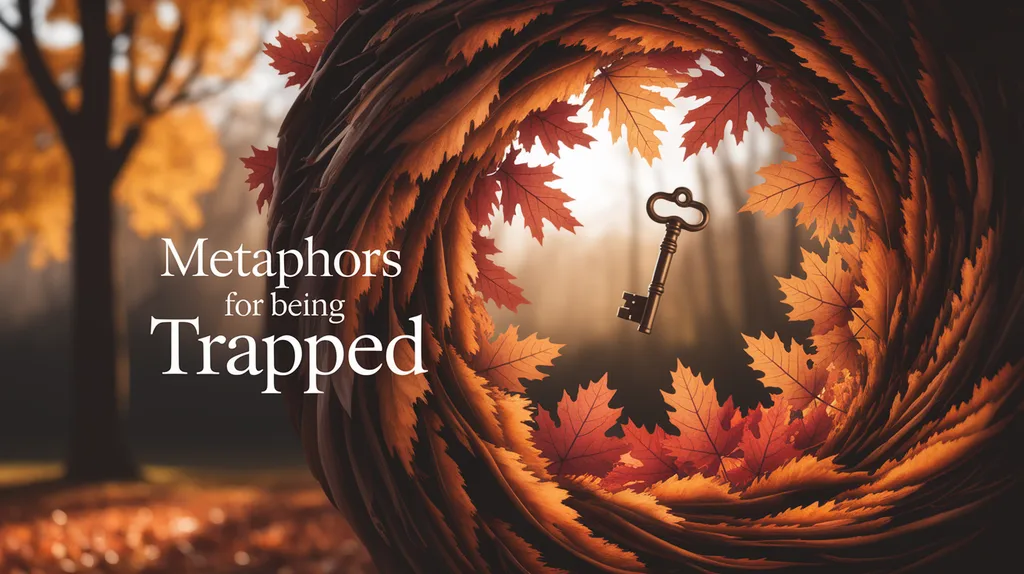
It starts quietly. A tightening in your chest, like invisible hands pressing inward. The room hasn’t changed, yet the walls seem closer. The door is open, but something inside you refuses to move. You’re not physically bound—yet you feel caught, held, contained. This is the strange, powerful experience of being trapped—not always by walls or cages, but by emotions, thoughts, expectations, or circumstances.
Metaphors for being trapped help give language to these invisible prisons. They transform abstract feelings into vivid imagery, making them easier to understand, express, and even overcome. Whether you’re a writer, a student, or simply someone trying to articulate a complex emotion, these metaphors act as bridges between feeling and expression.
In this article, you’ll explore rich, evocative metaphors for being trapped, along with examples, meanings, creative alternatives, and practical exercises to help you use them in writing, storytelling, and everyday communication.
The Power of Metaphors for Feeling Trapped
Metaphors allow us to step outside literal language and into emotional landscapes. When you say, “I feel stuck,” it communicates something—but when you say, “I feel like a bird beating its wings against a glass cage,” it reveals something deeper.
These expressions:
- Add emotional depth and clarity
- Make writing more engaging and relatable
- Help process internal struggles
- Create memorable imagery in storytelling
In essence, metaphors don’t just describe being trapped—they make others feel it.
Why We Use Metaphors to Describe Being Stuck
Human emotions are often too complex for plain language. Being trapped can involve fear, frustration, confusion, or even numbness. Metaphors translate these layered feelings into something tangible.
For example:
- A maze suggests confusion and endless searching
- A cage suggests restriction and helplessness
- A quicksand pit suggests gradual, inescapable sinking
Each metaphor carries its own emotional flavor, helping you choose the right tone for your message.
Metaphors for Being Trapped in Daily Life
We encounter metaphorical “traps” everywhere:
- A job that feels suffocating
- A relationship that limits growth
- A routine that drains energy
- A mindset that blocks progress
Using metaphors in these contexts can help you better explain your experience to others—or even to yourself.
Example:
- “I feel like I’m running on a treadmill that never stops.”
A Bird in a Cage: Classic Metaphor for Being Confined
Meaning & Explanation: This metaphor represents restriction despite the presence of potential. The bird symbolizes freedom and flight, while the cage represents limitation.
Example Sentence: “I felt like a bird in a cage, watching the sky but never touching it.”
Alternative Expressions:
- A songbird behind bars
- Wings clipped before flight
- A sky within sight but out of reach
Sensory/Emotional Detail: The fluttering wings, the metallic clang of bars, the longing gaze toward open skies.
Mini Storytelling: Think of a talented artist stuck in a rigid office job—creative wings folded, dreams echoing in silence.
Lost in a Maze: A Metaphor for Confusion and Entrapment
Meaning & Explanation: A maze suggests being trapped in complexity—no clear path forward, constant dead ends.
Example Sentence: “My thoughts felt like a maze with no exit.”
Alternative Expressions:
- A labyrinth of uncertainty
- Endless corridors of doubt
- A puzzle without a solution
Sensory Detail: Twisting paths, echoing footsteps, rising panic as every turn leads nowhere.
Real-Life Example: Students facing career decisions often feel this way—overwhelmed by choices yet unsure of direction.
Caught in Quicksand: Slowly Sinking Without Escape
Meaning & Explanation: This metaphor conveys a gradual, helpless descent into difficulty.
Example Sentence: “The more I tried to fix things, the deeper I sank, like quicksand pulling me down.”
Alternative Expressions:
- Drowning in slow motion
- Sinking into invisible mud
- Pulled under by unseen forces
Emotional Detail: Panic rising, movement becoming harder, the terrifying stillness required to survive.
Trapped Behind Glass: Visible Yet Untouchable
Meaning & Explanation: This metaphor highlights emotional isolation—being seen but not truly understood.
Example Sentence: “I felt like I was screaming behind glass—visible, but unheard.”
Alternative Expressions:
- A voice trapped in silence
- A shadow behind a window
- A life on display, not lived
Cultural Reference: This feeling often appears in modern social media culture—where people seem connected but feel deeply alone.
Chains That Cannot Be Seen: Emotional and Mental Traps
Meaning & Explanation: Invisible chains represent internal barriers—fear, doubt, guilt, or societal expectations.
Example Sentence: “I was bound by chains no one else could see.”
Alternative Expressions:
- Shackled by thoughts
- Tied down by invisible ropes
- Locked by unseen forces
Mini Story: Someone afraid to pursue their dream due to fear of failure may live their whole life in these unseen chains.
A Room Without Doors: Absolute Confinement
Meaning & Explanation: This metaphor represents total lack of options or escape.
Example Sentence: “It felt like being locked in a room with no doors or windows.”
Alternative Expressions:
- A sealed box
- A prison without exits
- A world without openings
Sensory Detail: Still air, silent walls, the weight of immobility pressing in.
The Spider’s Web: Subtle and Sticky Entrapment
Meaning & Explanation: A spider’s web represents a trap that is delicate yet incredibly hard to escape.
Example Sentence: “I didn’t notice it at first, but I was caught in a web I couldn’t break.”
Alternative Expressions:
- Tangled in threads
- Stuck in invisible glue
- Bound by fragile strands
Real-Life Example: Toxic relationships often feel like this—hard to leave despite appearing fragile from the outside.
A Puppet on Strings: Loss of Control
Meaning & Explanation: This metaphor reflects being controlled by external forces.
Example Sentence: “I felt like a puppet, my strings pulled by everyone but me.”
Alternative Expressions:
- A marionette without will
- Dancing to someone else’s tune
- Controlled like a remote toy
Emotional Tone: Frustration, helplessness, and loss of identity.
The Locked Door Within: Internal Barriers
Meaning & Explanation: Sometimes the trap is within us—fear, trauma, or self-doubt.
Example Sentence: “The door was there, but I couldn’t bring myself to open it.”
Alternative Expressions:
- A key I refuse to use
- A gate guarded by fear
- A lock forged by doubt
Drowning Without Water: Silent Struggles
Meaning & Explanation: This metaphor captures overwhelming emotions without visible cause.
Example Sentence: “I was drowning, even though everything looked fine.”
Alternative Expressions:
- Suffocating in air
- Overwhelmed by nothingness
- Lost in invisible waves
Three Powerful Metaphor Techniques to Use
1. Combine Nature and Emotion
Meaning: Nature-based imagery makes metaphors vivid and relatable.
Example: “I felt like a storm trapped in a bottle.”
Alternatives:
- A volcano sealed shut
- A river blocked by stone
Tip: Use elements like storms, oceans, or forests to deepen emotional impact.
2. Use Physical Spaces to Represent Feelings
Meaning: Rooms, cages, and walls symbolize mental states.
Example: “My mind was a locked room.”
Alternatives:
- A hallway with no end
- A shrinking box
3. Add Movement (or Lack of It)
Meaning: Movement enhances the feeling of being trapped—or unable to move.
Example: “I was running but going nowhere.”
Alternatives:
- Frozen in place
- Stuck in slow motion
Mini Storytelling: Bringing Metaphors to Life
Metaphors become more powerful when placed in a narrative.
Example: “She stood at the edge of her life, feeling like a bird in a cage with the door open—but her wings had forgotten how to fly.”
This blends metaphor with emotional storytelling, making it memorable and impactful.
Interactive Exercise: Create Your Own Metaphor
Try this simple activity:
Prompt 1: Think of a time you felt stuck. Complete: “I felt like __________ because __________.”
Prompt 2: Turn your feeling into an image:
- Is it a place?
- An object?
- A natural force?
Prompt 3: Add sensory detail:
- What do you see, hear, or feel?
Practice Prompts for Writers and Creators
- Describe a character trapped in their own thoughts
- Write a short paragraph using “glass” as a metaphor
- Compare emotional pain to a physical environment
Bonus Tips for Using Metaphors Effectively
- Keep them relatable and clear
- Avoid overcomplicating imagery
- Match tone with context
- Use sparingly for stronger impact
Using Metaphors in Social Media and Daily Life
Metaphors aren’t just for writing—they work beautifully in:
- Instagram captions
- Personal journaling
- Speeches and conversations
Example: “Some days feel like quicksand—best thing to do is stop struggling and breathe.”
Common Mistakes When Using Metaphors for Being Trapped
- Mixing too many metaphors
- Using clichés without variation
- Making them too abstract
- Ignoring emotional tone
Expanding Your Creative Expression Through Metaphors
Practice regularly. Observe your emotions. Translate them into images. Over time, your metaphors will become more natural, unique, and powerful.
FAQs
1. What is a metaphor for being trapped?
A metaphor for being trapped is a figurative expression that compares the feeling of confinement to something vivid, like a cage, maze, or quicksand.
2. Why are metaphors useful in expressing emotions?
They make complex feelings easier to understand and more engaging for readers or listeners.
3. Can metaphors help in mental health expression?
Yes, they can help people articulate emotions they struggle to explain directly.
4. How do I create my own metaphor?
Start with a feeling, then compare it to a physical object, place, or experience that reflects it.
5. Are clichés bad in metaphors?
Not always—but adding a unique twist makes them more impactful.
Conclusion
Feeling trapped is a universal experience—but staying silent about it doesn’t have to be. Metaphors give shape to the invisible, turning emotions into images that can be shared, understood, and even released.
Whether you feel like a bird in a cage, lost in a maze, or sinking in quicksand, remember: the act of expressing that feeling is already a step toward freedom. Words, after all, can open doors—even in the tightest of spaces. So the next time you feel stuck, don’t just say it—paint it.