
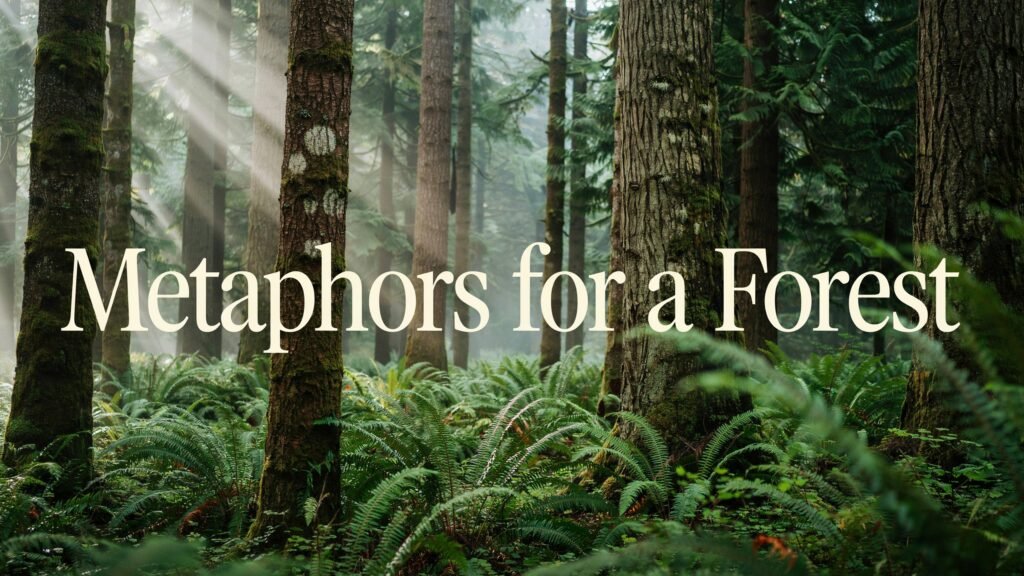
Have you ever stepped into a forest and felt as though you were entering another world? The air cools beneath the canopy, sunlight filters through leaves like golden ribbons, and every rustling branch seems to whisper a secret. A forest is more than a collection of trees—it is a place rich with emotion, symbolism, and imagination. Writers, poets, and storytellers have long used metaphors for a forest to capture its mystery, beauty, and deeper meanings.
Metaphors help us see familiar things in fresh ways. Instead of simply describing a forest as “large” or “green,” a metaphor transforms it into a living cathedral, a sleeping giant, or even a library of ancient wisdom. These comparisons create vivid imagery, evoke emotions, and make writing more memorable.
In this article, you’ll discover powerful forest metaphors, learn what they mean, explore practical examples, and find creative ways to use them in your own writing. Whether you’re a student, blogger, poet, or nature lover, these ideas will help you paint richer pictures with words.
Why Metaphors for a Forest Matter
A forest is one of the most symbolically rich elements in literature and everyday language. It can represent growth, mystery, danger, wisdom, or transformation.
When writers use metaphors for a forest, they:
- Create stronger imagery
- Connect with readers emotionally
- Add depth to storytelling
- Make descriptions more memorable
- Express abstract ideas through nature
Think about famous fairy tales. The forest often symbolizes a journey into the unknown. In modern writing, it may represent complexity, opportunity, or even the human mind.
Understanding Forest Metaphors
A metaphor directly compares one thing to another without using words like “as” or “like.”
For example:
The forest was a cathedral of emerald pillars.
This doesn’t mean the forest is literally a church. Instead, it suggests grandeur, peace, and awe.
The beauty of metaphors lies in their ability to communicate emotions and ideas instantly.
The Forest as a Living Cathedral
One of the most popular metaphors for a forest is a cathedral.
Meaning
This metaphor highlights the sacred, peaceful, and majestic qualities of the woods.
Example Sentence
“The forest stood as a cathedral where sunlight streamed through stained-glass leaves.”
Alternative Expressions
- Nature’s temple
- Green sanctuary
- Woodland chapel
Sensory Details
Imagine the hush beneath towering trees, the filtered light, and the feeling of reverence that fills the air.
This comparison appears frequently in environmental writing because forests often inspire the same wonder people feel in sacred spaces.
The Forest as an Ocean of Green
Forests can stretch endlessly across landscapes, creating waves of treetops.
Meaning
This metaphor emphasizes vastness and movement.
Example Sentence
“From the mountaintop, the forest became an ocean of green rolling toward the horizon.”
Alternative Expressions
- Emerald sea
- Green tide
- Leafy ocean
Emotional Impact
The image creates feelings of freedom, adventure, and endless possibility.
Travel writers often use this metaphor when describing panoramic forest views.
The Forest as Earth’s Lungs
Environmentalists frequently describe forests as Earth’s lungs.
Meaning
Forests absorb carbon dioxide and release oxygen, supporting life on the planet.
Example Sentence
“The rainforest serves as Earth’s lungs, breathing life into the world.”
Alternative Expressions
- Planet’s breathing system
- Nature’s respiratory network
- Green oxygen factory
Real-Life Relevance
This metaphor connects science and poetry, helping readers understand the ecological importance of forests.
Forest Metaphors in Literature
Throughout literary history, forests have symbolized personal growth and discovery.
In many classic stories, characters enter forests during moments of change. The woods become places where fears are confronted and lessons are learned.
Writers often use forests as metaphors for:
- The subconscious mind
- Life’s uncertainties
- Spiritual journeys
- Hidden truths
These meanings continue to resonate in modern storytelling.
The Forest as a Library of Time
Imagine every tree holding centuries of memories.
Meaning
This metaphor portrays the forest as a keeper of history and wisdom.
Example Sentence
“The ancient woodland was a library of time, each ring in every tree preserving forgotten stories.”
Alternative Expressions
- Archive of nature
- Book of centuries
- Museum of life
Storytelling Element
An old oak may have witnessed generations come and go, silently recording history through its growth rings.
The Forest as a Maze
Forests can appear confusing and endless.
Meaning
This metaphor represents uncertainty, complexity, and challenges.
Example Sentence
“The dense forest became a maze where every path led to another mystery.”
Alternative Expressions
- Natural labyrinth
- Woodland puzzle
- Green maze
Emotional Details
This comparison evokes curiosity, tension, and adventure.
It works especially well in mystery and fantasy writing.
Creative Ways to Use Forest Metaphors
You don’t have to be a novelist to benefit from these metaphors.
Try using them in:
- Blog posts
- Poetry
- Social media captions
- School essays
- Journals
- Speeches
For example:
“My thoughts were a forest of tangled paths.”
This simple metaphor transforms an ordinary statement into a memorable image.
Example 1: The Forest as a Kingdom
Meaning and Explanation
A kingdom suggests order, hierarchy, and countless inhabitants working together.
Example Scenario
“The forest was a kingdom where ancient oaks ruled over ferns and wildflowers.”
Alternative Ways to Express It
- Woodland empire
- Green realm
- Nature’s monarchy
Sensory and Emotional Details
Picture birds acting as messengers, squirrels as busy citizens, and towering trees as noble rulers.
Mini Story
A child walking through the woods imagines every creature belonging to a magical kingdom hidden from the outside world. Suddenly, every chirp and rustle feels meaningful.
Example 2: The Forest as a Giant Heart
Meaning and Explanation
This metaphor focuses on life, energy, and interconnectedness.
Example Sentence
“The forest was a giant heart, pumping life through rivers, roots, and wildlife.”
Alternative Ways to Express It
- Beating heart of nature
- Pulse of the wilderness
- Living core of the earth
Emotional Impact
This image encourages readers to see forests as living systems rather than static landscapes.
Real-Life Connection
Scientists have discovered that trees communicate through underground fungal networks, reinforcing the idea of a connected, living community.
Example 3: The Forest as a Dream
Meaning and Explanation
A dream symbolizes mystery, imagination, and wonder.
Example Sentence
“At dawn, the misty forest became a dream woven from silver light and shadow.”
Alternative Ways to Express It
- Living fantasy
- Woodland vision
- Sleeping dreamscape
Sensory Details
Soft fog, distant birdsong, and filtered sunlight create a magical atmosphere.
Literary Inspiration
Many fantasy novels use dreamlike forests to blur the boundary between reality and imagination.
The Forest as a Blanket
A forest canopy often covers the landscape like fabric.
Meaning
This metaphor suggests comfort, protection, and shelter.
Example Sentence
“The trees spread across the valley as a blanket shielding the earth.”
Alternative Expressions
- Green quilt
- Woodland cover
- Nature’s cloak
Emotional Tone
This comparison creates feelings of safety and warmth.
The Forest as a Symphony
Every forest contains countless sounds working together.
Meaning
This metaphor emphasizes harmony and complexity.
Example Sentence
“The forest was a symphony of birds, insects, wind, and rustling leaves.”
Alternative Expressions
- Nature’s orchestra
- Woodland concert
- Wild melody
Sensory Experience
Close your eyes and listen to a forest. The sounds blend into an intricate composition unlike any human-made music.
Forest Symbolism Across Cultures
Many cultures view forests as sacred places.
In folklore and mythology, forests often symbolize:
- Wisdom
- Protection
- Transformation
- Spiritual growth
- Hidden knowledge
Ancient legends from around the world feature heroes entering forests before emerging changed and stronger.
These stories demonstrate the enduring power of forest imagery.
Interactive Exercise: Create Your Own Forest Metaphor
Try this simple exercise.
Step 1
Think about a forest you’ve visited or imagined.
Step 2
Ask yourself:
- What emotion does it create?
- What does it remind you of?
- What role does it play in nature?
Step 3
Complete this sentence:
“The forest is a __________.”
Examples:
- The forest is a storyteller.
- The forest is a treasure chest.
- The forest is a sleeping giant.
Challenge
Write three different metaphors describing the same forest from different emotional perspectives.
Bonus Tips for Using Forest Metaphors in Writing
Match the Mood
Use gentle metaphors for peaceful scenes and darker metaphors for suspenseful moments.
Engage Multiple Senses
Combine sight, sound, touch, and smell to strengthen imagery.
Avoid Overused Comparisons
Try creating fresh metaphors that reflect your unique perspective.
Use in Social Media
Example caption:
“Lost in nature’s cathedral and loving every moment.”
Apply in Daily Life
Forest metaphors can help explain emotions and experiences.
For example:
“My schedule has become a forest of tangled trails.”
Common Mistakes When Using Forest Metaphors
Even beautiful metaphors can lose impact if used incorrectly.
Avoid:
- Mixing unrelated metaphors
- Overloading a paragraph with comparisons
- Using clichés repeatedly
- Choosing metaphors that don’t fit the tone
Strong metaphors feel natural and support the message rather than distract from it.
Bringing Forest Metaphors Into Storytelling
The best forest metaphors do more than decorate sentences.
They:
- Reveal character emotions
- Build atmosphere
- Support themes
- Deepen symbolism
Instead of saying a character feels lost, you might write:
“Her thoughts became a forest with no visible path.”
This paints a richer and more emotional picture.
FAQs
What is a metaphor for a forest?
A metaphor for a forest is a direct comparison that describes a forest as something else, such as a cathedral, ocean, maze, or kingdom, to create vivid imagery and deeper meaning.
Why are forest metaphors important in writing?
Forest metaphors make descriptions more engaging, help readers visualize scenes, and add emotional and symbolic depth to writing.
What does the forest symbolize in literature?
Forests often symbolize mystery, transformation, self-discovery, hidden knowledge, and journeys into the unknown.
How can I create my own forest metaphor?
Think about what the forest reminds you of emotionally or visually, then compare it directly to that object, place, or idea.
Can forest metaphors be used outside creative writing?
Yes. They can enhance speeches, blog posts, social media captions, marketing content, educational writing, and everyday communication.
Conclusion
A forest is far more than a landscape filled with trees. Through metaphor, it becomes a cathedral of wonder, an ocean of possibility, a library of wisdom, a kingdom of life, and a dream woven from light and shadow.
These comparisons allow us to express emotions, ideas, and experiences in ways that ordinary descriptions cannot. Whether you’re writing poetry, crafting stories, creating social media content, or simply appreciating nature, forest metaphors can transform your words into vivid experiences.
The next time you walk beneath a canopy of leaves or imagine a woodland path, challenge yourself to see the forest as something unexpected. You may discover that every tree holds a new story and every trail leads to a fresh metaphor waiting to be explored.