
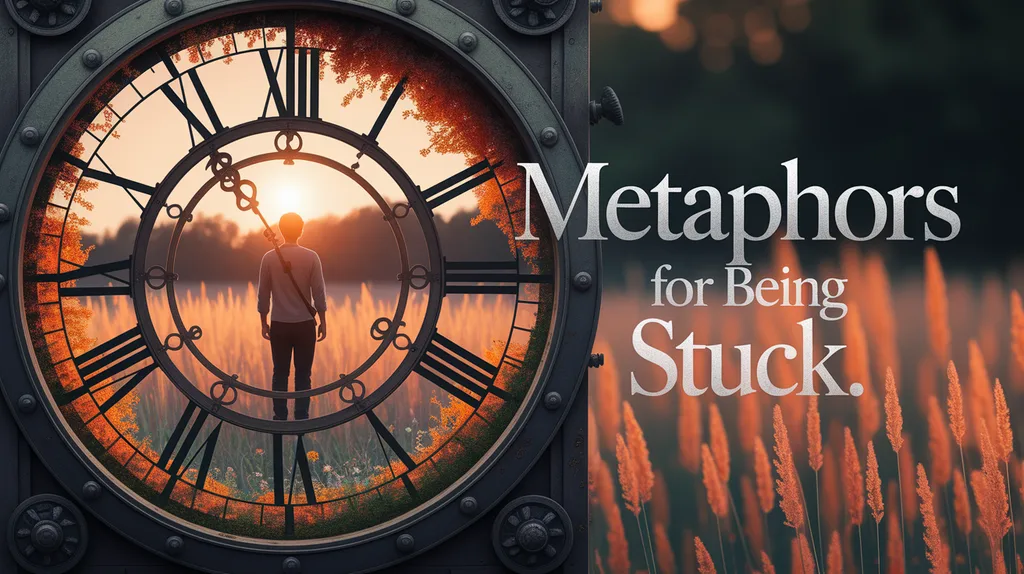
There’s a moment—quiet, heavy, and strangely familiar—when everything feels paused. Like standing in a room where the air doesn’t move, where your thoughts circle like restless birds but never land. You want to move forward, to change, to grow… yet something invisible holds you in place. It’s not always dramatic. Sometimes, it’s subtle—like trying to walk through water or pushing against an unseen wall.
This feeling of being “stuck” is universal. Whether it shows up in your career, relationships, creativity, or personal growth, it can leave you frustrated, confused, or even numb. That’s where metaphors come in. They give shape to the invisible, language to the unspoken, and clarity to the tangled.
Through metaphors, we don’t just describe being stuck—we understand it, feel it, and sometimes, even find our way out of it. Below, you’ll explore powerful metaphors for being stuck, along with meanings, examples, creative alternatives, and ways to use them in your own life and writing.
Feeling Trapped Like a Bird in a Cage
This metaphor captures emotional confinement—the sense of having wings but no sky.
Meaning & Explanation: It reflects the frustration of having potential but lacking freedom. You know you can do more, but circumstances, fear, or obligations hold you back.
Example: “I felt like a bird in a cage, watching opportunities fly past me.”
Alternative Expressions:
- A songbird with clipped wings
- A butterfly pinned in a glass case
Sensory Detail: You hear the echo of your own voice, feel the bars cold beneath your fingertips, and long for open skies.
Mini Story: Think of someone stuck in a job they’ve outgrown—talented, capable, yet confined by fear of change.
Stuck in Quicksand of Overthinking
Meaning & Explanation: Overthinking can feel like sinking—every thought pulls you deeper instead of helping you escape.
Example: “The more I tried to figure it out, the deeper I sank into the quicksand of my own thoughts.”
Alternative Expressions:
- Drowning in decisions
- Sinking in mental fog
Emotional Layer: Panic builds slowly, mixed with helplessness and exhaustion.
Like a Car Spinning Its Wheels in Mud
Meaning & Explanation: Effort without progress. You’re trying hard, but nothing is moving forward.
Example: “I’ve been working nonstop, but it feels like my life is just spinning its wheels in mud.”
Alternative Expressions:
- Running in place
- Pedaling uphill with no traction
Real-Life Connection: This often appears in burnout—where effort increases but results don’t.
Frozen in Time Like a Paused Clock
Meaning & Explanation: Life feels halted while everything else moves on.
Example: “After the loss, I felt like a clock that had stopped ticking.”
Alternative Expressions:
- A paused movie scene
- A frozen river in winter
Sensory Detail: Stillness, silence, and a strange detachment from the world.
Lost in a Maze Without an Exit
Meaning & Explanation: Confusion and lack of direction. You don’t know which way to go.
Example: “I feel like I’m wandering a maze with no exit in sight.”
Alternative Expressions:
- A traveler without a map
- A compass spinning wildly
Cultural Touch: This metaphor appears in myths and literature, symbolizing inner struggles and self-discovery.
Caught in a Spider’s Web of Fear
Meaning & Explanation: Fear traps you, making even small movements difficult.
Example: “I was caught in a web of fear, unable to take even the smallest step forward.”
Alternative Expressions:
- Entangled in doubt
- Bound by invisible threads
Emotional Tone: Sticky, tense, and suffocating.
Like a River Blocked by a Dam
Meaning & Explanation: Natural flow is interrupted—your energy, creativity, or emotions are held back.
Example: “My ideas felt like a river blocked by a dam, building pressure with nowhere to go.”
Alternative Expressions:
- A storm waiting to break
- A bottle shaken but unopened
Mini Story: Artists often feel this when they experience creative block.
Stuck on a Treadmill Going Nowhere
Meaning & Explanation: Constant movement but no progress—busyness without purpose.
Example: “I’ve been so busy, but it feels like I’m on a treadmill going nowhere.”
Alternative Expressions:
- Running in circles
- Chasing your own shadow
Like a Puzzle Missing Its Final Piece
Meaning & Explanation: Everything is almost complete, but something crucial is missing.
Example: “My life feels like a puzzle missing its final piece.”
Alternative Expressions:
- A sentence without an ending
- A melody without resolution
Emotional Layer: Frustration mixed with longing.
Anchored in Place Like a Ship at Sea
Meaning & Explanation: You have the ability to move, but something is holding you still.
Example: “I feel like a ship anchored in the middle of the ocean.”
Alternative Expressions:
- Tied to the shore
- Held by invisible chains
Three Powerful Metaphors to Transform Your Perspective
The Locked Door Waiting for a Key
Meaning: Being stuck might mean you haven’t found the right solution yet.
Example: “This challenge feels like a locked door—I just need the right key.”
Alternative Ways:
- A code waiting to be cracked
- A mystery waiting to be solved
Insight: Sometimes being stuck isn’t failure—it’s a puzzle.
The Cocoon Before Transformation
Meaning: Stillness can be part of growth, not a lack of it.
Example: “Maybe I’m not stuck—maybe I’m in a cocoon, waiting to transform.”
Alternative Ways:
- A seed beneath the soil
- Winter before spring
Mini Story: Many breakthroughs come after periods of stillness.
The Traffic Jam Before Open Roads
Meaning: Delays are temporary, not permanent.
Example: “I’m in a traffic jam right now, but the road will clear.”
Alternative Ways:
- A storm before calm
- A red light before green
How Metaphors Help You Understand Feeling Stuck
Metaphors translate abstract emotions into relatable images. Instead of saying “I feel stuck,” you create a picture—and that picture brings clarity, comfort, and even solutions.
They also help you communicate better with others, making your experiences more vivid and relatable.
Creative Writing Prompts for “Being Stuck”
Try these to unlock your imagination:
- Describe your current situation as a landscape
- Write a short story where the main character is physically stuck somewhere
- Turn your emotions into weather patterns
Interactive Exercise: Create Your Own Metaphor
Ask yourself:
- What does your “stuck” feeling look like?
- Is it heavy, slow, tangled, frozen?
- What object, place, or scene matches it?
Example Prompt: “I feel like ______ because ______.”
Fill it in and expand it into a paragraph.
Using Metaphors in Social Media and Daily Life
Metaphors make your words memorable.
Examples:
- “Feeling like I’m stuck in quicksand today.”
- “Just a bird waiting for the cage door to open.”
They add personality, emotion, and relatability to your posts.
Tips for Writing Powerful Metaphors
- Keep them simple and clear
- Use sensory details (sight, sound, touch)
- Make them relatable
- Avoid clichés unless you add a fresh twist
Cultural and Literary Inspirations
Writers throughout history have used metaphors to express being stuck—from characters trapped in circumstances to symbolic journeys through darkness.
You’ll find similar imagery in poetry, novels, and even films—reminding us that this feeling is deeply human.
Real-Life Example: Breaking Free from Feeling Stuck
Imagine someone who feels stuck in their career. They describe it as “being in a maze.” Once they see it that way, they realize: mazes have exits. They start exploring new paths—learning skills, networking, taking risks.
The metaphor shifts their mindset—and their life.
Bonus Tips for Applying These Metaphors Creatively
- Use them in journaling to process emotions
- Add them to speeches or presentations
- Turn them into visual art or sketches
- Use them in storytelling or blogging
FAQs
1. Why are metaphors useful for describing emotions?
They make abstract feelings easier to understand and communicate by turning them into vivid, relatable images.
2. Can metaphors actually help me feel less stuck?
Yes. They can shift your perspective and help you see new possibilities or solutions.
3. How do I create my own metaphor?
Think about how your situation feels, then compare it to something physical or visual.
4. Are common metaphors still effective?
They can be—but adding your own twist makes them more powerful and unique.
5. Can I use these metaphors in professional writing?
Absolutely, as long as they fit the tone and context.
Conclusion
Being stuck isn’t the end of your story—it’s a chapter. A pause. A moment where something is gathering, shifting, or waiting to unfold. Through metaphors, you give that moment meaning. You turn confusion into clarity, frustration into imagery, and stillness into something alive with possibility.
Sometimes, you’re not stuck—you’re just between versions of yourself. And like every river, every storm, every story… movement will come again.