

Language moves quickly, but meaning must move clearly. This is where similes become one of the most valuable tools in figurative language. Similes help writers slow things down just enough for readers to see, feel, and understand an idea through comparison.
Whether something moves too fast emotionally, physically, or mentally, similes give shape to speed and intensity in a human way. They turn motion into meaning and urgency into imagery.
The focus keyword too fast or to fast reflects more than grammar—it symbolizes strength, growth, resilience, wisdom, and the emotional pace of life itself.
In this article, you’ll explore what similes are, why they matter, and how powerful comparisons can express speed, momentum, and emotional depth with clarity and beauty.
What Is a Simile?
A simile is a figure of speech that compares two different things using the words like or as. It helps readers understand one idea by relating it to something familiar, vivid, or emotional.
Example: Time raced like a wild river after the storm.
This simile makes speed tangible by linking time to a fast-moving natural force.
1. Fast as lightning
Meaning: Extremely quick and sudden.
Usage Insight: Best for physical movement or instant reactions.
Examples:
- His reflexes were fast as lightning during the match.
- The news spread fast as lightning across the office.
- She answered the question fast as lightning.
- The cat darted away fast as lightning.
- His decision came fast as lightning, leaving no doubt.
2. Too fast like a racing heartbeat
Meaning: Speed driven by emotion or pressure.
Usage Insight: Ideal for emotional intensity or anxiety.
Examples:
- Her thoughts moved too fast like a racing heartbeat.
- The conversation escalated too fast like a racing heartbeat.
- His fears grew too fast like a racing heartbeat.
- The moment passed too fast like a racing heartbeat.
- Everything felt too fast like a racing heartbeat before the exam.
3. Fast as a flowing river
Meaning: Smooth, continuous speed.
Usage Insight: Works well for time, progress, or natural motion.
Examples:
- The days passed fast as a flowing river.
- Ideas moved fast as a flowing river during brainstorming.
- Life seemed fast as a flowing river after graduation.
- The conversation flowed fast as a flowing river.
- His growth came fast as a flowing river.
4. Too fast like sand slipping through fingers
Meaning: Speed that feels uncontrollable or fleeting.
Usage Insight: Best for emotional reflection or loss.
Examples:
- Childhood vanished too fast like sand slipping through fingers.
- The moment ended too fast like sand slipping through fingers.
- Time escaped too fast like sand slipping through fingers.
- The opportunity passed too fast like sand slipping through fingers.
- Happiness faded too fast like sand slipping through fingers.
5. Fast as a startled deer
Meaning: Sudden speed driven by fear or urgency.
Usage Insight: Ideal for instinctive reactions.
Examples:
- He ran fast as a startled deer.
- The child moved fast as a startled deer at the sound.
- She turned fast as a startled deer.
- Panic spread fast as a startled deer through the crowd.
- His escape was fast as a startled deer.
6. Too fast like fire in dry grass

Meaning: Rapid and uncontrollable spread.
Usage Insight: Best for emotions, rumors, or conflict.
Examples:
- Anger spread too fast like fire in dry grass.
- Gossip moved too fast like fire in dry grass.
- The argument grew too fast like fire in dry grass.
- Fear traveled too fast like fire in dry grass.
- Change came too fast like fire in dry grass.
7. Fast as the morning wind
Meaning: Light, quick, and refreshing speed.
Usage Insight: Great for positive or energetic motion.
Examples:
- She finished her work fast as the morning wind.
- His mood changed fast as the morning wind.
- The clouds moved fast as the morning wind.
- Inspiration arrived fast as the morning wind.
- He learned fast as the morning wind.
8. Too fast like a rushing train
Meaning: Overwhelming speed with no pause.
Usage Insight: Perfect for pressure or overload.
Examples:
- Life felt too fast like a rushing train.
- The semester moved too fast like a rushing train.
- Emotions hit too fast like a rushing train.
- The project escalated too fast like a rushing train.
- Everything changed too fast like a rushing train.
9. Fast as a blinking eye
Meaning: Almost instant speed.
Usage Insight: Best for short moments or sudden change.
Examples:
- The moment passed fast as a blinking eye.
- He disappeared fast as a blinking eye.
- The lights went out fast as a blinking eye.
- The answer came fast as a blinking eye.
- The accident happened fast as a blinking eye.
10. Too fast like skipping chapters in a book
Meaning: Rushed progress without understanding.
Usage Insight: Ideal for learning or emotional growth.
Examples:
- The relationship moved too fast like skipping chapters in a book.
- Life felt too fast like skipping chapters in a book.
- He learned too fast like skipping chapters in a book.
- The story unfolded too fast like skipping chapters in a book.
- Growth felt too fast like skipping chapters in a book.
11. Fast as falling rain
Meaning: Continuous and steady speed.
Usage Insight: Works well for repetitive motion or time.
Examples:
- Tasks piled up fast as falling rain.
- Words flowed fast as falling rain.
- The crowd arrived fast as falling rain.
- Thoughts came fast as falling rain.
- Progress moved fast as falling rain.
12. Too fast like a spinning wheel
Meaning: Motion without control or direction.
Usage Insight: Best for chaos or confusion.
Examples:
- His mind raced too fast like a spinning wheel.
- Events unfolded too fast like a spinning wheel.
- The day moved too fast like a spinning wheel.
- Emotions turned too fast like a spinning wheel.
- Life felt too fast like a spinning wheel.
13. Fast as a hunting hawk
Meaning: Focused, sharp, and intentional speed.
Usage Insight: Ideal for skill and precision.
Examples:
- She reacted fast as a hunting hawk.
- His focus moved fast as a hunting hawk.
- The decision came fast as a hunting hawk.
- He learned patterns fast as a hunting hawk.
- Strategy formed fast as a hunting hawk.
14. Too fast like melting ice
Meaning: Gradual loss happening quicker than expected.
Usage Insight: Good for emotional or environmental themes.
Examples:
- Trust disappeared too fast like melting ice.
- Time faded too fast like melting ice.
- Hope slipped too fast like melting ice.
- Calm vanished too fast like melting ice.
- Stability weakened too fast like melting ice.
15. Fast as flowing electricity
Meaning: Invisible yet powerful speed.
Usage Insight: Great for modern or abstract ideas.
Examples:
- Information traveled fast as flowing electricity.
- His thoughts moved fast as flowing electricity.
- News spread fast as flowing electricity.
- Creativity surged fast as flowing electricity.
- Connection formed fast as flowing electricity.
16. Too fast like waves crashing together
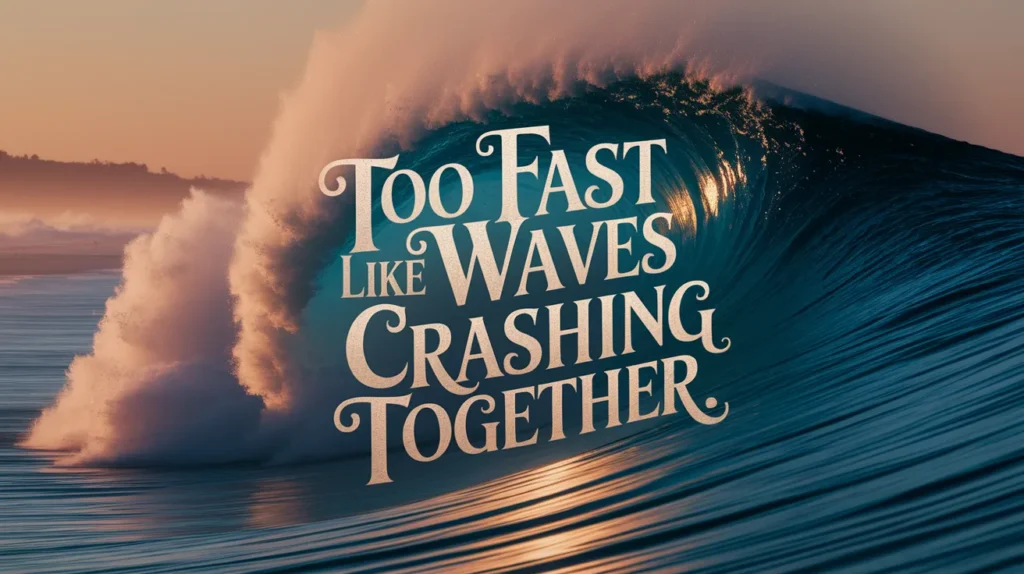
Meaning: Overlapping events without space.
Usage Insight: Best for emotional overload.
Examples:
- Problems came too fast like waves crashing together.
- Feelings hit too fast like waves crashing together.
- Responsibilities piled too fast like waves crashing together.
- Thoughts collided too fast like waves crashing together.
- Change arrived too fast like waves crashing together.
17. Fast as a summer storm
Meaning: Sudden and intense speed.
Usage Insight: Works for dramatic moments.
Examples:
- The argument rose fast as a summer storm.
- Success came fast as a summer storm.
- Fear struck fast as a summer storm.
- Energy surged fast as a summer storm.
- Chaos unfolded fast as a summer storm.
18. Too fast like pages turning in the wind
Meaning: Lack of control over pace.
Usage Insight: Ideal for time and memory.
Examples:
- Years passed too fast like pages turning in the wind.
- Childhood faded too fast like pages turning in the wind.
- Moments slipped too fast like pages turning in the wind.
- Life moved too fast like pages turning in the wind.
- Memories rushed too fast like pages turning in the wind.
19. Fast as a spark
Meaning: Instant ignition or reaction.
Usage Insight: Best for ideas or emotions.
Examples:
- Inspiration struck fast as a spark.
- Anger flared fast as a spark.
- Understanding clicked fast as a spark.
- Hope ignited fast as a spark.
- Curiosity awakened fast as a spark.
20. Too fast like a runaway clock
Meaning: Time feeling accelerated unnaturally.
Usage Insight: Perfect for stress or aging themes.
Examples:
- Life felt too fast like a runaway clock.
- Deadlines arrived too fast like a runaway clock.
- Days passed too fast like a runaway clock.
- Pressure mounted too fast like a runaway clock.
- Change came too fast like a runaway clock.
21. Fast as drifting clouds
Meaning: Gentle but noticeable speed.
Usage Insight: Good for peaceful imagery.
Examples:
- Time passed fast as drifting clouds.
- Thoughts moved fast as drifting clouds.
- The afternoon went fast as drifting clouds.
- Worries floated fast as drifting clouds.
- The day slipped fast as drifting clouds.
22. Too fast like a collapsing bridge
Meaning: Sudden failure due to speed.
Usage Insight: Best for cautionary themes.
Examples:
- The plan failed too fast like a collapsing bridge.
- Trust broke too fast like a collapsing bridge.
- The system fell too fast like a collapsing bridge.
- The relationship ended too fast like a collapsing bridge.
- Progress rushed too fast like a collapsing bridge.
23. Fast as a racing shadow
Meaning: Speed that is hard to grasp.
Usage Insight: Ideal for abstract ideas.
Examples:
- Opportunity vanished fast as a racing shadow.
- Time escaped fast as a racing shadow.
- Doubt passed fast as a racing shadow.
- His fear moved fast as a racing shadow.
- Success arrived fast as a racing shadow.
24. Too fast like boiling water spilling over
Meaning: Overflow caused by pressure.
Usage Insight: Great for emotional buildup.
Examples:
- Anger erupted too fast like boiling water spilling over.
- Stress rose too fast like boiling water spilling over.
- Tears came too fast like boiling water spilling over.
- Conflict grew too fast like boiling water spilling over.
- Emotions surged too fast like boiling water spilling over.
25. Fast as a shooting star
Meaning: Brief yet powerful speed.
Usage Insight: Best for fleeting moments.
Examples:
- Fame arrived fast as a shooting star.
- The chance passed fast as a shooting star.
- His smile flashed fast as a shooting star.
- Hope appeared fast as a shooting star.
- Inspiration vanished fast as a shooting star.
26. Too fast like skipping heartbeats

Meaning: Emotional overload or shock.
Usage Insight: Ideal for love or fear.
Examples:
- Love came too fast like skipping heartbeats.
- Fear struck too fast like skipping heartbeats.
- The moment hit too fast like skipping heartbeats.
- Excitement rose too fast like skipping heartbeats.
- Anxiety surged too fast like skipping heartbeats.
27. Fast as falling leaves
Meaning: Natural, steady movement.
Usage Insight: Good for seasonal or life changes.
Examples:
- Years passed fast as falling leaves.
- Thoughts drifted fast as falling leaves.
- Time moved fast as falling leaves.
- The season changed fast as falling leaves.
- Memories faded fast as falling leaves.
28. Too fast like rushing downhill
Meaning: Speed that gains momentum dangerously.
Usage Insight: Best for warning or tension.
Examples:
- Events spiraled too fast like rushing downhill.
- Mistakes grew too fast like rushing downhill.
- The argument escalated too fast like rushing downhill.
- Emotions surged too fast like rushing downhill.
- Life shifted too fast like rushing downhill.
29. Fast as a beating drum
Meaning: Rhythmic and intense speed.
Usage Insight: Works for energy and urgency.
Examples:
- His heart raced fast as a beating drum.
- The pace increased fast as a beating drum.
- The crowd moved fast as a beating drum.
- Pressure built fast as a beating drum.
- Excitement grew fast as a beating drum.
30. Too fast like burning through fuel
Meaning: Progress without sustainability.
Usage Insight: Ideal for burnout themes.
Examples:
- He worked too fast like burning through fuel.
- Success came too fast like burning through fuel.
- Energy drained too fast like burning through fuel.
- Growth happened too fast like burning through fuel.
- Life rushed too fast like burning through fuel.
How to Use Similes Effectively in Writing
Use similes to clarify movement, not clutter it. Choose comparisons that fit your tone—gentle for reflection, sharp for action. In poems, similes deepen emotion.
In stories, they shape pacing. In essays, they explain complex ideas. In songs, they create rhythm and imagery. Always aim for freshness, simplicity, and emotional truth.
FAQs
1. What does “too fast or to fast” mean in writing?
“Too fast” describes excessive speed, while “to fast” is grammatically incorrect in most contexts.
2. How do similes help explain speed?
They compare speed to familiar experiences, making it vivid and emotional.
3. What’s the difference between similes and metaphors?
Similes use like or as; metaphors state direct equivalence.
4. Can similes be used in academic writing?
Yes, when used sparingly to clarify complex ideas.
5. Are nature similes effective for speed?
Absolutely—nature offers universal, relatable imagery.
Conclusion
Understanding too fast or to fast goes beyond grammar—it’s about expressing pace, pressure, and progress with clarity. Similes turn speed into imagery, emotion into experience, and movement into meaning.
When used thoughtfully, they strengthen language, sharpen ideas, and deepen emotional connection. Whether you’re writing creatively or academically, similes help your words move fast—but never too fast for understanding.