
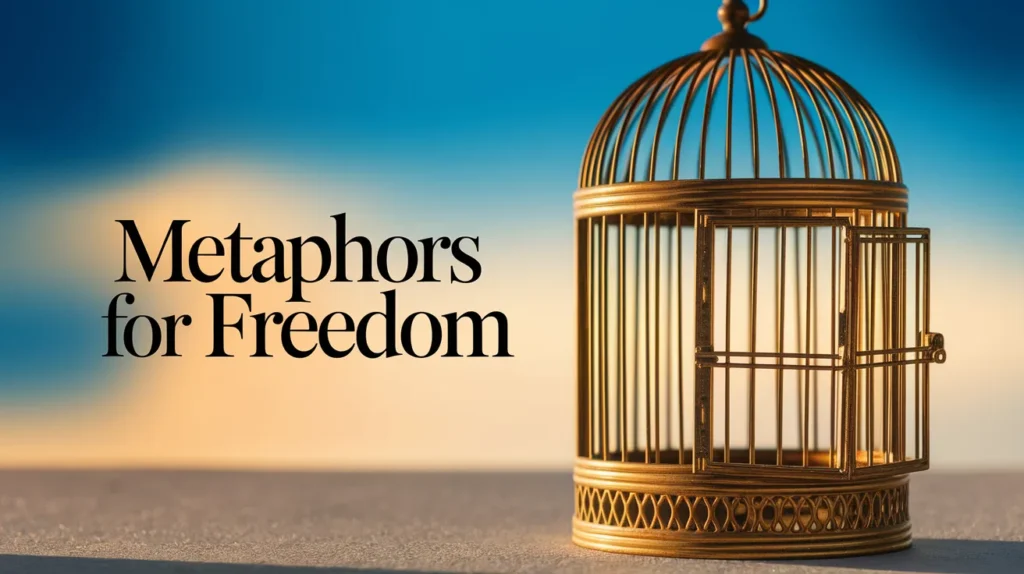
The morning air felt different that day—cooler, lighter, almost like it carried a secret. I remember standing at the edge of a quiet field, watching a flock of birds rise suddenly into the sky. No hesitation, no permission asked. Just a collective leap into the vast, open blue. In that fleeting moment, I didn’t just see freedom—I felt it.
Freedom is one of those powerful, abstract ideas that shape our lives in profound ways, yet it often slips through our fingers when we try to define it. That’s where metaphors come in. They give form to the formless, turning freedom into something we can see, touch, and understand. Whether you’re a writer, a student, or simply someone seeking clarity, metaphors for freedom can deepen your expression and emotional connection to this universal concept.
In this article, we’ll explore rich, vivid metaphors for freedom, unpack their meanings, and show you how to use them creatively in your writing and daily life.
The Open Sky: A Classic Metaphor for Freedom
The open sky is perhaps the most timeless metaphor for freedom—limitless, boundless, and inviting.
Meaning/Explanation: The sky represents infinite possibilities. It suggests a life without barriers, where dreams can stretch as far as imagination allows.
Example Scenario: After years of a rigid routine, she finally quit her job and said, “I feel like I’m standing under an open sky for the first time.”
Alternative Expressions:
- Endless horizon
- Boundless blue
- Infinite expanse
Sensory Detail: The warmth of sunlight on your face, the vastness overhead, the quiet hum of possibility.
Mini Storytelling: Think of explorers sailing into unknown waters centuries ago. For them, the sky wasn’t just above—it was a compass, a symbol of uncharted freedom.
Breaking Chains: Freedom as Liberation
Few images are as powerful as chains snapping apart.
Meaning/Explanation: This metaphor emphasizes release from oppression, control, or limitation—whether physical, emotional, or societal.
Example Sentence: Graduating felt like breaking chains that had held him back for years.
Alternative Ways to Express It:
- Shattering bonds
- Escaping the cage
- Unbinding the soul
Emotional Detail: A rush of relief, like exhaling after holding your breath too long.
Cultural Reference: This metaphor echoes in historical struggles—movements for independence, civil rights, and personal emancipation.
A Bird in Flight: Freedom as Movement
Birds soaring effortlessly often symbolize freedom in motion.
Meaning/Explanation: This metaphor reflects autonomy, grace, and the ability to choose one’s direction.
Example Scenario: After leaving a toxic environment, she said, “I finally feel like a bird in flight.”
Alternative Expressions:
- Soaring wings
- Gliding above
- Taking flight
Sensory Detail: The rush of wind, the thrill of elevation, the rhythm of wings cutting through air.
Metaphors for Personal Freedom in Everyday Life
Freedom isn’t always dramatic—it often appears in quiet, personal moments.
Think of:
- Removing tight shoes after a long day
- Taking a deep breath in fresh air
- Saying “no” without guilt
Each of these moments can become a metaphor for reclaiming your space and identity.
Emotional Freedom as a Flowing River
A river doesn’t ask permission—it simply flows.
Meaning/Explanation: This metaphor represents emotional freedom—the ability to feel and express without restraint.
Example Sentence: Once he forgave himself, his emotions flowed like a river.
Alternative Ways:
- Unblocked current
- Gentle stream
- Unrestrained tide
Mini Story: A person burdened by regret finds healing through journaling. Slowly, their emotions begin to flow again—like a river after a long drought.
Freedom as a Key Unlocking Doors
A simple key can open endless possibilities.
Meaning/Explanation: Freedom here symbolizes opportunity and access—removing barriers to new experiences.
Example Scenario: Education became the key that unlocked doors she never knew existed.
Alternative Expressions:
- Opening gateways
- Turning the lock
- Access granted
Cultural and Literary Metaphors for Freedom
Across literature and culture, freedom has taken many symbolic forms:
- Fire: representing rebellion and transformation
- Wind: invisible yet unstoppable
- Light: clarity and truth
These metaphors resonate because they connect deeply with human experience.
Freedom as a Wild Horse
A wild horse embodies untamed energy and independence.
Meaning/Explanation: This metaphor highlights raw, natural freedom—uncontrolled and authentic.
Example Sentence: His spirit was like a wild horse, refusing to be tamed.
Alternative Ways:
- Untamed soul
- Running free
- Unbridled energy
Emotional Detail: The pounding of hooves, the thrill of speed, the refusal to be confined.
The Horizon: Freedom as Endless Possibility
The horizon always stays just out of reach—yet it invites us forward.
Meaning/Explanation: It symbolizes hope, exploration, and the idea that freedom is a journey, not a destination.
Example Scenario: After starting her own business, she said, “The horizon finally feels within reach.”
Freedom as Fresh Air
Sometimes, freedom feels like breathing again.
Meaning/Explanation: This metaphor emphasizes relief and renewal after restriction.
Example Sentence: Leaving that environment felt like stepping into fresh air.
Sensory Detail: Cool breeze, expanded lungs, clarity of mind.
3 Powerful Metaphors for Freedom (Deep Dive)
1. Freedom as a Door Swinging Open
Meaning: Opportunity, transition Example: “When she moved abroad, it was like a door swinging open to a new life.” Alternatives: Gate opening, curtain rising Emotion: Anticipation, excitement
2. Freedom as Untied Shoelaces
Meaning: Release from constraints Example: “After finishing exams, I felt like untied shoelaces—loose and relaxed.” Alternatives: Loosened grip, relaxed knot Detail: Lightness in steps
3. Freedom as a Blank Canvas
Meaning: Creativity and choice Example: “After retirement, his life became a blank canvas.” Alternatives: Empty page, fresh start Emotion: Curiosity, possibility
Interactive Exercise: Create Your Own Freedom Metaphors
Try this:
- Think of a moment you felt free.
- Ask yourself: What did it look like? Feel like? Sound like?
- Turn that into a metaphor.
Prompt Ideas:
- Freedom feels like…
- Freedom sounds like…
- Freedom moves like…
Challenge: Write three metaphors using nature, objects, and emotions.
Using Metaphors for Freedom in Writing
To make your writing vivid:
- Use sensory details (sight, sound, touch)
- Keep metaphors relatable
- Avoid clichés by adding a twist
Example Upgrade: Instead of “free as a bird,” try “free like a bird discovering wind for the first time.”
Social Media and Daily Life Applications
Metaphors aren’t just for essays—they shine in everyday communication.
Ideas:
- Instagram captions: “Chasing horizons, not deadlines.”
- Journaling: “Today felt like breathing fresh air.”
- Conversations: “I finally broke free from that chapter.”
Common Mistakes to Avoid
- Overusing the same metaphor
- Mixing metaphors (confusing imagery)
- Being too vague
Clarity and originality matter.
Bonus Tips for Creative Expression
- Combine metaphors with storytelling
- Draw from personal experiences
- Use contrast (freedom vs. confinement)
Why Metaphors for Freedom Matter
They help us:
- Express complex emotions
- Connect with others
- Inspire action and reflection
Freedom isn’t just a concept—it’s a feeling, and metaphors help us share that feeling.
FAQs
1. What is a metaphor for freedom?
A metaphor for freedom is a figurative way to describe independence or liberation using imagery, like “a bird in flight.”
2. Why are metaphors important in writing?
They make abstract ideas more vivid, relatable, and emotionally engaging.
3. Can I create my own metaphors?
Absolutely. Personal metaphors often feel more authentic and powerful.
4. What are common symbols of freedom?
Birds, sky, wind, open roads, and broken chains are widely used symbols.
5. How can I avoid cliché metaphors?
Add unique details, combine ideas creatively, and draw from personal experiences.
Conclusion
Freedom is one of the most cherished human experiences, yet it often defies simple definition. Through metaphors, we give it shape, color, and movement. We turn it into skies, rivers, keys, and wild horses—each image revealing a different facet of what it means to be free.
So the next time you feel that quiet, powerful sense of liberation—pause. Notice it. Name it. Maybe it’s the first deep breath after a storm, or the moment your wings finally catch the wind. And then, let your words take flight.