
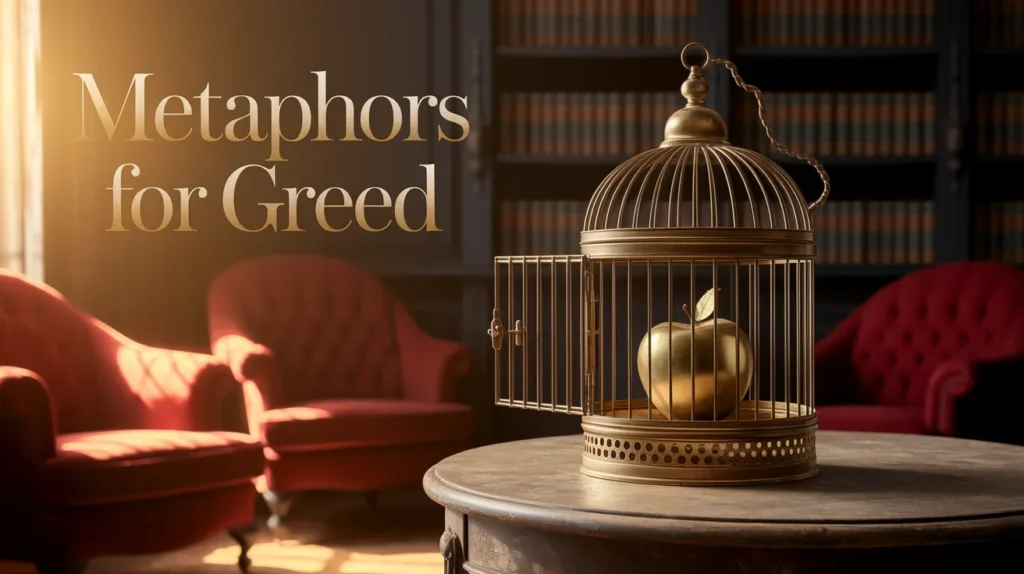
Greed doesn’t knock politely—it seeps in like a quiet hunger, growing louder with every bite. Picture a table overflowing with food, yet one person keeps piling their plate higher, eyes darting not with satisfaction, but with fear of not having enough. That restless craving—that hollow ache that refuses to be filled—is the essence of greed. It’s more than wanting; it’s wanting without end.
Metaphors for greed help us give shape to this abstract force. They transform a complex human emotion into something we can see, feel, and understand. Whether you’re a writer aiming to deepen your storytelling, a student exploring figurative language, or simply someone trying to describe human behavior more vividly, these metaphors unlock a richer way of expression.
In this article, you’ll explore powerful metaphors for greed, learn how to use them effectively, and even practice crafting your own. Along the way, you’ll encounter storytelling moments, cultural echoes, and creative exercises designed to sharpen your imagination.
Greed as a Bottomless Pit: The Endless Hunger
This metaphor portrays greed as something that can never be filled, no matter how much is poured into it.
Meaning & Explanation: A bottomless pit symbolizes insatiable desire. No amount of wealth, power, or possessions can satisfy it.
Example Sentence: “His ambition was a bottomless pit, swallowing every success without ever feeling full.”
Alternative Expressions:
- An endless void
- A hollow cavern
- A well with no bottom
Sensory Detail: Imagine shouting into a deep cave and hearing nothing return—only silence that devours your voice.
Mini Story: Think of a wealthy collector who keeps acquiring rare artifacts, yet feels emptier with each addition. The more he owns, the less he feels fulfilled.
Greed as a Hungry Beast: The Devouring Instinct
Meaning & Explanation: Greed becomes an animalistic force—wild, uncontrolled, and always seeking its next meal.
Example Sentence: “Greed prowled inside her like a hungry beast, never letting her rest.”
Alternative Ways to Say It:
- A ravenous wolf
- A starving predator
- A beast that never sleeps
Emotional Detail: There’s a sense of fear here—greed is no longer passive; it hunts.
Cultural Reference: Many folktales portray greed as a monster that ultimately consumes its host.
Greed as a Fire That Spreads
Meaning & Explanation: Like fire, greed grows rapidly and destroys everything in its path.
Example Sentence: “His greed was a wildfire, burning through friendships and trust.”
Alternative Expressions:
- A raging blaze
- A spark turned inferno
- A consuming flame
Sensory Detail: Crackling heat, choking smoke, and flames that leap from one thing to another—unstoppable.
Greed as a Poison in the Veins
Meaning & Explanation: Greed corrupts from within, slowly damaging character and morality.
Example Sentence: “Greed coursed through him like poison, clouding every decision.”
Alternative Ways:
- A toxic drip
- Venom in the blood
- A slow-acting toxin
Real-Life Reflection: Consider how corruption scandals often begin with small compromises that grow into larger ethical failures.
Greed as a Black Hole: Consuming Everything
Meaning & Explanation: A black hole consumes everything around it, just like greed absorbs all attention and resources.
Example Sentence: “Her desire for wealth became a black hole, pulling in everything she valued.”
Alternative Expressions:
- A gravitational void
- A consuming force
- An endless absorber
Greed as Chains That Bind
Meaning & Explanation: Instead of freedom, greed traps individuals in endless pursuit.
Example Sentence: “He thought wealth would free him, but greed only wrapped him in chains.”
Alternative Ways:
- Golden shackles
- Invisible restraints
- A tightening grip
Emotional Detail: The irony here is powerful—what seems like gain becomes imprisonment.
Greed as a Storm That Never Settles
Meaning & Explanation: Greed creates chaos, turbulence, and instability.
Example Sentence: “His greed was a storm, leaving destruction wherever it passed.”
Alternative Expressions:
- A raging tempest
- A relentless hurricane
- A thunderstorm of desire
Greed as a Mirror That Distorts Reality
Meaning & Explanation: Greed changes how people see the world, making them value things incorrectly.
Example Sentence: “Through the mirror of greed, everything looked smaller unless it belonged to him.”
Alternative Ways:
- A warped reflection
- A twisted lens
- A deceptive glass
Greed as an Addiction That Grows
Meaning & Explanation: Like addiction, greed intensifies over time and demands more.
Example Sentence: “Wealth became his addiction, and greed was the craving he couldn’t escape.”
Alternative Expressions:
- A growing dependency
- An unbreakable habit
- A thirst that deepens
Greed as a Shadow That Follows
Meaning & Explanation: Greed lingers, always present even when ignored.
Example Sentence: “No matter how far she ran, greed followed like a shadow at her heels.”
Alternative Ways:
- A haunting presence
- A constant companion
- A dark echo
Greed as a Leech Draining Life
Meaning & Explanation: Greed feeds off others, often harming relationships and communities.
Example Sentence: “His greed clung like a leech, draining the life from those around him.”
Alternative Expressions:
- A parasite
- A draining force
- A silent siphon
Greed as a Mountain That Never Peaks
Meaning & Explanation: The climb never ends; there’s always something higher to reach.
Example Sentence: “He climbed the mountain of wealth, only to realize there was no summit.”
Alternative Ways:
- An endless climb
- A peak that recedes
- A never-ending ascent
Greed as a Broken Compass
Meaning & Explanation: Greed leads people in the wrong direction morally and emotionally.
Example Sentence: “With greed as his compass, he was always lost.”
Alternative Expressions:
- A misguided path
- A faulty guide
- A directionless journey
Greed as a Vacuum That Pulls Everything In
Meaning & Explanation: It sucks in attention, energy, and resources, leaving nothing behind.
Example Sentence: “Her greed became a vacuum, pulling in every opportunity for herself.”
Alternative Ways:
- A sucking force
- A consuming pull
- A relentless draw
Greed as a Mask That Hides True Intentions
Meaning & Explanation: Greed often disguises itself as ambition or necessity.
Example Sentence: “Behind the mask of success, greed quietly smiled.”
Alternative Expressions:
- A hidden face
- A false front
- A concealed motive
How to Use Metaphors for Greed in Writing and Speech
Metaphors are powerful tools—but only when used with intention. Here’s how to make them shine:
- Match the tone: A “hungry beast” feels intense, while a “shadow” feels subtle.
- Avoid overuse: One strong metaphor is better than five weak ones.
- Connect to emotion: Let readers feel the metaphor, not just understand it.
Bonus Tip: Use sensory details—sound, touch, sight—to bring metaphors alive.
Creative Exercises: Practice Metaphors for Greed
Exercise 1: Complete the Sentence “Greed is like ______ because ______.”
Exercise 2: Rewrite a Scenario Take this sentence: “He wanted more money.” Rewrite it using a metaphor: “His desire for money was a wildfire, spreading beyond control.”
Exercise 3: Personal Reflection Think of a moment when someone wanted too much. Describe it using a metaphor.
Using Greed Metaphors in Social Media and Daily Life
- Use short metaphors in captions: “Greed is a fire—don’t let it burn you.”
- Add impact to speeches or essays
- Turn them into quotes or poetic lines
Example: “Greed whispers promises but delivers emptiness.”
FAQs
1. What is a metaphor for greed?
A metaphor for greed compares it to something else (like fire or a beast) to make the concept more vivid and understandable.
2. Why are metaphors important in describing greed?
They help transform abstract emotions into concrete images, making writing more engaging and relatable.
3. Can I create my own metaphors for greed?
Absolutely. Personal metaphors often feel more authentic and powerful.
4. Are metaphors for greed only used in literature?
No, they’re also used in speeches, social media, storytelling, and everyday conversation.
5. What is the most powerful metaphor for greed?
It depends on context, but “a bottomless pit” and “a hungry beast” are widely impactful.
Conclusion
Greed is a complex and deeply human emotion—one that can shape stories, decisions, and entire lives. Through metaphors, we give this invisible force a voice, a face, and a form. Whether it’s a fire that spreads, a beast that devours, or a shadow that follows, each metaphor reveals a different truth about desire unchecked.
As you write, speak, or reflect, remember this: the right metaphor doesn’t just describe greed—it makes others feel it. And in that feeling lies the true power of language.