
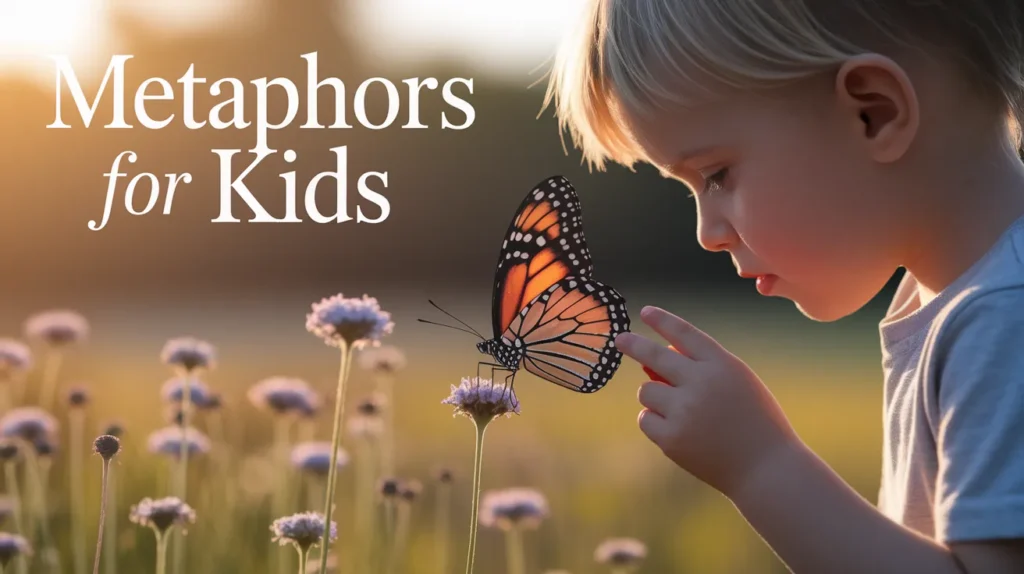
A child once looked up at the night sky and whispered, “The moon is a sleepy lantern hanging above the world.” That single sentence turned an ordinary evening into something glowing and unforgettable. Children naturally see magic in everyday life. A puddle becomes a mirror to another world, a classroom turns into a jungle of adventures, and friendship feels like a warm blanket on a cold morning. This is the power of metaphors.
Metaphors for kids are more than playful comparisons. They help children understand emotions, describe experiences, improve creativity, and become stronger writers and storytellers. Instead of saying “I was nervous,” a child might say, “Butterflies were dancing in my stomach.” Suddenly, feelings become vivid and relatable.
In this guide, you’ll explore creative metaphor examples for kids, easy explanations, writing tips, storytelling ideas, and fun activities that encourage imagination. Whether you are a parent, teacher, student, or young writer, these metaphor ideas can transform ordinary words into colorful pictures painted with language.
What Are Metaphors for Kids?
A metaphor is a comparison that says one thing is another thing to create a stronger image or feeling. Unlike similes, metaphors do not use “like” or “as.”
For example:
- “The classroom was a zoo.”
- “Her smile was sunshine.”
- “Time is a thief.”
These comparisons help children picture emotions, actions, and scenes more clearly. Metaphors make language exciting because they invite imagination into every sentence.
Think of metaphors as little bridges between reality and creativity. They connect simple ideas to powerful images that stay in the mind long after the words are spoken.
Why Metaphors Matter in Children’s Learning
Metaphors are important tools in child development and language learning. They strengthen reading comprehension, emotional expression, and storytelling abilities.
Children who practice metaphors often:
- Become more creative writers
- Understand emotions more deeply
- Improve communication skills
- Develop richer vocabularies
- Enjoy reading and storytelling more
A teacher might say, “Books are doors to new worlds.” A child instantly understands that reading leads to adventure and discovery.
Metaphors also appear everywhere in literature, movies, songs, and conversations. Learning them early helps children appreciate language in a deeper way.
Easy Metaphors Kids Can Understand
Young learners benefit from simple and relatable metaphor examples. Here are a few easy ones:
- “My brother is a tornado.” Meaning: He is wild and energetic.
- “Grandpa is a walking encyclopedia.” Meaning: Grandpa knows many things.
- “The playground was an adventure island.” Meaning: The playground felt exciting and magical.
- “Her voice was music.” Meaning: Her voice sounded beautiful.
- “The baby is a tiny alarm clock.” Meaning: The baby cries loudly and often.
These examples connect familiar experiences with vivid imagery children can easily imagine.
Animal Metaphors for Kids
Animals make fantastic metaphors because children already associate them with certain traits.
Clever Animal Metaphors
- “He is a busy bee.” Meaning: He works hard and stays active.
- “She is a shy turtle.” Meaning: She hides her feelings and stays quiet.
- “My friend is a lion in soccer.” Meaning: My friend is brave and strong.
Mini Storytelling Example
During a school race, Emma froze at the starting line. Her coach smiled and said, “You’re a cheetah waiting to sprint.” Suddenly, Emma imagined speed rushing through her legs. She ran faster than ever before.
Animal metaphors help children connect emotions and personality traits with memorable images.
Nature Metaphors That Inspire Imagination
Nature is filled with colors, sounds, and movements that work beautifully in metaphors.
Creative Nature Metaphors
- “The snow was a white blanket.”
- “The sun is a golden coin in the sky.”
- “Rain tapped on the roof like tiny dancers.”
- “The river was a silver ribbon.”
Sensory Writing Tip
Encourage children to use sight, sound, touch, and smell when creating metaphors. Instead of saying “The garden was pretty,” they could say:
“The garden was a rainbow painted with flowers.”
This makes writing feel more alive and emotional.
Friendship Metaphors for Children
Friendship can sometimes be difficult for kids to explain. Metaphors help express care, trust, and connection.
Friendship Comparison Ideas
- “A best friend is a lighthouse in a storm.”
- “Friends are glue holding happy moments together.”
- “My sister is my safety net.”
Real-Life Example
A child nervous about starting school may feel comforted hearing:
“Good friends are umbrellas during rainy days.”
The metaphor gently explains emotional support in a way children remember.
School and Learning Metaphors
Teachers often use metaphors to make lessons more exciting and understandable.
Fun School Metaphors
- “The classroom is a treasure chest of ideas.”
- “Homework is a mountain to climb.”
- “A pencil is a magic wand.”
- “Knowledge is a key.”
Cultural and Literary Connection
Many famous children’s books use metaphorical language. In fantasy stories, schools become kingdoms of discovery and books become portals to hidden worlds. These images encourage curiosity and wonder.
Emotion Metaphors for Kids
Children sometimes struggle to describe emotions. Metaphors give feelings shape and color.
Emotional Metaphor Examples
- “Anger was a volcano inside him.”
- “Her sadness was a rainy cloud.”
- “Joy bubbled like soda.”
- “Fear crawled like icy spiders down my back.”
Example Scenario
Instead of saying, “I felt nervous before the play,” a child might write:
“My stomach became a circus full of flipping acrobats.”
The emotion suddenly becomes vivid and relatable.
Funny Metaphors Kids Love
Humor keeps children engaged and encourages playful thinking.
Silly and Funny Metaphors
- “Dad snores like a rusty tractor.”
- “My backpack is a black hole.”
- “My little brother is a popcorn machine.”
- “The cafeteria was a roaring jungle.”
Funny metaphors make classroom writing activities more exciting and memorable.
Fantasy and Fairy Tale Metaphors
Children naturally love dragons, castles, magic, and mythical adventures. Fantasy metaphors bring stories to life.
Magical Metaphor Ideas
- “Her imagination was a flying dragon.”
- “Dreams are stars hidden in your pocket.”
- “The castle stood like a sleeping giant.”
Mini Storytelling Moment
A young writer once described courage by saying:
“Bravery was a tiny candle glowing inside the knight.”
That small metaphor transformed a simple sentence into a cinematic image.
Food Metaphors for Creative Writing
Food metaphors are playful, relatable, and sensory-rich.
Delicious Metaphor Examples
- “Life is a giant pizza with many slices.”
- “Her laughter was sweet candy.”
- “The classroom buzzed like popping popcorn.”
- “The baby cheeks were marshmallows.”
Food metaphors often create warm and comforting imagery children enjoy using in stories.
Three Powerful Metaphor Ideas Explained
Here are three detailed metaphor examples with meanings, alternatives, and creative uses.
“Books Are Windows”
Meaning: Books allow readers to see new ideas, cultures, and adventures.
Example Sentence: “Whenever Maya opened a novel, it became a window into another world.”
Alternative Expressions:
- Books are doors to adventure
- Stories are passports for the imagination
- Reading is a journey across hidden lands
Emotional Detail: This metaphor creates feelings of curiosity and exploration.
“The Mind Is a Garden”
Meaning: Thoughts and ideas grow when cared for.
Example Scenario: A teacher explains that positive habits are like watering flowers in the mind.
Alternative Expressions:
- Ideas bloom like flowers
- Knowledge grows like trees
- Learning plants seeds for the future
Bonus Tip: This metaphor works beautifully in motivational writing and classroom posters.
“Hope Is a Candle”
Meaning: Hope shines even during difficult times.
Example Sentence: “Even after failing the test, hope flickered like a candle inside him.”
Alternative Expressions:
- Hope is a guiding star
- Hope is sunrise after darkness
- Hope is a lantern on a lonely road
Sensory Touch: Children can imagine the soft glow of a candle in darkness, making the emotion feel comforting and visual.
How Kids Can Create Their Own Metaphors
Teaching children to invent metaphors encourages imagination and confidence.
Simple Formula
- Pick an emotion, object, or experience.
- Think about what it feels or looks like.
- Compare it creatively to something else.
Example:
- Feeling: Excitement
- Comparison: Fireworks
- Metaphor: “Excitement exploded inside me like fireworks.”
Practice Prompt
Ask children:
- If happiness were weather, what would it be?
- If school were an animal, which one would it become?
- If your imagination had wings, where would it fly?
These prompts help children think visually and emotionally.
Interactive Metaphor Exercises for Kids
Hands-on activities make metaphor learning more enjoyable.
Exercise One: Finish the Metaphor
Complete these sentences:
- “My room is a ______.”
- “The playground is a ______.”
- “My teacher is a ______.”
Exercise Two: Metaphor Treasure Hunt
Ask children to find metaphors in:
- Songs
- Movies
- Storybooks
- Cartoons
This teaches them that figurative language exists everywhere around them.
Exercise Three: Draw Your Metaphor
Children can draw images based on their metaphors. For example:
“My anger is a volcano.”
Drawing the volcano helps connect visual creativity with language skills.
Writing Tips for Using Metaphors Naturally
Strong metaphors should feel meaningful, not confusing.
Helpful Tips
- Keep comparisons simple for younger children.
- Use familiar objects and experiences.
- Avoid mixing too many metaphors together.
- Focus on emotions and sensory details.
- Read metaphors aloud to hear how they sound.
Instead of writing:
“The classroom was a tornado dragon spaceship.”
Choose one clear image:
“The classroom was a buzzing beehive.”
Clarity makes metaphors more powerful.
Using Metaphors in Daily Life and Social Media
Metaphors are not only for stories and poetry. Kids and teens can use them in conversations, captions, journals, and presentations.
Fun Everyday Examples
- “Monday feels like a sleepy turtle.”
- “Summer vacation is a giant ice cream cone.”
- “My playlist is a roller coaster of emotions.”
Bonus Social Media Tip
Creative metaphors make captions more memorable:
- “Chasing dreams like fireflies in the dark.”
- “Friendship is sunshine after rain.”
- “My thoughts are clouds floating across the sky.”
These imaginative phrases capture attention and emotion instantly.
Common Mistakes Kids Make With Metaphors
Learning metaphors takes practice, and mistakes are part of the journey.
Frequent Errors
- Comparing unrelated things that confuse readers
- Using clichés too often
- Overcomplicating the image
- Mixing similes and metaphors incorrectly
For example:
Incorrect: “My anger was like a volcano dragon storm.”
Better: “My anger was a volcano ready to erupt.”
The simpler version creates a clearer mental image.
Encouraging Creativity Through Metaphorical Thinking
Metaphors help children see the world differently. A puddle becomes a mirror. A kite becomes a dancing bird. A rainy day transforms into a gray painting dripping from the sky.
Parents and teachers can encourage metaphorical thinking by asking imaginative questions during daily activities.
At bedtime, ask:
- “What did your day feel like?”
- “If your mood were a color, what would it be?”
- “What kind of weather matches your emotions today?”
These conversations strengthen emotional intelligence and creativity at the same time.
FAQs
What is a metaphor for kids?
A metaphor is a comparison that says one thing is another thing to create vivid imagery and stronger emotions in writing or speech.
What are some easy metaphor examples?
Easy examples include:
- “The classroom was a zoo.”
- “Her smile was sunshine.”
- “My backpack is a black hole.”
Why should kids learn metaphors?
Metaphors improve creativity, emotional expression, vocabulary, storytelling, and reading comprehension.
How do metaphors differ from similes?
Metaphors compare directly without using “like” or “as,” while similes use those words for comparison.
How can children practice writing metaphors?
Kids can practice by describing feelings, animals, weather, or daily experiences using imaginative comparisons and creative writing prompts.
Conclusion
Metaphors for kids open the door to imagination, emotion, and creativity. They transform ordinary sentences into colorful adventures filled with meaning and wonder. A child who learns metaphors does more than improve writing skills — they learn to see the world through a magical lens where clouds become cotton castles and courage becomes a glowing flame.
Whether used in school assignments, bedtime stories, journals, conversations, or social media captions, metaphors help children express thoughts in memorable ways. The beauty of metaphorical language is that there are no limits. Every child carries a universe of comparisons waiting to bloom into stories.