
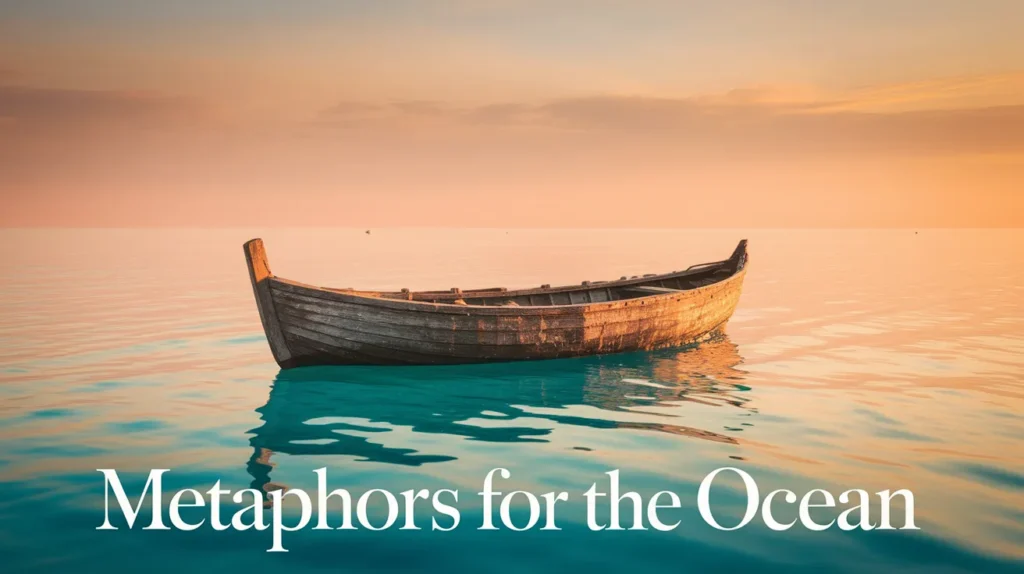
The first time you stand before the ocean, it rarely feels like just water. It breathes. It roars. It whispers secrets in a language older than memory. The salty wind brushes your face like a storyteller urging you closer, while waves collapse and rise again—like thoughts, like feelings, like time itself. In moments like these, ordinary words fall short. That’s where metaphors step in. Metaphors for the ocean allow us to translate its vastness into something human—something we can feel, relate to, and express.
Whether you’re writing poetry, crafting a story, posting on social media, or simply trying to describe your emotions, ocean metaphors provide powerful tools to connect imagination with reality. In this article, we’ll explore the beauty and versatility of ocean metaphors, unpack their meanings, and give you practical ways to use them creatively.
Ocean Metaphors for Emotions and Feelings
The ocean is often used as a mirror for human emotions—deep, shifting, and sometimes overwhelming.
Example 1: “Her mind was an ocean in a storm.”
- Meaning: Turbulent thoughts or emotional chaos.
- Scenario: A character struggling with anxiety before a big decision.
- Alternatives: “A sea of unrest,” “waves of worry crashing within.”
- Sensory detail: The pounding of waves reflects a racing heartbeat.
Example 2: “His calm was a glassy sea at dawn.”
- Meaning: Peaceful and steady emotional state.
- Alternative: “Still as a quiet tide.”
Mini storytelling: Think of a quiet morning by the shore—no wind, no noise, just a smooth surface stretching endlessly. That’s the emotional clarity this metaphor captures.
The Ocean as a Symbol of Mystery and Depth
The ocean’s unseen depths make it a perfect metaphor for the unknown.
Example: “Her thoughts were as deep as the ocean floor.”
- Meaning: Complex, layered thinking.
- Scenario: Describing an introspective person.
- Alternative: “An abyss of ideas,” “a mind with hidden trenches.”
Cultural reference: Many ancient myths describe the ocean as a gateway to hidden worlds—echoing how we use it to symbolize inner depth.
Using Ocean Metaphors in Creative Writing
Metaphors can elevate your writing from simple to evocative.
Tip: Match the ocean’s mood with your story tone.
- Calm ocean = peace
- Stormy ocean = conflict
- Endless ocean = freedom or isolation
Example: “The city lights flickered like distant ships, and her dreams stretched before her like an endless sea.”
Ocean Comparisons for Life Journeys
Life itself is often described as an ocean voyage.
Example: “Life is an unpredictable ocean.”
- Meaning: Full of uncertainty and change.
- Scenario: Reflecting on personal growth.
- Alternatives: “A sea of possibilities,” “waves of opportunity.”
Real-life connection: Think about how sailors navigate without seeing the full journey ahead—just like we do in life.
Metaphors for the Ocean in Poetry and Literature
Poets frequently use the ocean to evoke emotion and imagery.
Example: “The ocean is a restless heart.”
- Meaning: Constant movement and longing.
- Alternative: “A breathing giant,” “a living pulse.”
Exercise: Try writing a two-line poem using the ocean as a metaphor for love.
Ocean Metaphors for Strength and Power
The ocean’s force makes it a symbol of strength.
Example: “Her determination was a tidal wave.”
- Meaning: Unstoppable energy.
- Alternative: “A surge of strength,” “a rising tide.”
Emotional detail: The unstoppable crash of waves reflects resilience.
Gentle Ocean Metaphors for Calmness
Not all ocean imagery is intense—some is soothing.
Example: “His voice was a soft tide.”
- Meaning: Gentle and comforting.
- Alternative: “A whispering wave.”
Scenario: A comforting presence during difficult times.
Ocean Metaphors for Love and Relationships
Love and the ocean share depth and unpredictability.
Example: “Their love was an endless sea.”
- Meaning: Boundless and enduring.
- Alternative: “A tide that never retreats.”
Mini storytelling: Like lovers walking along a shoreline, unsure where the waves will lead but trusting the journey.
Dark Ocean Metaphors for Fear and Uncertainty
The ocean can also represent fear.
Example: “His fears were a dark ocean at night.”
- Meaning: Unknown and overwhelming.
- Alternative: “A sea of shadows.”
Sensory detail: Cold water, unseen depths, distant echoes.
Ocean as a Metaphor for Time and Change
Waves are a natural symbol of passing time.
Example: “Time flows like the tide.”
- Meaning: Constant and unstoppable movement.
- Alternative: “An endless current.”
Metaphors for the Ocean in Everyday Language
You don’t have to be a poet to use these.
Examples:
- “Drowning in work”
- “A wave of relief”
- “Lost at sea”
These everyday phrases show how deeply ocean metaphors are embedded in language.
Interactive Exercise: Create Your Own Ocean Metaphor
Try this:
- Pick an emotion (e.g., happiness, fear, excitement).
- Imagine the ocean reflecting that emotion.
- Write one sentence describing it.
Prompt: “My excitement was like…”
Ocean Imagery for Social Media and Storytelling
Ocean metaphors can make captions stand out.
Example captions:
- “Riding waves of possibility 🌊”
- “Lost in a sea of dreams.”
Tip: Pair metaphor with imagery for stronger impact.
Advanced Techniques for Crafting Ocean Metaphors
- Combine senses: “The ocean tasted like forgotten memories.”
- Use contrast: “A storm inside a calm sea.”
- Layer meaning: “An ocean hiding storms beneath silence.”
Common Mistakes to Avoid in Ocean Metaphors
- Overusing clichés like “deep as the ocean.”
- Mixing metaphors (e.g., ocean + fire inconsistently).
- Being too vague—add sensory detail.
Bonus Tips for Using Ocean Metaphors Effectively
- Keep them relevant to context.
- Use sparingly for impact.
- Experiment with unique angles.
FAQs
1. Why are ocean metaphors so popular?
Because the ocean is vast, emotional, and universally relatable.
2. Can ocean metaphors be used in formal writing?
Yes, if used carefully and appropriately.
3. How do I make my metaphors unique?
Add sensory details and personal perspective.
4. Are ocean metaphors suitable for social media?
Absolutely—they add depth and creativity to posts.
5. What emotions work best with ocean metaphors?
Almost all—especially love, fear, calmness, and uncertainty.
Conclusion
The ocean is more than a natural wonder—it’s a living metaphor for everything we feel but struggle to say. By using ocean metaphors, you tap into a timeless language of depth, motion, and emotion. Whether you’re crafting a story, expressing your feelings, or simply playing with words, these metaphors can transform ordinary sentences into something vivid and memorable.
So next time you find yourself searching for the right words, think of the ocean. Let your ideas rise like waves, stretch like horizons, and carry meaning as deep as the sea itself.