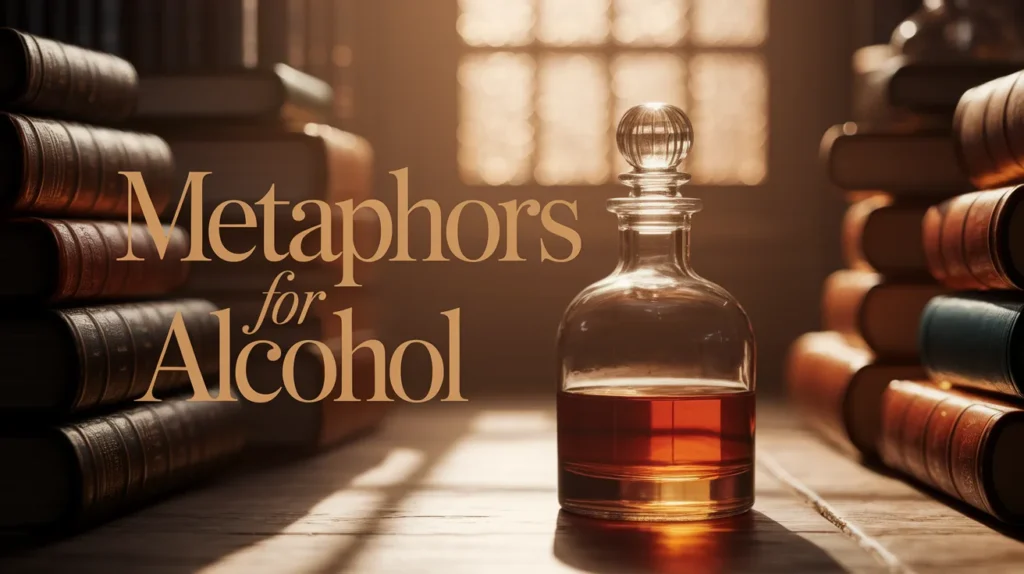
The glass catches the light just so—amber fire trembling at the rim. A faint clink echoes like a secret about to be told. Someone laughs too loudly in the corner, while another sits quietly, staring into the swirl as if it holds answers. Alcohol, in all its forms, is more than a drink—it’s a story, a symbol, a mirror. It warms, it loosens, it lingers. And because it carries so many meanings, it begs for metaphor.
Metaphors for alcohol help us express its complexity—its charm and danger, its celebration and sorrow. Whether you’re a writer, poet, content creator, or simply someone who loves playing with language, these figurative expressions offer a powerful way to capture emotion, mood, and experience. In this article, we’ll explore vivid metaphors, unpack their meanings, and give you creative tools to craft your own.
The Allure of Alcohol in Figurative Language
Alcohol often appears in writing as more than a beverage—it becomes temptation, escape, courage, or even illusion. A well-crafted metaphor can transform a simple drink into a symbol of desire or danger.
Think of phrases like “liquid courage” or “a golden escape.” These aren’t just poetic—they shape how we perceive alcohol’s role in human life.
Why Use Metaphors for Alcohol in Writing?
Metaphors deepen storytelling. Instead of stating facts, they evoke feelings. Saying “he drank too much” feels flat—but calling alcohol “a velvet trap tightening around him” creates tension and imagery.
Using metaphors allows you to:
- Add emotional depth
- Create memorable imagery
- Connect with readers on a sensory level
Alcohol as Liquid Fire: Passion and Destruction
Meaning: Alcohol as something intense, burning, and powerful—both exciting and dangerous.
Example: “The whiskey burned like liquid fire, igniting courage he didn’t know he had.”
Alternative Expressions:
- Bottled flames
- A burning river
- Fire in a glass
Sensory Detail: Heat rising in the throat, a sharp sting followed by warmth spreading through the body.
Mini Story: In many classic novels, characters sip strong liquor before bold decisions. The “fire” becomes symbolic of transformation—like stepping into a new version of oneself.
The Glass as a Mirror: Reflection and Truth
Alcohol often lowers inhibitions, revealing hidden thoughts.
Meaning: Drinking as a way to confront inner truths.
Example: “She stared into her wine glass like it was a mirror, reflecting the parts of herself she tried to forget.”
Alternatives:
- A truth serum in disguise
- A reflective pool
- A confessional in liquid form
Emotional Tone: Quiet, introspective, sometimes melancholic.
Alcohol as a Social Glue: Binding Moments Together
Meaning: Alcohol as a connector of people and shared experiences.
Example: “The laughter flowed as freely as the wine, binding strangers into friends.”
Alternatives:
- A bridge in a bottle
- Liquid camaraderie
- A shared rhythm in glasses
Real-Life Insight: From weddings to casual gatherings, alcohol often becomes a ritual that brings people closer—symbolizing unity.
A Velvet Trap: The Subtle Danger of Alcohol
Meaning: Something soft and inviting that hides risk.
Example: “The cocktail was a velvet trap—sweet enough to forget, strong enough to regret.”
Alternatives:
- A honeyed snare
- A soft-edged danger
- A silk-lined cage
Emotional Detail: Comfort turning slowly into loss of control.
Alcohol as Time Travel: Escaping the Present
Meaning: Drinking as a way to revisit the past or avoid the present.
Example: “Each sip carried him back to summers he could never return to.”
Alternatives:
- A bottled memory
- A rewind button in liquid form
- A doorway to yesterday
The Ocean in a Glass: Depth and Unpredictability
Meaning: Alcohol as something vast and unpredictable.
Example: “Her emotions rose and fell like an ocean in a glass.”
Alternatives:
- A tidal drink
- Waves of intoxication
- A storm beneath the surface
A Mask Maker: Hiding and Revealing Identity
Alcohol can both conceal and reveal.
Example: “The drink gave him a mask—but somehow, it also showed his true face.”
Alternatives:
- A costume in liquid form
- A disguise that slips
- A double-edged mirror
Golden Chains: Pleasure That Binds
Meaning: Enjoyment that can lead to dependency.
Example: “What began as celebration became golden chains he couldn’t break.”
Alternatives:
- Sweet captivity
- Glittering restraint
- A gilded cage
A Fading Sunset: Beauty with an End
Meaning: Alcohol as something temporarily beautiful.
Example: “The evening glowed like a fading sunset in her glass.”
Alternatives:
- A fleeting glow
- A dying light
- A moment slipping away
The Illusionist: Distorting Reality
Meaning: Alcohol as something that changes perception.
Example: “The room tilted under the illusionist’s spell.”
Alternatives:
- A magician in a bottle
- A trickster drink
- A bending lens
Midnight Ink: Deep Emotions and Secrets
Meaning: Alcohol drawing out hidden feelings.
Example: “His thoughts spilled like midnight ink after the third drink.”
Alternatives:
- Liquid confession
- Dark poetry in a glass
- A storyteller’s fuel
A Borrowed Flame: Temporary Energy
Meaning: A short-lived boost in confidence or mood.
Example: “It was only a borrowed flame—bright, but bound to fade.”
Alternatives:
- A fleeting spark
- Temporary fire
- A candle in the wind
The Tightrope: Balance Between Joy and Risk
Meaning: Drinking as a delicate balance.
Example: “She walked the tightrope of indulgence, careful not to fall.”
Alternatives:
- A balancing act
- A fragile line
- A dance on the edge
The Siren’s Song: Temptation and Seduction
Meaning: Alcohol as something alluring yet dangerous.
Example: “The bottle sang like a siren, promising escape but hiding the cost.”
Alternatives:
- A seductive whisper
- A call from the deep
- A tempting echo
A Silent Storm: Calm Outside, Chaos Within
Meaning: Hidden emotional turbulence.
Example: “He looked calm, but inside, the drink stirred a silent storm.”
Alternatives:
- Quiet chaos
- A hidden hurricane
- Still waters with depth
Three Creative Metaphor Frameworks You Can Use
1. Alcohol as Emotion Amplifier
Meaning: Alcohol intensifies feelings.
Example: “The wine turned her sadness into a symphony.”
Alternatives:
- Volume knob for emotions
- Emotional magnifier
Tip: Use this in storytelling to show character depth.
2. Alcohol as Journey or Escape
Meaning: A path away from reality.
Example: “Each sip was a step further from the world he knew.”
Alternatives:
- A drifting boat
- A wandering road
Mini Story: In many films, characters drink alone not for taste—but to escape their thoughts.
3. Alcohol as Double-Edged Sword
Meaning: Both helpful and harmful.
Example: “It gave him courage—and took away his control.”
Alternatives:
- A gift with a cost
- A coin with two sides
Interactive Exercises to Practice Metaphors
Exercise 1: Sensory Transformation
Take a drink (real or imagined) and describe it using all five senses. Turn each into a metaphor.
Prompt: “What does the taste feel like emotionally?”
Exercise 2: Mood Mapping
Write one metaphor for alcohol in each mood:
- Joy
- Sadness
- Anger
- Nostalgia
Exercise 3: Story Starter
Complete this sentence: “The glass in his hand was not just a drink—it was…”
Write a short paragraph expanding your metaphor.
Bonus Tips for Using Metaphors in Writing & Social Media
- Keep them relatable but unique
- Avoid clichés like “drunk as a skunk”
- Use metaphors in captions for emotional impact
- Pair metaphors with visuals for stronger storytelling
- Experiment with contrast (sweet vs bitter, light vs dark)
FAQs
What is a metaphor for alcohol?
A metaphor for alcohol is a figurative expression that represents it as something else—like fire, escape, or illusion—to convey deeper meaning.
Why are alcohol metaphors common in literature?
Because alcohol symbolizes complex human experiences—joy, pain, escape, and connection—making it rich for storytelling.
Can metaphors for alcohol be positive and negative?
Yes. They can highlight pleasure (liquid gold) or danger (velvet trap), depending on context.
How do I create my own alcohol metaphors?
Focus on emotion, sensory detail, and comparison. Ask what the drink feels like, not just what it is.
Are alcohol metaphors useful for social media content?
Absolutely. They make captions more engaging, poetic, and memorable.
Conclusion
Alcohol, like language, has layers. It can sparkle like celebration or weigh heavy like regret. Through metaphors, we translate these experiences into something vivid and meaningful—something readers can feel.
Whether you describe it as liquid fire, a siren’s song, or a fading sunset, the key is authenticity. Let your metaphors reflect real emotion, real moments, real stories. Because in the end, the most powerful metaphors don’t just describe alcohol—they reveal something about us.