
Words shape how we understand actions, emotions, and time, and the difference between shown vs showed is a perfect example of this power. While both words come from the verb show, they carry different tones and uses depending on context.
To explain such nuances clearly and memorably, similes play a vital role in figurative language. Similes compare ideas using like or as, helping readers visualize meaning instead of just reading definitions.
In literature and everyday writing, similes—especially nature similes—are often used to express strength, growth, resilience, wisdom, and deep human emotion.
When paired with shown vs showed, similes help us feel the difference between quiet revelation and active demonstration. This article explores that contrast through vivid comparisons that are simple, expressive, and powerful.
What Is a Simile?
A simile is a figure of speech that compares two unlike things using like or as to make meaning clearer and more vivid.
Example: Her kindness was shown like sunlight through a cracked window.
1. Shown like roots beneath the soil
Meaning: Quietly revealed through actions over time.
Usage Insight: Best for subtle character development.
Examples:
- His loyalty was shown like roots beneath the soil.
- Her strength was shown like roots beneath the soil.
- Wisdom was shown like roots beneath the soil.
- Love was shown like roots beneath the soil.
- Trust was shown like roots beneath the soil.
2. Showed like a flag raised high
Meaning: Open and deliberate display.
Usage Insight: Ideal for bold or public actions.
Examples:
- He showed his pride like a flag raised high.
- She showed her anger like a flag raised high.
- The leader showed confidence like a flag raised high.
- They showed unity like a flag raised high.
- He showed success like a flag raised high.
3. Shown like scars on old skin
Meaning: Evidence revealed through experience.
Usage Insight: Works well for emotional depth.
Examples:
- His pain was shown like scars on old skin.
- Growth was shown like scars on old skin.
- Survival was shown like scars on old skin.
- Wisdom was shown like scars on old skin.
- Strength was shown like scars on old skin.
4. Showed like fireworks in the night
Meaning: Dramatic and attention-grabbing display.
Usage Insight: Best for sudden actions or emotions.
Examples:
- She showed excitement like fireworks in the night.
- He showed talent like fireworks in the night.
- Anger showed like fireworks in the night.
- Victory was showed like fireworks in the night.
- Joy showed like fireworks in the night.
5. Shown like footprints in fresh snow
Meaning: Clearly revealed without intention.
Usage Insight: Useful for honesty or truth themes.
Examples:
- His fear was shown like footprints in fresh snow.
- The truth was shown like footprints in fresh snow.
- Guilt was shown like footprints in fresh snow.
- Emotion was shown like footprints in fresh snow.
- Change was shown like footprints in fresh snow.
6. Showed like a spotlight on stage
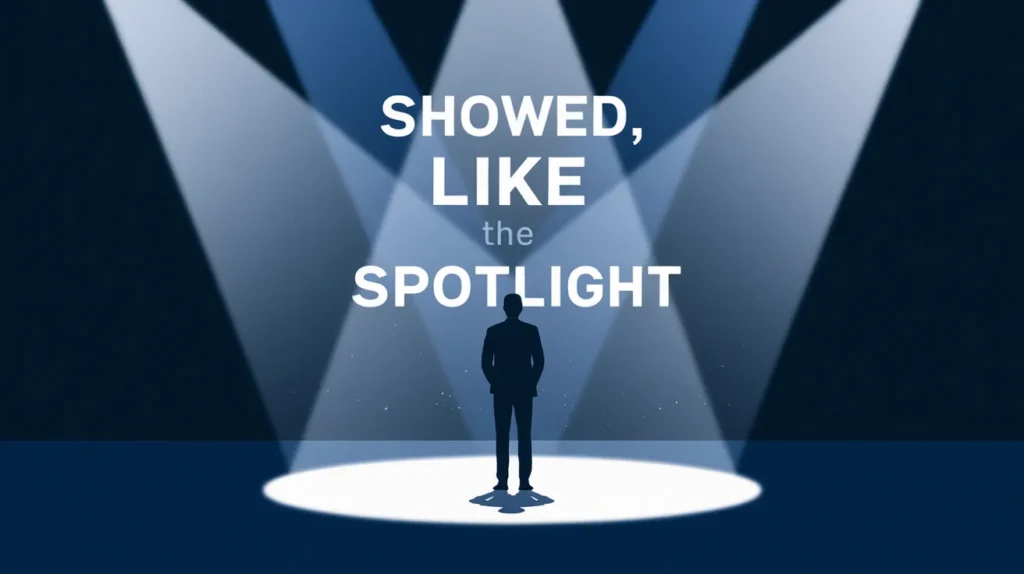
Meaning: Intentionally highlighted.
Usage Insight: Perfect for performances or achievements.
Examples:
- She showed skill like a spotlight on stage.
- He showed courage like a spotlight on stage.
- The speech showed passion like a spotlight on stage.
- Talent showed like a spotlight on stage.
- Confidence showed like a spotlight on stage.
7. Shown like a tree bending in wind
Meaning: Strength revealed through endurance.
Usage Insight: Ideal for resilience themes.
Examples:
- Her patience was shown like a tree bending in wind.
- Faith was shown like a tree bending in wind.
- Strength was shown like a tree bending in wind.
- Hope was shown like a tree bending in wind.
- Character was shown like a tree bending in wind.
8. Showed like a mirror held up
Meaning: Clear and direct revelation.
Usage Insight: Best for honesty or confrontation.
Examples:
- He showed the truth like a mirror held up.
- Her words showed reality like a mirror held up.
- The test showed weakness like a mirror held up.
- Life showed lessons like a mirror held up.
- Actions showed intent like a mirror held up.
9. Shown like embers glowing softly
Meaning: Quiet but powerful emotion.
Usage Insight: Works for subtle feelings.
Examples:
- Love was shown like embers glowing softly.
- Anger was shown like embers glowing softly.
- Hope was shown like embers glowing softly.
- Courage was shown like embers glowing softly.
- Desire was shown like embers glowing softly.
10. Showed like thunder after lightning
Meaning: Strong reaction following a signal.
Usage Insight: Best for cause-and-effect writing.
Examples:
- He showed anger like thunder after lightning.
- She showed strength like thunder after lightning.
- The crowd showed fear like thunder after lightning.
- Justice showed force like thunder after lightning.
- Confidence showed power like thunder after lightning.
11. Shown like pages worn by time
Meaning: Gradual revelation through years.
Usage Insight: Ideal for wisdom or age.
Examples:
- Wisdom was shown like pages worn by time.
- Love was shown like pages worn by time.
- Pain was shown like pages worn by time.
- Experience was shown like pages worn by time.
- Growth was shown like pages worn by time.
12. Showed like a door flung open
Meaning: Sudden openness or confession.
Usage Insight: Great for dramatic shifts.
Examples:
- He showed honesty like a door flung open.
- She showed emotion like a door flung open.
- The truth showed like a door flung open.
- Fear showed like a door flung open.
- Love showed like a door flung open.
13. Shown like rain soaking the ground
Meaning: Steady and unavoidable revelation.
Usage Insight: Works well for emotional impact.
Examples:
- Sadness was shown like rain soaking the ground.
- Care was shown like rain soaking the ground.
- Faith was shown like rain soaking the ground.
- Truth was shown like rain soaking the ground.
- Change was shown like rain soaking the ground.
14. Showed like sparks from steel
Meaning: Instant reaction under pressure.
Usage Insight: Ideal for conflict scenes.
Examples:
- Anger showed like sparks from steel.
- Talent showed like sparks from steel.
- Passion showed like sparks from steel.
- Courage showed like sparks from steel.
- Energy showed like sparks from steel.
15. Shown like shadows at sunset
Meaning: Gently revealed without words.
Usage Insight: Best for reflective writing.
Examples:
- Fear was shown like shadows at sunset.
- Peace was shown like shadows at sunset.
- Doubt was shown like shadows at sunset.
- Memory was shown like shadows at sunset.
- Love was shown like shadows at sunset.
16. Showed like ink on white paper

Meaning: Clear and undeniable evidence.
Usage Insight: Great for factual emphasis.
Examples:
- Results showed like ink on white paper.
- Mistakes showed like ink on white paper.
- Intentions showed like ink on white paper.
- Truth showed like ink on white paper.
- Effort showed like ink on white paper.
17. Shown like a heartbeat in silence
Meaning: Presence felt more than seen.
Usage Insight: Ideal for emotional nuance.
Examples:
- Love was shown like a heartbeat in silence.
- Fear was shown like a heartbeat in silence.
- Hope was shown like a heartbeat in silence.
- Life was shown like a heartbeat in silence.
- Trust was shown like a heartbeat in silence.
18. Showed like waves crashing ashore
Meaning: Overwhelming and forceful display.
Usage Insight: Best for intense emotion.
Examples:
- Grief showed like waves crashing ashore.
- Joy showed like waves crashing ashore.
- Anger showed like waves crashing ashore.
- Passion showed like waves crashing ashore.
- Power showed like waves crashing ashore.
19. Shown like moss on stone
Meaning: Gradual change over time.
Usage Insight: Useful for long-term growth.
Examples:
- Wisdom was shown like moss on stone.
- Age was shown like moss on stone.
- Patience was shown like moss on stone.
- Faith was shown like moss on stone.
- Character was shown like moss on stone.
20. Showed like a clock striking noon
Meaning: Exact and timely action.
Usage Insight: Works well in decisive moments.
Examples:
- He showed resolve like a clock striking noon.
- She showed discipline like a clock striking noon.
- Truth showed clarity like a clock striking noon.
- Action showed precision like a clock striking noon.
- Choice showed certainty like a clock striking noon.
21. Shown like stars in a dark sky
Meaning: Beauty revealed through contrast.
Usage Insight: Ideal for hope themes.
Examples:
- Hope was shown like stars in a dark sky.
- Kindness was shown like stars in a dark sky.
- Truth was shown like stars in a dark sky.
- Faith was shown like stars in a dark sky.
- Love was shown like stars in a dark sky.
22. Showed like smoke from fire
Meaning: Evidence of something deeper.
Usage Insight: Best for cause-and-effect writing.
Examples:
- Fear showed like smoke from fire.
- Trouble showed like smoke from fire.
- Emotion showed like smoke from fire.
- Conflict showed like smoke from fire.
- Passion showed like smoke from fire.
23. Shown like a compass pointing north
Meaning: Clear moral direction.
Usage Insight: Works for ethical themes.
Examples:
- Integrity was shown like a compass pointing north.
- Values were shown like a compass pointing north.
- Purpose was shown like a compass pointing north.
- Truth was shown like a compass pointing north.
- Leadership was shown like a compass pointing north.
24. Showed like a storm breaking loose
Meaning: Sudden emotional release.
Usage Insight: Ideal for dramatic scenes.
Examples:
- Anger showed like a storm breaking loose.
- Grief showed like a storm breaking loose.
- Joy showed like a storm breaking loose.
- Fear showed like a storm breaking loose.
- Relief showed like a storm breaking loose.
25. Shown like light through glass
Meaning: Clear but gentle revelation.
Usage Insight: Perfect for calm reflection.
Examples:
- Truth was shown like light through glass.
- Love was shown like light through glass.
- Peace was shown like light through glass.
- Hope was shown like light through glass.
- Faith was shown like light through glass.
26. Showed like a banner in the wind

Meaning: Proud and visible display.
Usage Insight: Best for public identity.
Examples:
- He showed loyalty like a banner in the wind.
- She showed belief like a banner in the wind.
- The team showed unity like a banner in the wind.
- Culture showed pride like a banner in the wind.
- Victory showed honor like a banner in the wind.
27. Shown like cracks in old walls
Meaning: Truth revealed over time. Usage Insight: Ideal for realism. Examples:
- Weakness was shown like cracks in old walls.
- History was shown like cracks in old walls.
- Pain was shown like cracks in old walls.
- Change was shown like cracks in old walls.
- Truth was shown like cracks in old walls.
28. Showed like flames in dry grass
Meaning: Rapid and uncontrollable display.
Usage Insight: Best for escalating tension.
Examples:
- Anger showed like flames in dry grass.
- Fear showed like flames in dry grass.
- Chaos showed like flames in dry grass.
- Excitement showed like flames in dry grass.
- Conflict showed like flames in dry grass.
29. Shown like dew on morning leaves
Meaning: Gentle and fresh revelation.
Usage Insight: Ideal for renewal themes.
Examples:
- Hope was shown like dew on morning leaves.
- Love was shown like dew on morning leaves.
- Peace was shown like dew on morning leaves.
- Faith was shown like dew on morning leaves.
- Kindness was shown like dew on morning leaves.
30. Showed like a lighthouse beam
Meaning: Guidance made visible.
Usage Insight: Best for leadership or wisdom.
Examples:
- Wisdom showed like a lighthouse beam.
- Truth showed like a lighthouse beam.
- Courage showed like a lighthouse beam.
- Hope showed like a lighthouse beam.
- Direction showed like a lighthouse beam.
How to Use Similes Effectively in Writing
Similes work best when they match your purpose and tone. In poems and songs, emotional and nature similes add beauty and feeling. In stories, similes help reveal character and mood without long explanations.
In essays or academic writing, use similes sparingly to clarify ideas. Always avoid overuse, and make sure each simile strengthens meaning rather than distracting the reader.
FAQs
1. What is the difference between shown and showed?
Shown is the past participle, while showed is the simple past tense.
2. How do similes help explain shown vs showed?
They visualize the difference between quiet revelation and active display.
3. What is the difference between similes and metaphors?
Similes use like or as; metaphors do not.
4. Are similes used in academic writing?
Yes, when they clarify complex ideas clearly.
5. Why are nature similes so effective?
They are familiar, visual, and emotionally relatable.
Conclusion
Similes connected to shown vs showed enrich language by turning grammar into imagery and emotion. They help readers understand whether something is gently revealed or boldly displayed.
Through nature similes and vivid comparisons, writers can express strength, growth, resilience, wisdom, and human feeling with clarity and depth.
When used thoughtfully, these similes transform simple verbs into powerful storytelling tools, making writing more memorable, expressive, and meaningful.